
Packers offensive line concerns for 2026 overlook why Green Bay’s unit could actually improve this season
Green Bay offense might not be elite upfront, but it’s a viable group who has a real shot to be better than it was last season.


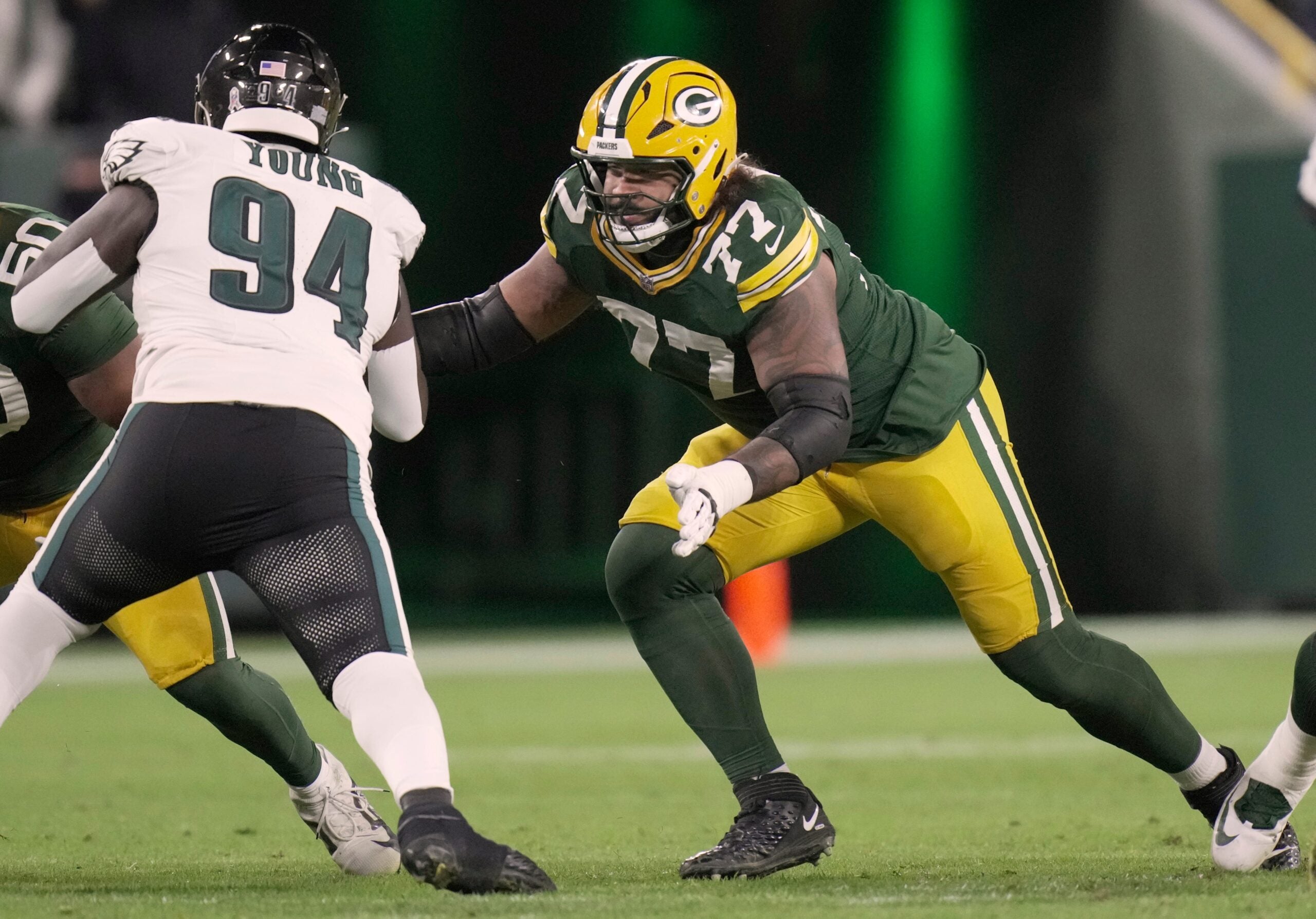
The Green Bay Packers offensive line enters 2026 as one of the most scrutinized units in football, but the criticism might have gone too far. A composite ranking from Football Insights, which aggregates evaluations from Mike Clay (ESPN), Sharp Football, 4for4, FTN, USA Today, and FPTS, projects Green Bay as the 27th offensive line heading into the season. Only FPTS ranks the Packers as high as 21st, while 4for4 slots them 30th.
None of the evaluators place the unit in the top 20. Those projections, however, don’t align with what the Packers produced along the offensive line last season, and how much it was an extreme situation for the group.
The 2025 numbers paint a better picture, even if it wasn’t great
According to ESPN, the Packers ranked sixth in pass block win rate and 19th in run block win rate during the 2025 season. Even the weaker arm of the line (run blocking) graded out as a top-20 unit. PFF’s evaluations were less favorable, placing Green Bay 25th in pass blocking grade and 20th in run blocking grade. Still, those marks describe a below-average group, not one of the worst in the NFL.
The context behind those numbers matters. Right tackle Zach Tom, the Packers’ best offensive lineman, missed five games due to injury last season, including the final stretch. Green Bay shuffled its lineup constantly throughout 2025. Jordan Morgan, expected to start at left tackle, shifted to guard early because of injuries elsewhere. Rasheed Walker stepped in and kept the starting job at left tackle as a result. Left guard Aaron Banks missed time as well, and Elgton Jenkins lost a significant portion of the season, forcing Sean Rhyan to move from guard to center.
The Packers dealt with significant disruption and still produced a functional unit, even if it wasn’t ideal. That reality should temper the alarm around the 2026 projections.
The starting 5 could be better, not worse
Green Bay lost Walker and Jenkins this offseason, and the depth behind the starters is thin, limited to Darian Kinnard and rookie Jager Burton. Those are legitimate concerns. But the starting lineup has reasons for optimism.
Morgan moves to left tackle on a full-time basis for the first time in his NFL career. If he can perform at a reasonable level there, he represents a plausible upgrade over Walker. Tom is expected to be healthy for Week 1, which would restore the Packers’ best lineman to full-season duty after he missed significant time in 2025. And Anthony Belton, who transitioned from tackle to guard during last season, now gets his first full training camp at the position. Year 2 progression for Belton is a reasonable expectation given the adjusted role.
That combination of factors suggests the Packers’ starting five could be as good or slightly better than what they fielded last season, particularly if health cooperates.
The Packers are also protected by head coach Matt LaFleur’s offensive system, which has consistently maximized the production of its offensive linemen throughout his tenure in Green Bay. LaFleur’s scheme design and the so-called “illusion of complexity” reduce the exposure of individual linemen and create advantageous angles at the point of attack.
If the Packers can perform at last year’s level or marginally above it, the unit should be adequate enough to protect quarterback Jordan Love and create lanes for running back Josh Jacobs. The depth concern is real, and one significant injury could test the group in ways that expose its limitations. But projecting the Packers as a bottom-five offensive line ignores the evidence from 2025 and the tangible reasons for improvement heading into the new season.
