
Status of Vikings QB J.J. McCarthy revealed after successful surgery on meniscus
Minnesota Vikings rookie quarterback J.J. McCarthy had successful surgery on his torn meniscus on Wednesday morning. Unfortunately, he will be out for the season after it was deemed a repair was necessary as head coach Kevin O'Connell confirmed during his press availability on Wednesday. McCarthy suffered the injury against the Las Vegas Raiders on Saturday […]

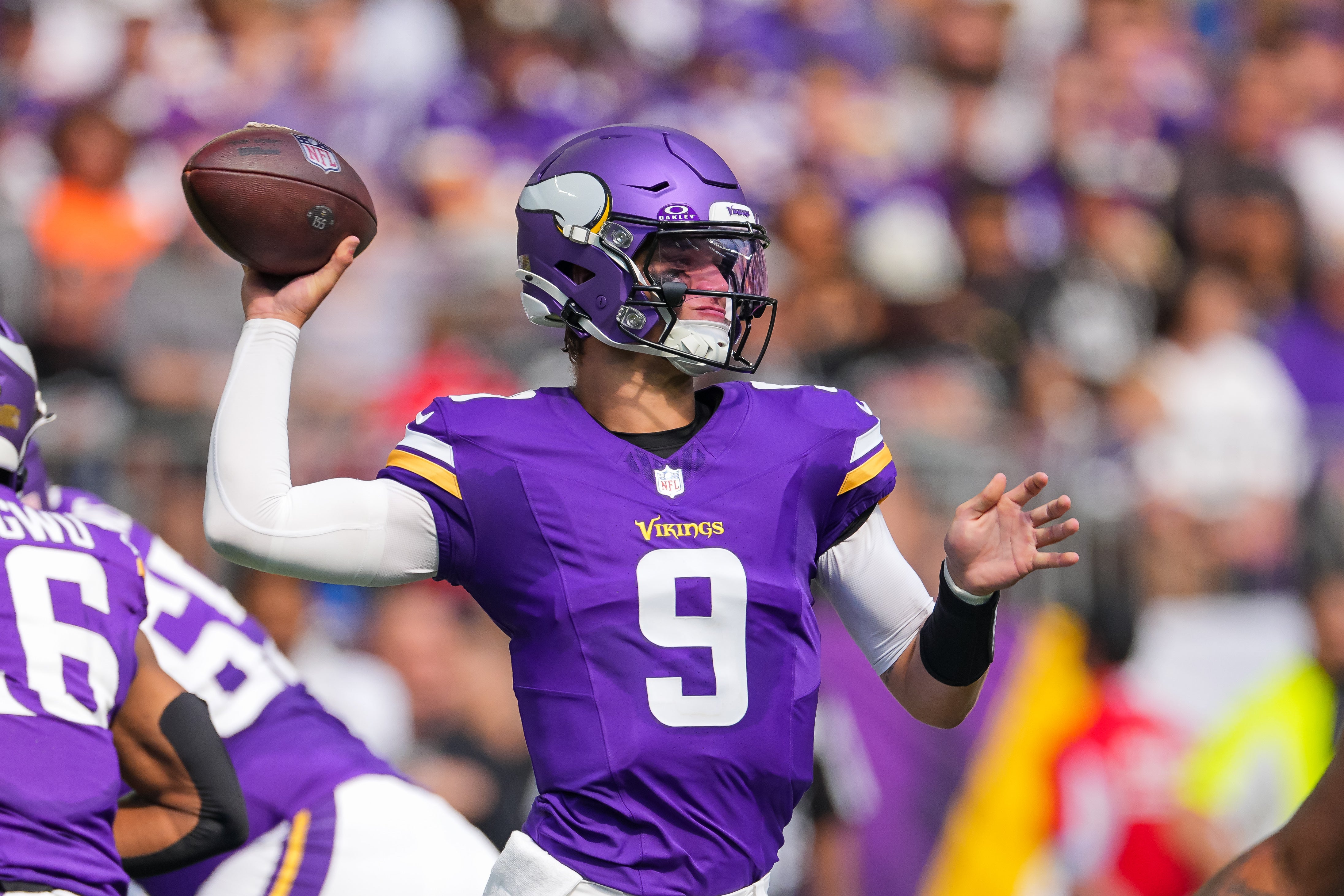
Minnesota Vikings rookie quarterback J.J. McCarthy had successful surgery on his torn meniscus on Wednesday morning. Unfortunately, he will be out for the season after it was deemed a repair was necessary as head coach Kevin O'Connell confirmed during his press availability on Wednesday.
McCarthy suffered the injury against the Las Vegas Raiders on Saturday afternoon. He mentioned knee soreness to the Vikings on Monday and didn't practice that evening. O'Connell said that he would have surgery during a press availability on Tuesday. The recovery process could take upward of nine months but he would certainly be ready for training camp and possibly be ready for organized team activities and minicamp.
This is a great outcome for McCarthy's long-term health as it will allow his knee to be as healthy as possible. However, it stinks for the Vikings that he will be out for the remainder of the 2024 season.
Earlier on Wednesday, I spoke to Dr. Matt Anderson, an orthopedic sports medicine surgeon at the Bone and Joint Institute in Franklin, Tennessee about what the surgery process would look like and why a repair is a good idea.
"From the perspective of a healthcare professional, you want to preserve the meniscus whenever possible. However, there are different factors to consider when deciding between a meniscus repair and debridement (trim). These factors include the size, shape, and location of the meniscus tear in addition to the patient’s age and goals. For a young, high-level athlete with a large meniscus tear that is close to the joint capsule where the blood supply is better and the probability of healing is higher, my recommendation would be for a meniscus repair. If the tear is small and farther away from the blood supply, the probability of getting that tear to successfully heal decreases, and I typically lean more towards a debridement.”
One of the reasons why it's so important to keep as much of the meniscus intact is the potential adverse effects on the knee. Anderson spoke specifically to arthritis as to why a repair is often the best-case scenario.
"The meniscus can be thought of as the shock absorber of the knee, and it cushions or protects the cartilage. The cartilage is the smooth surface on the ends of bones that allows the different bones that comprise a joint, such as the knee, to glide past one another smoothly. Arthritis occurs when this cartilage breaks down. So the meniscus helps to preserve cartilage and prevent arthritis. When you remove part of the meniscus during a debridement, the cartilage sees more force and can begin to thin or break down faster than normal.
“The other big consideration in deciding between meniscus repair and debridement is the recovery timeline. Following a meniscus repair, patients are typically not allowed to bear weight through the affected leg for several weeks. Full return to activity often requires 3-4 months of rehabilitation. On the other hand, patients that undergo meniscus debridement are typically not restricted following the procedure and can return to sport as early as 3-4 weeks after surgery. So there’s a balance between wanting to preserve the integrity and health of the knee while listening to a patient’s goals, which for professional athletes often involves returning to competition as quickly as possible.”
Something that could help speed up the process is using a platelet-rich plasma treatment.
“Platelet rich plasma is a relatively new technique in which a patient’s blood is drawn, spun down to increase the concentration of platelets, and then injected into injured tissue. While some studies have shown that PRP has the potential to stimulate and even expedite healing, other studies have produced less promising results. The role for PRP in treating meniscus tears is a very active area of research in orthopedics.”
We know that the Vikings and McCarthy aim to win a Super Bowl. Having the full repair is best for that path, as it will be less likely for him to develop adverse effects from the injury.
With McCarthy having the surgery for a full repair, Vikings fans can feel more comfortable about the long-term health of their superstar quarterback.
