
Titans coaches correctly predicted how they would lose to the Chargers in Week 10
NASHVILLE – Sunday's 27-17 loss to the Los Angeles Chargers went exactly how the Tennessee Titans coaching staff predicted. Titans head coach Brian Callahan, offensive coordinator Nick Holz, and defensive coordinator Dennard Wilson all spoke to the media last week and discussed their expectations for the Week 10 matchup between the Titans and Chargers. Given […]

NASHVILLE – Sunday's 27-17 loss to the Los Angeles Chargers went exactly how the Tennessee Titans coaching staff predicted.
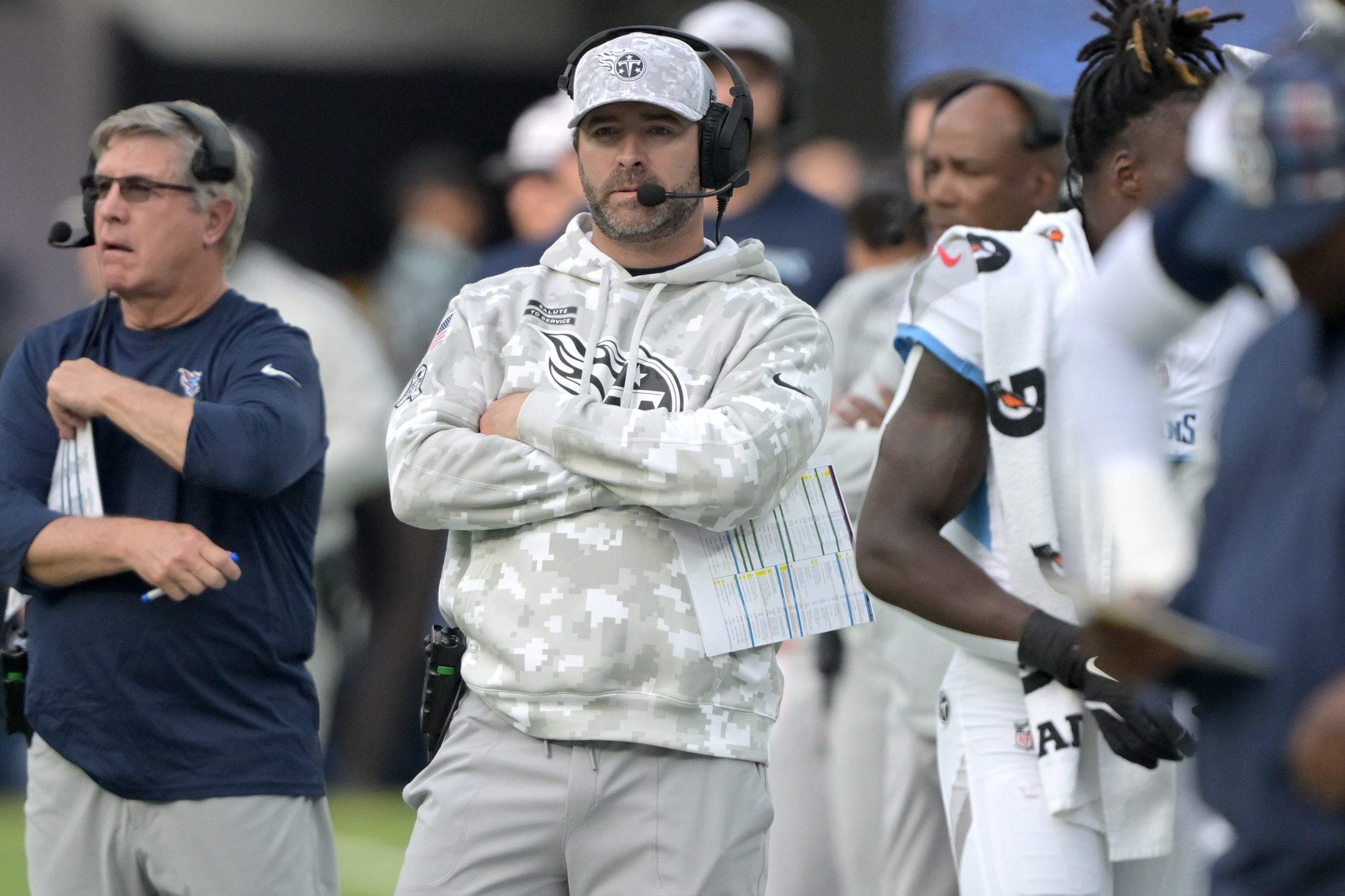
Titans head coach Brian Callahan, offensive coordinator Nick Holz, and defensive coordinator Dennard Wilson all spoke to the media last week and discussed their expectations for the Week 10 matchup between the Titans and Chargers.
Given LA's slow tempo offense and suffocating defensive style, the Titans coaches knew that negative plays and capitalizing on possessions would be paramount to success on Sunday.
But the Chargers imposed their will upon Tennessee. This Titans team was unable to overcome the very things the coaches predicted could happen and cause their demise.
No Negative Plays
The Titans' defensive effort against the Chargers was disappointing. Not only did they surrender 27 points, create zero turnovers, and get beat on the ground. The Titans' defense failed to create negative plays for the Chargers' offense entirely.
Tennessee did not sack Justin Herbert once. It's the first time all season that Herbert hasn't been sacked in a game. He also scored his first rushing touchdown since October 1st, 2023.
"We had a hard time getting the quarterback down. He got out a few times and made some runs," said Titans head coach Brian Callahan after the game. "They're a bleed offense. They suck the air out of the game. They run the ball well. It was nothing big, it was just steady. It's death by a thousand paper cuts when you play that way."
The Chargers allowed zero sacks. They only had one offensive penalty on the day. They also allowed just four "negative plays" all game. And while there was one play in every quarter that went for -1 or -2 yards, it was an overall clean offensive effort that stayed on schedule and, as Callahan said, sucked the air out of the game.
Los Angeles faced 10 third downs on Sunday. Only 3/10 came on 3rd & 6 or longer. Manageable third downs was another key that was discussed in the days leading up to the game by the Titans coaching staff. The Titans wanted to stay on schedule. But guess how that went?
Tennessee faced nine third down scenarios on Sunday and 7/9 came on 3rd & 6+. That's 77 percent of long third downs and only 30 percent for the Chargers.
"The key for us is staying on schedule. First and second down are almost more important than third down, theoretically. These guys have given up six conversions on 3rd and 8+. If you get behind the sticks here, it's been a famine," said offensive coordinator Nick Holz last week. "If you get off schedule, those pass rushers, Khalil Mack, they will crush the pocket. They play soft zone and make you check it down,. Getting behind the chains, that will be very disadvantageous to us. Stay on schedule and both teams are going to play it the same way. So hopefully we can outplay them at their own game."
It was just as Holz predicted. If you get behind the sticks. If you give up sacks and penalties that set your offense back, you'll end up exactly where the Chargers' defense wants you.
On defense, if you can't generate negative plays and get LA off schedule or behind the sticks, they will kill you one paper cut at a time.
Failure to Finish Drives
The "bleed offense" that Brian Callahan referred to in his postgame press conference was not a new revelation for the Titans head coach. Tennessee knew going into that game on Sunday that the Chargers M.O. on offense is running the ball, controlling the clock, and leaning on a lead.
Callahan talked to the media last week about the possibility that possessions would be hard to come by.
"You know when your possessions are going to be limited"….."You know you're going to be in the seven to eight possessions, potentially. And that's not a lot. [I've] definitely had games where you come out of it, and you've had three possessions in the first half. So you have to treat those with the respect they deserve. And you know that you might not be able to get the normal 10 or 11 or 12 possessions, and you have to make them count," said Callahan in a press conference last week. "There's a heightened awareness to know that when you have possessions, you got to make them count and you have to do something with them."
Callahan was right on the money. As predicted, the Titans only got eight possessions in Sunday's loss (not counting the 0:04 at the end of the first half). But even with a "heightened awareness," the Titans failed to make those possessions count.
Back-to-back penalties (face mask, false start) on right tackle Leroy Watson IV killed a second quarter drive, backing the Titans out of the red zone and into a long field goal attempt. The drive took nearly six minutes off the clock and ended with a missed field goal. Nick Folk missed his first kick of the season wide right from 49 yards out.
On the opening drive of the second half, the Titans were looking to set the tone and gain some momentum on the road. Tennessee went 62 yards, burned over seven minutes of clock, but came up short in the red zone and settled for a field goal. While the Chargers were finishing off long drives with touchdowns, the Titans were settling for three points. That's never a winning recipe.
Tennessee got a total of four possessions in the second half. There was one touchdown drive, one field goal, and two punts. But with the Chargers scoring touchdowns and chewing clock in a game where possessions are at a premium, the Titans looked up and the game felt out of reach.
It's exactly what Dennard Wilson and Brian Callahan knew was coming. But Tennessee still was unable to execute at those critical junctures of the game.
