
Packers should embark on quest for long-term answer at running back
Aaron Jones will be 29 in a month. It's difficult to say if his injuries will get more sparse at this point of his career. AJ Dillon is slated to be a free agent. Emanuel Wilson didn't get playing time over practice-squader Patrick Taylor. Practically, the Green Bay Packers don't have a long-term definitive piece […]


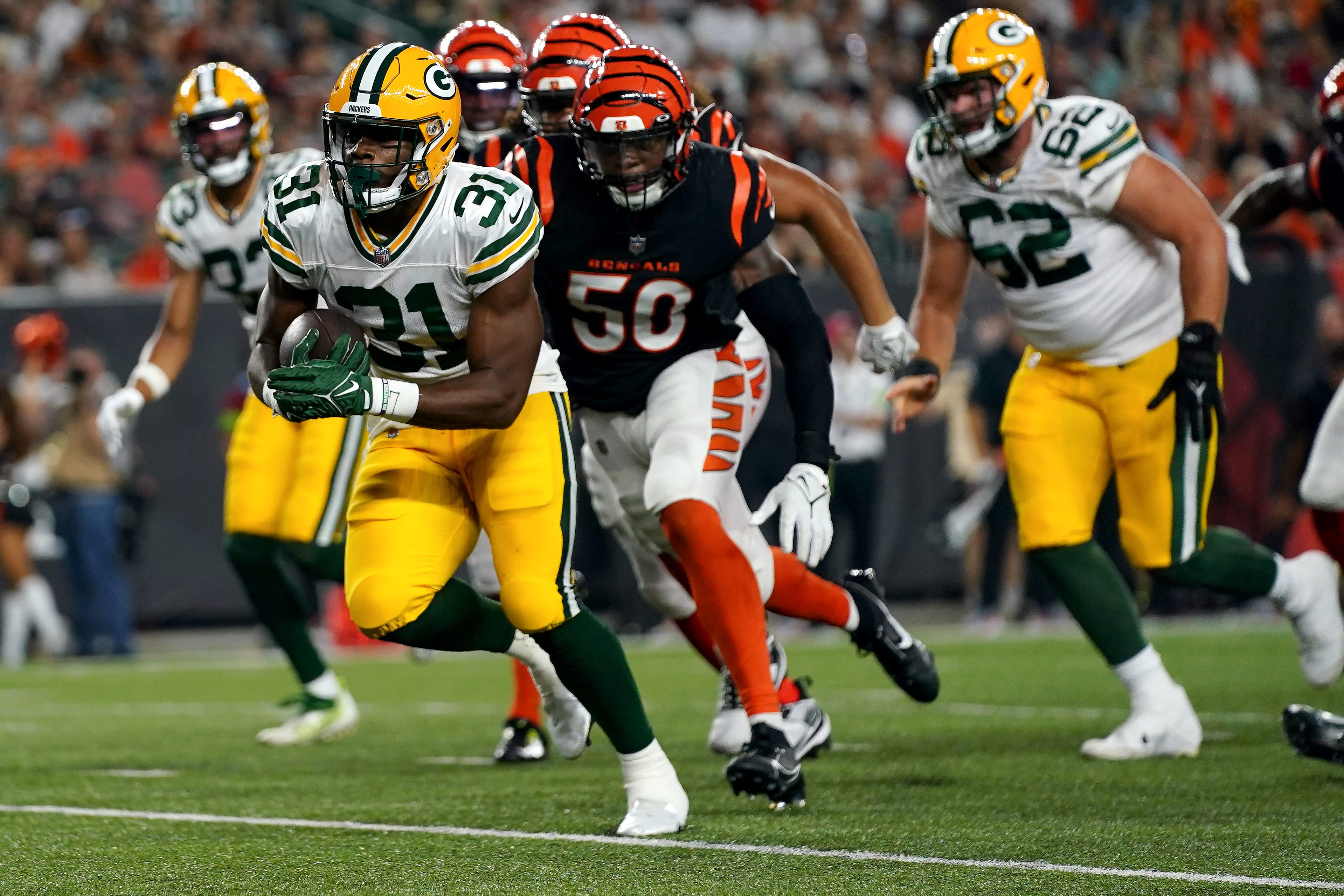
Aaron Jones will be 29 in a month. It's difficult to say if his injuries will get more sparse at this point of his career. AJ Dillon is slated to be a free agent. Emanuel Wilson didn't get playing time over practice-squader Patrick Taylor. Practically, the Green Bay Packers don't have a long-term definitive piece at running back, and that's one of the answers the team can try to find over the last 10 games of this season.
It's a young offense, but the running back duo of Jones and Dillon was supposed to be a staple for Jordan Love and the receivers to lean on while developing. The plan didn't work. Jones injured his hamstring in week 1, and hasn't been fully healthy since. The starter missed three games and was on a pitch count in the other three. The Packers have had seven games this season, and Jones has had a total of 29 carries for 123 yards.
That could mean an opportunity for AJ Dillon, who's in a contract year, but the former second-round pick hasn't taken advantage of that. He's had the volume, with 85 attempts, but his performance is mediocre at best. He's had 266 yards, 3.1 per carry, and only one touchdown.
By trading veteran cornerback Rasul Douglas to the Buffalo Bills, the Packers gave a clear indication that they are thinking about the future. And if that's the case, they should use the rest of this season to look for alternatives that can help the team beyond 2023.
2024 situation
Theoretically, Aaron Jones is signed for 2024. However, he's slated to have a $17.7 million cap hit. If he's traded or released, the dead money will be $12.3 million — but it would open $5.4 million in cap space in 2024 and $6.6 million in 2025. The Packers could even designate Jones as a post-June 1st release, which would open $12 million in 2024, but the rest of the difference would hit in the following year's cap anyway.
Whichever is the case, Jones will soon be 30, and the other running backs from his draft class are already showing signs of decline. The Packers have the option the extend Jones or adjust his contract again as they did this year, but it doesn't seem like he will be as productive as he's been for much longer.
Dillon has never panned out as the Packers expected when they took him in the second round in 2020. He's good in terms of success rate, but he's one of the least explosive runners in the NFL. He tends to take what the offensive line gives him, and the front problems for the Packers this season exposed Dillon's limitations. He's a free agent and his market might not be as strong, so there's a chance the Packers extend him. But either way, Dillon should not be the preferred starter moving forward.
Options
The first answer is Emanuel Wilson. The rookie shined during preseason, leading the NFL in rushing yards. However, he's shown his rawness during the regular season — head coach Matt LaFleur mentioned problems as a pass protector, for example. But he leads the Packers running backs in yards per carry, even though it's in a small sample size of seven carries for 30 yards — 4.3 average, ahead of Jones (4.2), Dillon (3.1), and Patrick Taylor (2.8). Taylor, by the way, was released and is now with the New England Patriots.
If the Packers are willing to let the young receivers, tight ends, and offensive linemen play through their mistakes, why wouldn't they have a similar approach with Wilson? He's not under contract for 2024 either, but as a first-year player, he's slated to be an exclusive-rights free agent. The Packers have control over his contract situation through 2025, and then he would become a restricted free agent.
The other in-house option is James Robinson, who was signed to the practice squad after the Packers released Patrick Taylor. However, he's not that young and his ceiling is limited since an Achilles injury affected his explosiveness.
Market
At this point of the season, it's virtually impossible to find good young players available to sign. The best free agent that is relatively young is former Tampa Bay Buccaneers running back Ronald Jones, who is 25. But, well, you wouldn't expect for him to be a long-term starter.
What the Packers could do, and they did it in 2018 with Allen Lazard, for instance, is to take a lost season to test new pieces signing developmental players off of other teams' practice squads. The best name for that purpose would be Xazavian Valladay, who's with the New York Jets. Undrafted out of Arizona State, he's a rookie and has already spent time with the Houston Texans and Pittsburgh Steelers.
Deneric Prince, who's with the Kansas City Chiefs, is another alternative.
Running back is always a volatile position, and it's easier to find an answer than most positions in football. Next year, the free agent class will be full of talent: Saquon Barkley, Josh Jacobs, Austin Ekeler, Derrick Henry, and Tony Pollard are some of the examples — unless they get tagged. But in a season where the evaluation became the most relevant factor, there's no reason for the Packers not to test more scenarios.
