
Packers seven-round trade-heavy mock two weeks ahead of the NFL Draft
We are 17 days away from the NFL draft. By this time, teams have most finalized their boards and are talking to each other, exploring trade scenarios. Over the next two weeks, executives have complete clarity over how much it costs to move up and how much it's possible to get to trade down. And […]



We are 17 days away from the NFL draft. By this time, teams have most finalized their boards and are talking to each other, exploring trade scenarios. Over the next two weeks, executives have complete clarity over how much it costs to move up and how much it's possible to get to trade down.
And Green Bay Packers general manager Brian Gutekunst hasn't shied away from moving up and down according to how the board is falling. The 2018 draft, his first one as a GM, is the best example.
The Packers moved down from 14 to 27, adding a fifth and future first-rounder with the New Orleans Saints, and then moved back up to 18, paying just a third-rounder and a late-round swap to select cornerback Jaire Alexander. He moved up in 2019 to get safety Darnell Savage and in 2020 to select quarterback Jordan Love. Last year, he moved down twice early in the second round, adding multiple day 3 picks before drafting wide receiver Jayden Reed.
Exercise
So the idea of this mock is to explore how much the Packers would have to pay to move up significantly in the first round, and how they could recoup the value later on.
Utilizing the PFF draft simulator tool, I was able to move up from 25 to 16 with the Seattle Seahawks paying a third- and a fifth-rounder (picks 88 and 169). The Seahawks is a perfect spot because they can realistically trade down, and general manager John Schneider has a close relationship with Brian Gutekunst — Schneider worked for the Packers from 1993 to 1996 and from 2002 to 2009, and Green Bay called Seattle to move up in 2019 to select Savage.
In this exercise, the Packers would take Alabama cornerback Terrion Arnold. They would still keep two second-round picks and a third.
Even so, I executed two trade downs from 41, in a similar move to what the Packers made last year before taking Reed. With these two trades, the Packers would move down from 41 to 45 and then to 49, adding a fourth- and a fifth-rounder in 2024, plus fourth- and fifth-rounders in 2025. They would still get tackle Kingsley Suamataia and wide receiver Keon Coleman in the second round, and running back Trey Benson in the third.
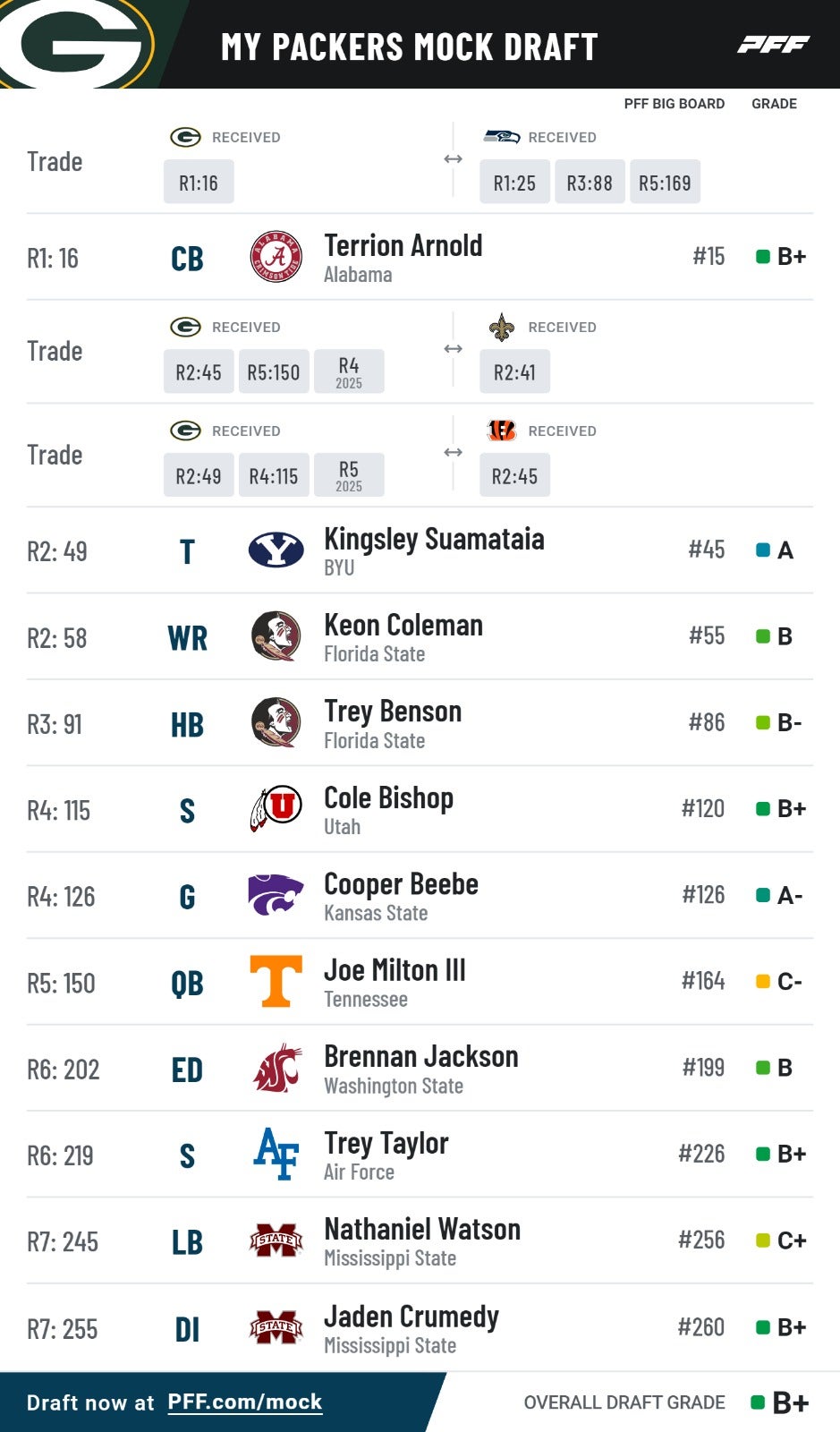
At the end of the draft, the Packers would have the same number of picks they originally have, eleven. Plus, they would finish it up with a high-end prospect in Terrion Arnold and two extra picks in 2025 — currently, they are slated to have eight picks next year, their original seven ones, plus a compensatory seventh-rounder.
Trade up scenario
Usually, trading up early in the draft is a hard proposition. Big moves tend to be risky, especially for non-quarterbacks, and it's hard to pay off. In this case, though, the value was fair.
And that's the biggest point. Maybe, a top quarterback prospect will still be available, driving the price up. Gutekunst doesn't like to involve future picks in this kind of deal, and correctly so.
If he can move up without adding his two second-rounders or a future pick, it might work. In this case, he would only need to give up a third and a fifth, which would make the deal basically a no-brainer with so much talent available early on.
Trades make the draft night much more fun and hard to predict. Brian Gutekunst has shown willingness to be a part of that fun, and it's certainly something to watch on April 25.
