
A combination of stats shows exactly where Jordan Love can get better for the Packers in 2024
The Green Bay Packers have much more certainty around what Jordan Love is and what he can be than a year ago. He's poised to get a big-time extension and will be the starter for a long time. But that doesn't mean Love doesn't have areas to improve in his game, and one of them […]


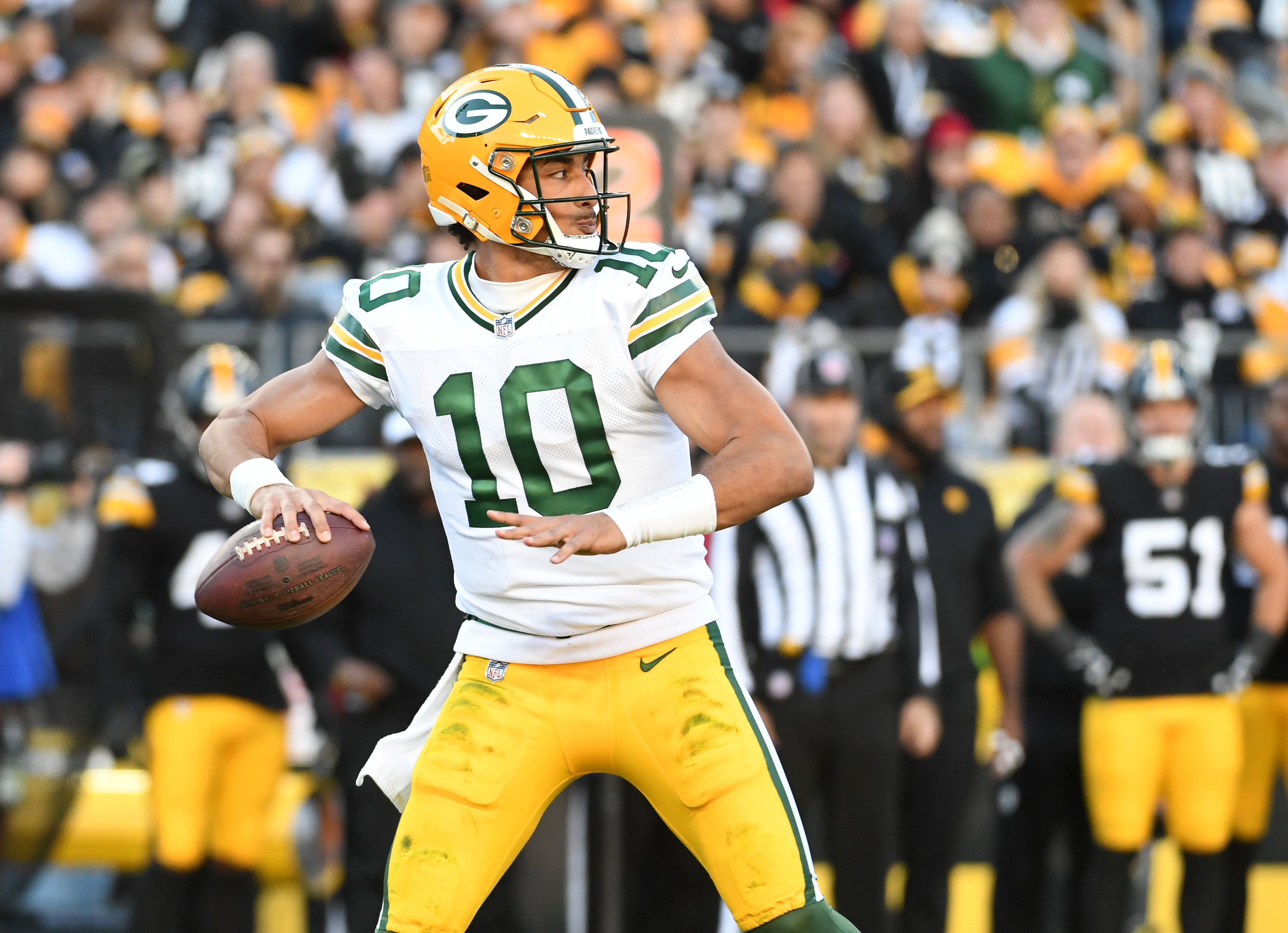
The Green Bay Packers have much more certainty around what Jordan Love is and what he can be than a year ago. He's poised to get a big-time extension and will be the starter for a long time. But that doesn't mean Love doesn't have areas to improve in his game, and one of them was evident by analyzing a combination of two stats.
Carter Donnick tweeted this, and it's pretty interesting. In 2023, his first season as a full-time starter, Love had a 118.0 passer rating on playaction plays, but it fell to 89.5 in normal dropback throws. The 28.5 difference is the fifth highest in the league, just behind Joe Flacco, Kenny Pickett, Brock Purdy, and Daniel Jones.
Love is in the orange area of the graphic, which also includes players like CJ Stroud, Lamar Jackson, Justin Herbert, and Josh Allen. So it's not something to be overly concerned about. But it's a fair consideration.
"It was (Love's) first year as a starter, so he was seeing things for the first time," said Packers quarterbacks coach Tom Clements. "But obviously as the year went on we started to develop and were pretty good at the end of the year. We know we can be pretty good. Now you just have to work to get to that same spot."
The positive news
While it's an area where Jordan Love can get better, it's not like he was awful in the dropback game. He was 16th in passer rating, and most quarterbacks around the league follow this trend of being better with playaction — that's a cheat code for almost everyone.
Better than that, it's a staple of Matt LaFleur's offensive philosophy, which tries to marry pass and run concepts to make it harder for the opposing defense to identify the play.
It's not a coincidence that offenses from the same coaching tree — San Francisco 49ers, Houston Texans, and New York Jets — had similar results.
Philosophical discussion
For years, analytically-inclined people have tried to separate playaction effectiveness with run game success, while old schoolers see a relation. For the most part, players also see that difference, and the graphic above shows an obvious connection between teams that were bad running the ball and how ineffective their quarterbacks were with playacion (the Dallas Cowboys and the Tampa Bay Buccaneers are the two most extreme examples).
"Those guys thinking we are going to run the ball because we are running it good, getting four or five yards a pop, so it slows down their rush, especially on the play-action pass because they are trying to stop the run," Packers left guard Elgton Jenkins said during last season. "By the time they find out it's the pass, J-Love throwing a dot to somebody. It works hand-in-hand, it works real good together."
The fact, though, is that the Packers will keep a high percentage of playaction plays to maximize what Jordan Love does best. At the same time, it's important for him to get better when the playaction is not realistic.
