
Packers face difficult decisions on whether to correct past mistakes or give familiar situations another chance to finally work
Brian Gutekunst has to evaluate the situations of guard Aaron Banks and cornerback Nate Hobbs.


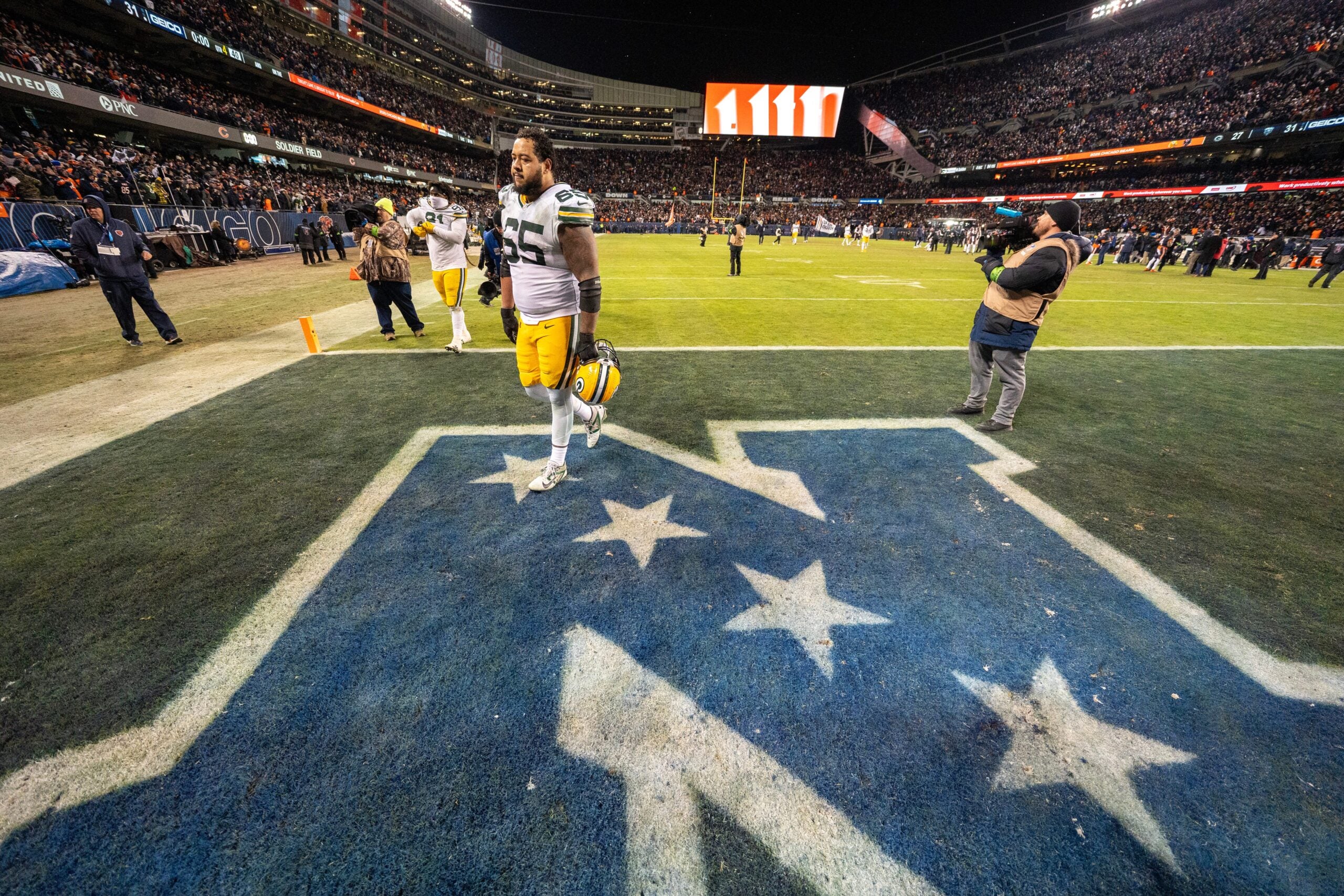
The Green Bay Packers have a very usual way of structuring contracts. In terms of cash, nothing is guaranteed beyond Year 1 — unless you are a quarterback or Micah Parsons. For cap purposes on big deals, though, it’s usually a 2 + 2 — two years where the impact is significant, then essentially two team options down the road.
That intersection in the second year brings a difficult discussion to the table this offseason with free agent signings from a year ago, left guard Aaron Banks and cornerback Nate Hobbs.
Past mistakes
If the Packers could go back in time, general manager Brian Gutekunst would probably want back his decisions to sign both Banks and Hobbs — or at least to the deals they received from the team. Both got contracts well above the projected market. Good for them, good for their agents, not so good for the Packers.
Now, though, Green Bay has a realistic chance of moving on from them. That would make a lot of sense cash wise, not as much cap wise in the short-term, and it would bring follow-up questions about the roster.
Aaron Banks
Would you give Banks a one-year, $18.1 million contract? Well, that’s the question the Packers have to answer this offseason, because it’s the case he’s due in 2026. If the Packers cut him, that would turn out to be a one-year, $29.4 million contract — that would be an absurd amount for an elite guard, let alone for an average player.
But that’s where the situation is at now. If the Packers cut him, they’d have $20.25 million in dead money from the signing bonus proration — money already paid that hasn’t hit the cap yet. The cap savings would be $4.5 million in 2026, $22.25 million in 2027, and $20.75 million in 2028.
If the Packers keep Banks and cut him next year, that would become a two-year, $47.5 million contract. A year from now, it’s a $13.5 million dead money, opening up $8.75 million of cap — plus $20.75 million in 2028.
That’s a lot of money either way, because the contract was frontloaded to beat the market even without guarantees beyond Year 1.
The Packers already have a difficult offensive line situation — Elgton Jenkins may be released, and Sean Rhyan is a set to be a free agent. If the team decides to release Banks as well, it would probably have to find alternatives elsewhere. But based on Banks’ production (and the 2025 season wasn’t just a bad outlier, it’s what he’s always been), it’s hard to justify his price and not that hard to replicate his performance with a cheaper option.
Nate Hobbs
Hobbs was the signing to address the biggest roster hole at the time, at cornerback — remember, the Packers had lost Eric Stokes and decided to part ways with Jaire Alexander. He signed a four-year, $48 million deal, and differently from Banks, the deal isn’t as frontloaded.
It also had a significant $16 million signing bonus, but it’s a more manageable situation. Hobbs is slated to make $9.05 million in 2026, a fine price tag for a slot corner — and despite injuries and underwhelming performance as a boundary corner, Hobbs did play reasonably well in the slot while healthy.
If the Packers cut him, there would be $12 million in dead money in 2026 and just $838k in cap savings — plus $14.05 million in 2027 and $14.7 million in 2028. Because the cornerback situation is so rough and there aren’t many avenues to improve, the Packers will likely give Hobbs another chance to prove himself — and hopefully stay healthy for a full season.
There’s a specific date for the Packers to make a decision. Both players have roster bonuses due on March 13, days after the start of the league year — that’s $9.5 million for Banks and $6.25 million for Hobbs. If they are to release them, that’s the logical limit to do it. And Brian Gutekunst will have to evaluate his options to see if past mistakes still make sense for the roster.
