
The Lions have been building their defense in a very similar way to the Seahawks, why it hasn’t worked for Detroit
The Seattle Seahawks are the Super Bowl champions, and now we head into the offseason, where the Detroit Lions and 30 other teams will be looking to be the next team to win it all. I saw this tweet on Monday morning, and it made me think about how the Lions are building in a […]

The Seattle Seahawks are the Super Bowl champions, and now we head into the offseason, where the Detroit Lions and 30 other teams will be looking to be the next team to win it all. I saw this tweet on Monday morning, and it made me think about how the Lions are building in a similar way to the Seahawks.
The Lions have been picking up square pegs
Take a look at that list. That’s a bunch of guys whose previous teams didn’t see the vision and either traded them away or just let them walk. The Lions have guys like that on their team. Guys like Al-Quadin Muhammad, Thomas Harper, Amik Robertson, Marcus Davenport, and Rock Ya-Sin. Players that teams gave up, and the Lions were able to unlock.
Also, we’re talking about free agents who don’t cost a ton of money. Look at how those players break down in terms of cost.
Seahawks went low-cost on defense for the most part
- Josh Jobe: 1-year deal with $2 million
- Drake Thomas: 3-year deal worth $2.71 million
- Ernest Jones: 3-year deal worth $33 million
- Leonard Williams: 3-year deal worth $64.5 million
- Julian Love: 3-year deal worth $33 million
- Demarcus Lawrence: 3-year deal worth 32.5 million
- Uchenna Nwosu: 3-year deal worth $45 million
A quick note, just to make this all make sense. These deals have been completed over the course of the last three years. This wasn’t what Seattle did last March or something like that. The Lions have had plenty of larger signings like D.J. Reed, DJ Reader, and Cameron Sutton. They’ve yet to make the big deal like Leonard Floyd, but that’s because they had their own version of Floyd in Alim McNeill.
The Lions have invested in players who either didn’t work out where they were and have worked out here, or players whose teams may have felt they weren’t going to get good play out of them anymore.
Why has it worked for Seattle, and it hasn’t for Detroit?
You’re going to hate this when I say it, but it’s injuries, and that’s it. The Lions can’t stay healthy. The Seahawks lost the fewest total value in the league due to injury this year. The Lions lost the 10th most value due to injuries in the league.
It was never that the Lions didn’t have a good defense; it was that they couldn’t keep it healthy this year or last year. They were a top-five defense in the NFL as late as Week 11. I know you do not believe that, but it is true. The Seahawks were ranked first in defensive DVOA after Week 11, and the Lions were fourth. Then all hell broke loose.
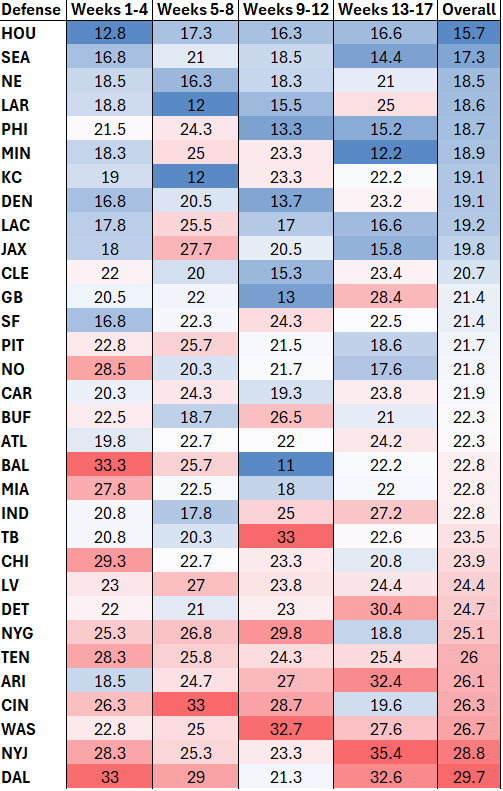
You can actually see it happen on this graph. Terrion Arnold got hurt, Brian Branch got hurt, the Kerby Joseph injury changed things, and the D.J. Reed injury changed things. Alim McNeill didn’t return to his usual self, and Marcus Davenport got hurt and then got hurt again. The whole secondary went down, and the Lions could not survive.
It’s not that the Lions aren’t signing good players or that they don’t have good players; it’s that they can’t seem to keep them healthy. They’re having the worst luck you could have with this stuff.
This is why the Lions need to be a little more aggressive than normal this year, and a lot of signs to point to the idea that they are. They need depth on top of depth, and they want to consider finding some new starters in a couple of different areas.
But more than anything, they need to find a way to remain healthy for an entire season or, at the very least, get healthy when it matters the most. I just don’t know how you do that. The answer isn’t simply firing the training staff and starting over again. There has to be something a little deeper than that.
