
Latest intel confirms suspicion about why Packers would be perfect landing spot for disgruntled Cardinals edge rusher Josh Sweat
Sweat started Cardinals’ training camp on the physically unable to perform (PUP) list, but it doesn’t sound like it’s a serious issue.


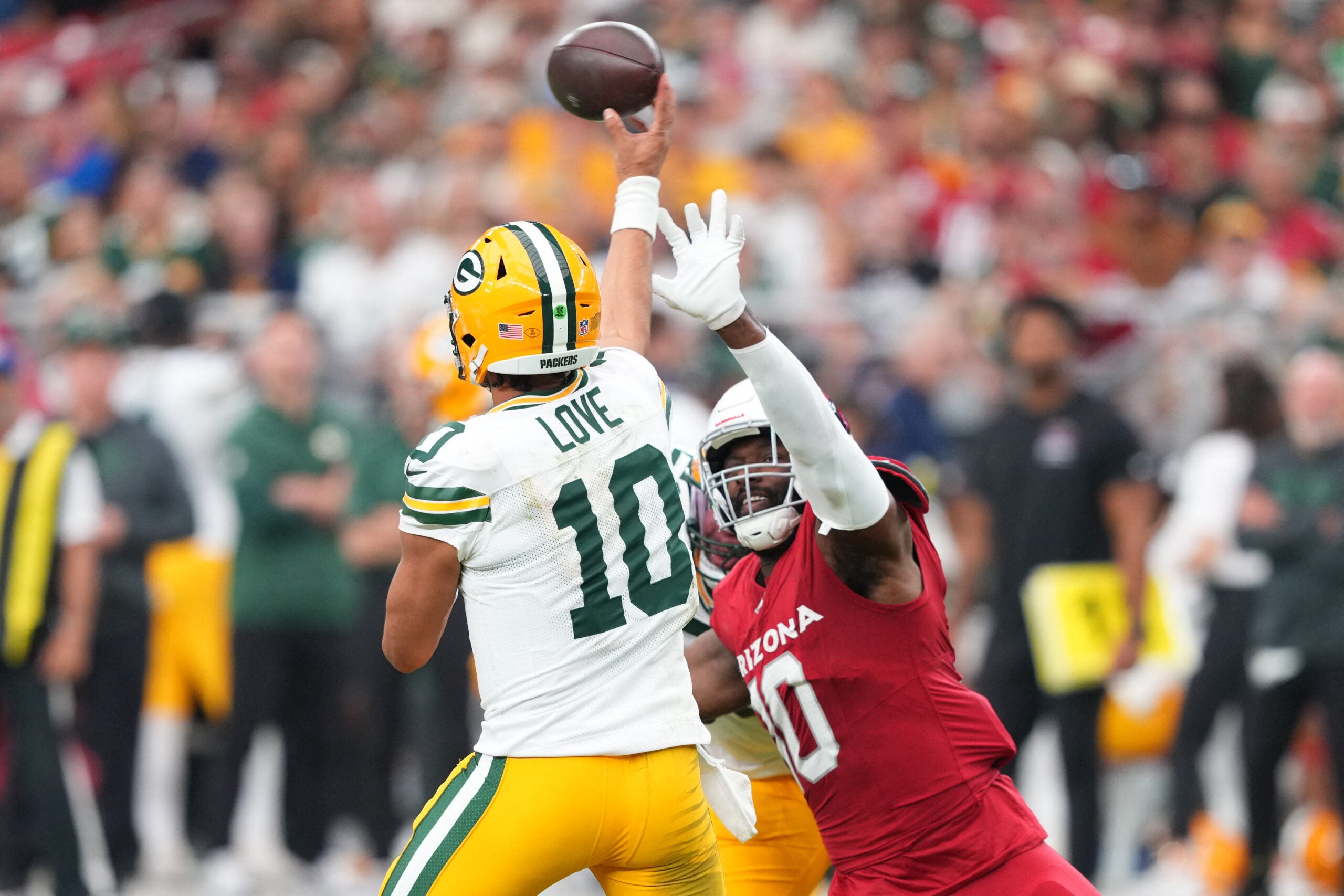
The Green Bay Packers have a natural connection to a veteran edge rusher who wants out of Arizona. Josh Sweat, the Cardinals’ productive pass rusher, has reportedly asked for a trade, and Packers defensive coordinator Jonathan Gannon could be the driving force behind a potential deal.
With Green Bay still evaluating its edge rusher depth during training camp and Micah Parsons unavailable for the first month of the regular season, the timing and fit make this a situation worth monitoring closely.
The Gannon connection
Sweat signed a four-year, $76.4 million contract with Arizona last offseason, but the landscape shifted when the Cardinals fired Gannon. According to Johnny Venerable of PHNX Cardinals, Sweat asked to be traded the same day Gannon was let go because of the strong personal and professional relationship between the two.
That connection is backed by production. Sweat had 11 sacks under Gannon with the Philadelphia Eagles in 2022, then followed that up with 12 sacks for Arizona last season. A former fourth-round pick, Sweat has recorded at least 40 pressures in each of the past five seasons. Last year he added 47 pressures and 20 stops for the Cardinals. Even on a struggling team, Sweat performed at a level that justified his contract.
Arizona declined to trade Sweat earlier in the offseason, but the situation has the chance to evolve. Sweat started training camp on the physically unable to perform list, and Cardinals head coach Mike LaFleur described it as knee maintenance, though the circumstances raise questions about whether it could also function as a form of hold in.
Based on Venerable’s reporting on the Ari Meirov podcast, Arizona may not be willing to move Sweat now but could become more open to a deal if the team starts the season slowly, making a trade around the deadline more realistic from the Cardinals’ perspective.
The timeline may be a problem for Green Bay
The challenge for the Packers is that their window of need doesn’t align with Arizona’s potential willingness to deal. Green Bay won’t have Parsons for roughly the first month of the regular season. Acquiring an edge rusher by the trade deadline wouldn’t solve that problem, because Parsons would already be back by then.
That means if the Packers want Sweat, the deal would need to happen before Week 1, during a window when the Cardinals may not yet feel the pressure to move him.
From a financial standpoint, the deal would be manageable for the Packers. Arizona already paid Sweat’s $18.5 million signing bonus, so that dead cap stays on the Cardinals’ books regardless. For the acquiring team, Sweat’s contract would carry a $18.1 million cap hit in each of 2026, 2027, and 2028, with only the 2026 salary and option bonus combination guaranteed. After that, the remaining years would essentially function as team options.
The Packers don’t have a first-round pick next year after trading it to the Dallas Cowboys for Parsons, but they do have extra draft capital through compensatory picks down the road. That gives general manager Brian Gutekunst flexibility to offer draft compensation without gutting the team’s future assets.
Wait-and-see approach
Green Bay’s current strategy reflects its typical process. The Packers decided not to sign Jadeveon Clowney, who went to the Houston Texans. Instead, the front office wants to give its young edge rushers a chance to prove themselves during training camp first.
If that development doesn’t materialize, the Packers could pivot to a trade like this or explore free agency options closer to Week 1.
