
Packers’ solution to a major early-season problem may come from a surprising place on the defensive side of the ball
Green Bay’s plan to solve the pass rush problem without Micah Parsons should come from the interior of the defensive line.


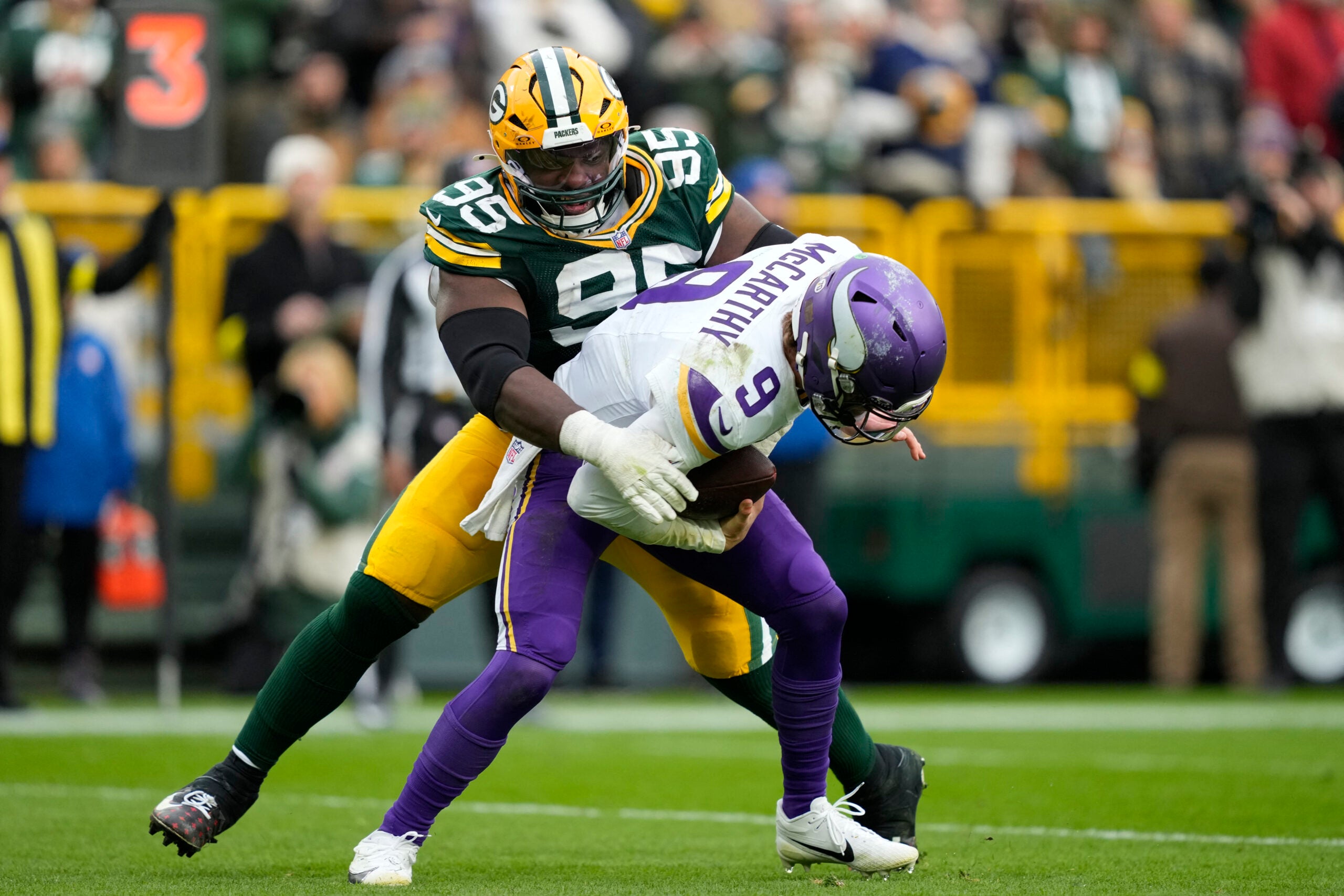
The Green Bay Packers who are going to be on the field in Week 1 against the Minnesota Vikings will have lost roughly 56% of their pressures from last season, and their answer to the pass-rush void without Micah Parsons for the first month of the 2026 season does not come from the edge defender position.
Parsons will miss at least four games while on the physically unable to perform list as he continues recovering from his ACL injury. Combined with the offseason departures of Rashan Gary (traded to the Dallas Cowboys) and Kingsley Enagbare (signed with the New York Jets in free agency), Green Bay’s edge group looks thin on paper.
Lukas Van Ness, Brenton Cox, and Barryn Sorrell combined for only 34 pressures in 2025. The fourth piece of the rotation is fourth-round rookie Dani Dennis-Sutton. Even if Van Ness takes a realistic step forward, the Packers simply don’t have the personnel to generate consistent pressure from the edge.
Interior pressure as the foundation
That’s why the Packers will likely adjust their defensive structure to funnel pressure through the interior defensive line under Jonathan Gannon. Green Bay has the potential and the player characteristics to disrupt quarterbacks from the inside.
The front office invested heavily in this position group throughout the offseason. The Packers extended Devonte Wyatt, who is back from injury and has proven ability to generate pressure from the interior. In ten games last year, the former first-round pick generated 22 pressures and four sacks.
They signed Javon Hargrave to a two-year, $23 million contract in free agency specifically because of his interior pass-rush skill set. Karl Brooks is another depth piece who can create pressure even though he is not as effective against the run. Green Bay also drafted Chris McClellan in the third round. McClellan is more of an all-around defensive tackle in terms of balancing pressure generation and run-stopping, but he can still collapse the pocket, especially when aligned at nose tackle.
Edge rushers as run defenders, not primary pass rushers
The Packers appear comfortable with Van Ness and Sorrell as their starting edge defenders because those players, while not necessarily great pressure generators, can set the edge, contribute against the run, and protect the integrity of the pocket. The actual havoc, the disruption of timing and pocket structure against opposing quarterbacks, is designed to come from the defensive tackles.
Getting some production from the outside linebackers would obviously help. Brenton Cox might even be the best option in terms of bending the edge and generating pressure with velocity. If Van Ness can become more impactful as a pass rusher, that would benefit the defense tremendously as well. But that outcome is hope, not plan. The plan is interior pressure.
Nonetheless, this approach doesn’t guarantee a successful defense. The Packers ranked 10th in defensive success rate last season with Parsons on the field and plummeted to 30th without him over the final three weeks. Projecting a high-level defensive unit without Parsons for the first month is difficult regardless of scheme adjustments.
But if the defense holds up, the reason will likely trace back to Wyatt, Brooks, Hargrave, and McClellan generating pressure from the interior and disrupting offenses early in the season. When Parsons returns, the defensive structure might shift, and the interior run-stopping ability could be a problem. That’s an issue to solve later in the season, though, and it’s a lesser problem to have considering how impactful Parsons has been since Green Bay acquired him in a trade last year.
