
Vikings future plans for QB Kyler Murray depend on a multitude of factors, and it’s something to consider now
If Kyler Murray is really good for the Minnesota Vikings, the discussion about his future will be a very interesting one.


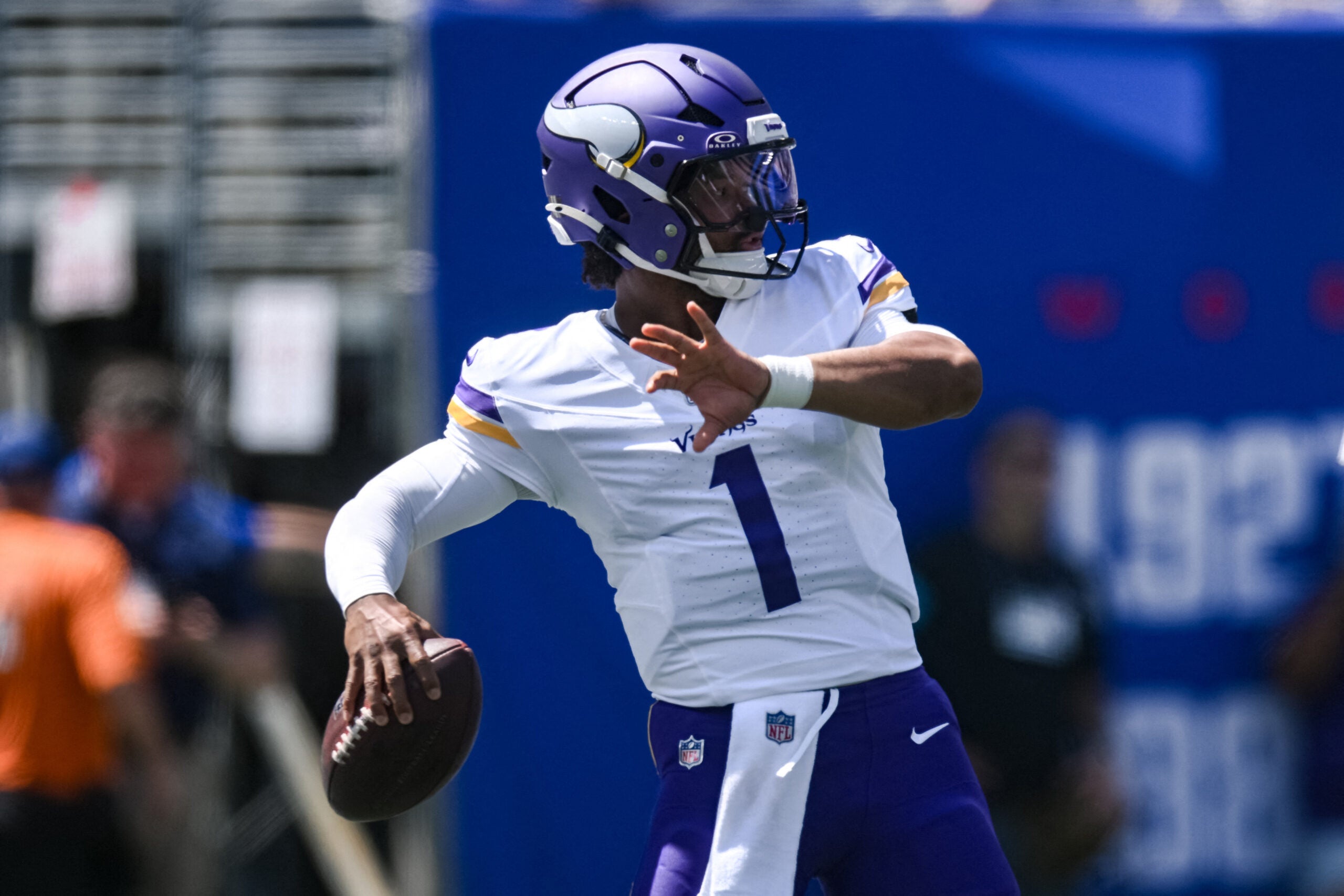
The Minnesota Vikings are paying quarterback Kyler Murray just $1.3 million this season, which is quite the bargain. Murray is a reclamation project on a prove-it deal, and if he proves it, the Vikings will face one of the more layered situations in recent history.
The question won’t be whether Minnesota wants to keep Murray if he plays well. The question is how much it will cost, and whether the quarterback market gives the Vikings any leverage.
The $60 million question
When it comes to how much Murray could get paid, it boils down to a multitude of factors. If we go with Murray being a possible most valuable player candidate, could he sniff the top of the market?
Only two quarterbacks have ever hit $60 million per year in average annual value. Patrick Mahomes averages about $64.5 million, and Dak Prescott got $60 million. Mahomes is a generational talent, and Prescott’s deal can largely be attributed to Jerry Jones’ front office mismanagement rather than Prescott being worth that figure on the open market. Beyond those two, the market has been remarkably stagnant.
Lamar Jackson hasn’t hit $60 million, and neither has Joe Burrow. Josh Allen just signed another extension at $54 million per year, even when he could have signed for much more. C.J. Stroud and Baker Mayfield are reportedly seeking $60 million, but there’s a reason neither has gotten it. Almost every major quarterback contract signed over the past four years has landed in the same $50 million to $55 million bucket. Tua Tagovailoa, Jordan Love, Allen, Burrow. They haven’t gone up.
That raises a question worth exploring: are quarterback contracts being suppressed because other positions are seeing their values rise dramatically? Edge rusher Will Anderson Jr. just got $50 million. Cornerbacks just hit $30 million. The gap between quarterback compensation and the rest of the roster is shrinking, and franchises may not be willing to fork over $60 million when building out the rest of the team requires paying market rates at multiple premium positions.
Where does Murray fit in this market?
Even if Murray has a Pro Bowl-caliber season, the leverage dynamics are complicated. He’s not coming into negotiations from a position of extreme strength unless he’s an MVP or MVP candidate. The starting point for discussions would likely land around $40 million, with performance dictating how much higher it goes.
The reclamation project element adds another layer. Sam Darnold signed a three-year deal worth $100.5 million. Daniel Jones got two years and $88 million with the ability to hit $100 million through incentives. No reclamation-type quarterback has hit $50 million per year on that first contract after re-establishing himself. The Vikings, who have always been cap-savvy, will point to those benchmarks. If Darnold got $33.5 million per year, why would Murray command $50 million? Does his past success in Arizona weigh in stronger than it did with those other quarterbacks?
The champagne problem
Murray has already had one massive payday. There’s a possibility, however little it may be, that he values stability and fit over squeezing every last dollar out of negotiations. Kevin O’Connell’s offense could maximize Murray’s skill set in ways Arizona never did, and sometimes that matters. For example, maybe $45 million in Minnesota will be more appealing than $50 million from the Jets.
That said, players should maximize their earnings every time they sit at the negotiating table. They’re setting up generational wealth, and they should never feel bad about pursuing every cent available to them.
The broader conversation about rookie quarterback contracts is worth acknowledging too. Only six quarterbacks this century have reached the Super Bowl on a rookie deal: Tom Brady, Ben Roethlisberger, Eli Manning, Joe Flacco, Russell Wilson, and Patrick Mahomes. The idea that you need a cheap quarterback to build a championship roster hasn’t been proven true nearly as often as people suggest. A baseline level of quarterback play is insanely valuable to an organization, even if it costs real money.
If the Vikings find themselves in a position where they have to pay Murray at the end of the year because he was that good, it’s a champagne problem. You’re keeping a quarterback because he earned it, not because you’re stuck. And if he’s bad? Minnesota took a smart shot on a $1.3 million investment, and you move on. The season opener against the Green Bay Packers at U.S. Bank Stadium will start providing answers, and the contract conversation will follow from there.

