
Vikings bringing back Harrison Smith creates multiple roster challenges with limited resources to fix them
The Minnesota Vikings signed safety Harrison Smith to a one-year deal worth up to $16 million on Saturday afternoon. It’s good news for the defense, which could use his communication skills on the back end, but it raises a lot of questions about the future of the franchise when it comes to the salary cap. […]


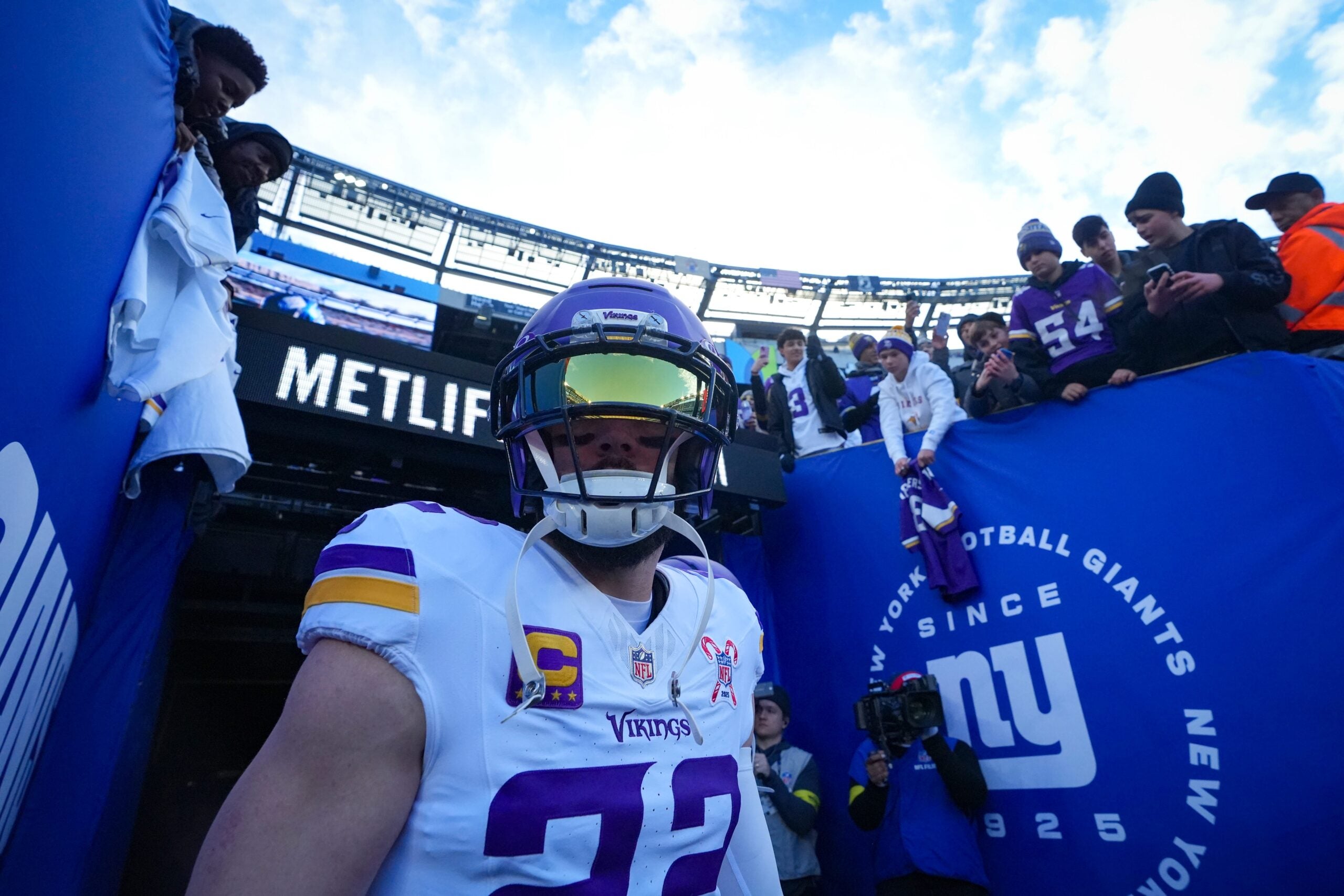
The Minnesota Vikings signed safety Harrison Smith to a one-year deal worth up to $16 million on Saturday afternoon. It’s good news for the defense, which could use his communication skills on the back end, but it raises a lot of questions about the future of the franchise when it comes to the salary cap.
Minnesota sits around $8.8 million under the salary cap before the Smith signing. There isn’t a ton of wiggle room on how the Vikings can maneuver with his deal. We don’t know the full structure of the contract yet, and it could involve void years with a minimum base salary and near a $7 million signing bonus spread out over five years. It’s a structure they have used before with Smith. We do know that $4 million comes in per-game roster bonuses and another $4 million is tied to performance incentives, including winning the Super Bowl.
Even so, the Vikings still need operating money to get through the season. They are going to have to make a move of some kind in order to operate throughout the rest of the year. There aren’t many roster moves to make when it comes to restructuring because they did so much of it during the offseason, but three options make a lot of sense.
Extend EDGE Andrew Van Ginkel
Andrew Van Ginkel is going into the final year of his contract, and there are real questions about what he could be. Van Ginkel has been a huge asset to Brian Flores’ defense, but he is over the age of 30 and missed significant time in 2025 due to injury. Will the Vikings want to pay him a large contract when they’re likely about to give Dallas Turner that same kind of deal?
It’s an interesting question, but if they can strike a deal with Van Ginkel, it would make a lot of sense. Doing so could save the Vikings around $10 million depending on the term and structure of the deal. He currently carries $15.39 million in base salary and $510,000 in per-game roster bonuses. You can whittle that down and get Minnesota in a good spot while maneuvering money throughout the course of that deal.
It would help the Vikings this year but put them in a slightly more painful spot long-term. If Van Ginkel, who has been playing well, continues that level of play, it would be a worthwhile move.
Cut LB Ivan Pace Jr.
This is going to be at the top of every list like this until it happens or the season is over. Pace was on all of these lists during the offseason due to being benched last season and his expensive salary.
Having Pace on the roster is a good thing for the Vikings, especially after he showed growth in multiple areas. Even so, he’s the fourth of four linebackers and making $3.52 million to do it. If they move on from Pace, it’s not guaranteed money, and they would see all of that saved on the salary cap. It would be much easier to make happen if they didn’t give Jacob Roberts an injury settlement, but alas.
Restructure RG Will Fries
This one is going to be more controversial because Fries hasn’t exactly been good yet for the Vikings. He signed a five-year deal worth $18.5 million per year before the 2025 season and did not live up to that as a first-year Viking. The hope is that with an entire offseason to actually practice and get better rather than rehabbing a broken leg, Fries would be a much better performer in 2026.
He currently has a base salary of $12.61 million with $510,000 in per-game roster bonuses. You can whittle that down and save around $8.5 million if you really wanted to make it work, but that would also mean committing to him long-term because he already has $12 million in dead money after the 2026 season. By maneuvering nearly $11 million across multiple years, it would be around $20 million in dead money that would hit the salary cap if you were to cut him after the season. If you really believe in Fries long-term,
Restructure ILB Blake Cashman
This is the move the Vikings would likely go to only in desperation. Cashman probably won’t be with Minnesota after this year, because they drafted Jake Golday. The idea would be that Golday takes his place next season, especially after the extension Eric Wilson signed, which oddly enough was the exact deal Cashman signed two years ago.
Cashman has been a phenomenal player for the Vikings and arguably at times the most important player on the defense for Minnesota. Even so, he is over the age of 30 and constantly injured, missing time. So far with the Vikings, he’s missed big chunks of both seasons he’s been in Minnesota.
If they were to restructure him, it would signal a likely longer-term relationship than the Vikings currently have with the linebacker, which has both its positives and negatives. He has two void years already built into his contract, and if they were to maneuver with it, he would likely command more than the $7.5 million he signed for in 2024 in an extension.
Trade J.J. McCarthy
This has been a major discussion point over the last month ever since Kyler Murray was named the starting quarterback. The majority of the discussion was rooted in cutting ties with an asset that wasn’t going to give you the return on the investment you made, along with giving McCarthy a fresh start. You won’t save much from a salary cap perspective by trading him, but it’s not zero.
Everything depends on whether or not his roster bonus of $1,706,800 has been paid or not. If it has, the Vikings would save just $1.075 million, but if it hasn’t, it would go over to McCarthy’s new team and save the Vikings $2,781,800.

