
Packers hold a major advantage in Tucker Kraft contract talks, and one overlooked detail explains why
The franchise tag isn’t necessarily what the Packers want to apply, but it can be useful to help the team during negotiations.


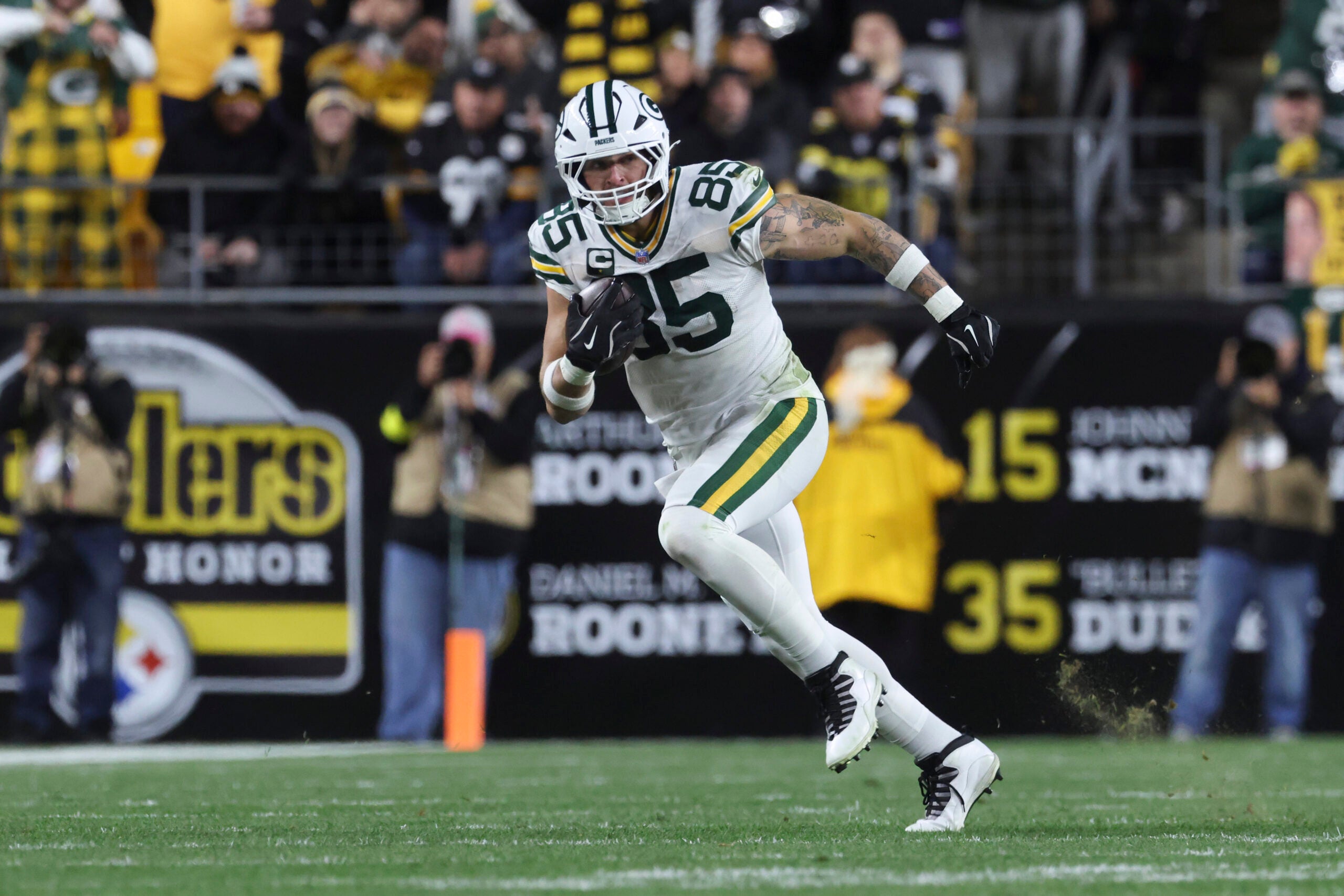
The Green Bay Packers are working toward a contract extension with tight end Tucker Kraft, and the franchise tag gives them a significant negotiation advantage. Kraft is entering the final year of his rookie deal in 2026, making a long-term extension the logical next step for both sides.
General manager Brian Gutekunst has acknowledged the ongoing talks, noting that these types of deals take time because of the variables involved. One of those variables is Kraft’s return from an ACL injury. Another is the complicated tight end market itself.
The tight end market creates a narrow window
The top of the tight end market features San Francisco 49ers’ George Kittle at $19.1 million per year and Arizona Cardinals’ Trey McBride at $19 million per year. After that, there’s a drop-off to a second tier: Kyle Pitts of the Atlanta Falcons at $17.6 million and T.J. Hockenson at $16.5 million. Then comes another significant drop to a group including Isaiah Likely, Mark Andrews, Dalton Schultz, Jake Ferguson, Cole Kmet, Pat Freiermuth, Travis Kelce, and Brenton Strange, all making around $12 million or slightly above.
Tucker Kraft belongs in the conversation with the top tier, but the market doesn’t offer much room to blow past the ceiling.
The franchise tag gives the Packers more flexibility
Unlike positions like quarterback, wide receiver, or offensive lineman, the franchise tag is a manageable tool at tight end. According to Over the Cap, the projected franchise tag for tight ends in 2027 sits just under $17.5 million. That number is likely lower than what Kraft would receive on a long-term extension yearly average.
The tag does come with a structural downside, though. The entire amount hits the salary cap in a single year, with no ability to spread the cost through signing bonuses or void years. But for a player of Kraft’s caliber, it remains a reasonable figure.
Consider the math over a three-year window. In 2026, Kraft is slated to make $3.683 million on his rookie deal. A projected first franchise tag in 2027 would cost $17.479 million. A second consecutive tag in 2028 (120% of the previous salary) would escalate to $20.97 million. Over those three seasons, Green Bay would pay Kraft a total of $42.13 million, averaging $14.044 million per year. Even isolating only the two franchise tag years, the total comes to $38.449 million, an average of $19.22 million annually. That essentially matches the top of the market, but only by a slim margin.
The negotiation dynamic favors the Packers
That framework puts Kraft in a difficult position. If he pushes to surpass the top of the market by a significant margin, the Packers can simply point to the franchise tag as a viable alternative. Two consecutive tags would pay him near the market ceiling without requiring Green Bay to commit long-term guaranteed money at an inflated price.
The Packers obviously prefer to reach a long-term deal. A multi-year extension gives them a more favorable contract structure with lower early cap hits, and it keeps Kraft happy, which matters for both sides. Ideally, Green Bay would lock Kraft into a four-year extension, which is the typical structure the organization uses for rising young players.
But the franchise tag serves as a background tool in these negotiations. The Packers don’t need to threaten to use it aggressively. Its mere existence shifts the leverage in their direction, because at tight end, the tag number isn’t prohibitive the way it is elsewhere.
The 2027 projected franchise tag for a quarterback is $50.3 million. For a wide receiver, $31.2 million. For an offensive lineman, $30.4 million. The tight end tag sits as the third lowest in the league, ahead of only running backs and specialists. That disparity is the core of Green Bay’s advantage.
The Packers want Tucker Kraft on a long-term deal, and they should. He’s one of the best young tight ends in football. But the franchise tag ensures Green Bay can negotiate from a position of strength, keeping the contract structure team-friendly no matter how long the talks take.
