
Inside a simulated Tucker Kraft contract negotiation between the Packers and his representatives, and what it means for their future
The former third-round tight end shined before an injury ended his 2025 season, and now he’s eligible for the first time to receive a contract extension.

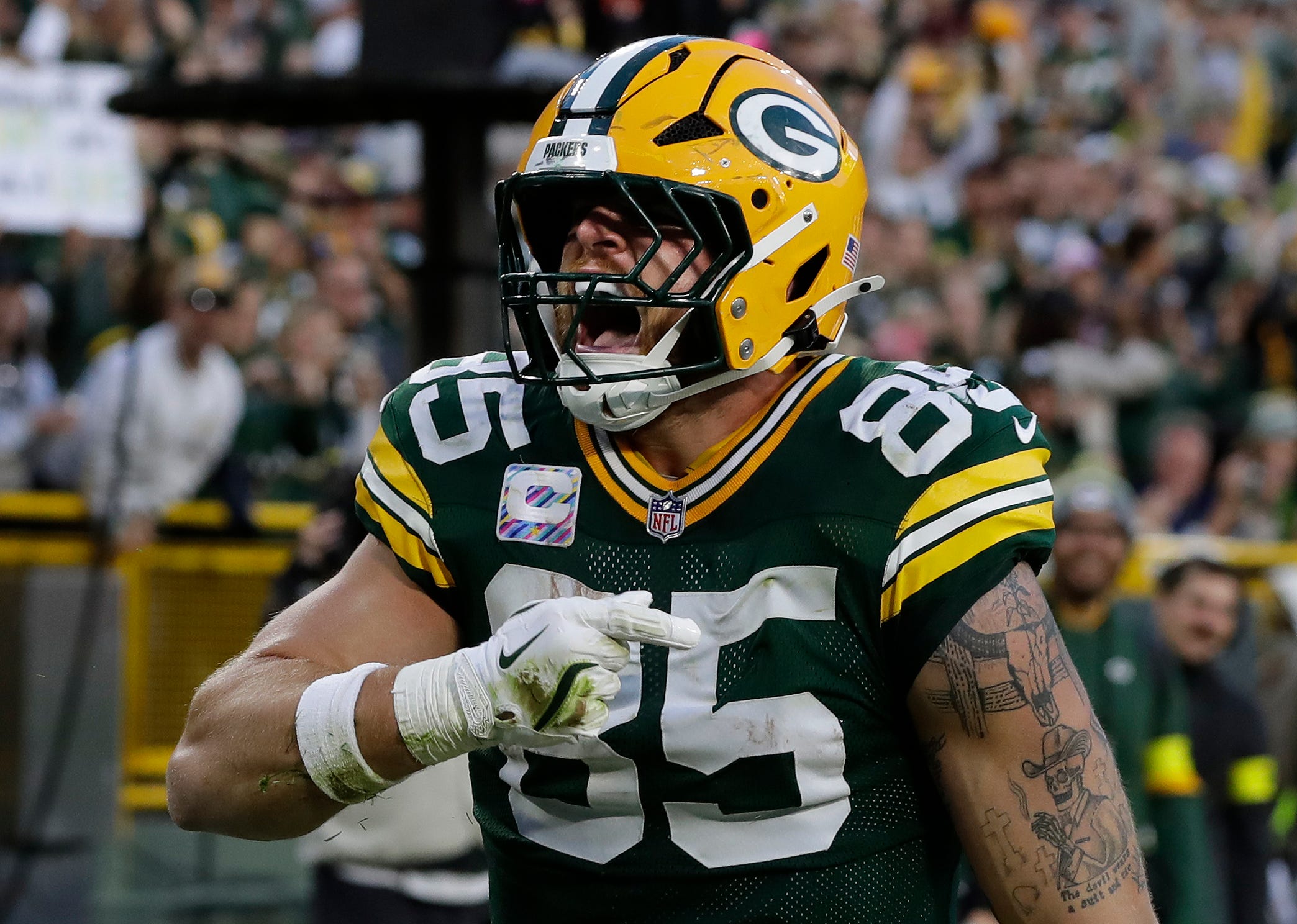
Tight end Tucker Kraft is finally eligible for a contract extension, but it comes at a bittersweet moment. The offensive weapon is coming off his best season in terms of efficiency and performance, but he’s also recovering from an ACL injury that made him miss the second half of the year.
So, our Green Bay Packers beat writer Wendell Ferreira and our NFL national writer Kyle Crabbs will wear their negotiating hats to simulate what the talk could look like. Ferreira will simulate Packers executive vice president/director of football operations Russ Ball, and Crabbs will be Kraft’s agent Jack Bechta.
What he is a player
Tucker Kraft’s representation: You can pay a lot now, or you can pay more later. Anyone not yet arrived to the ‘Tucker Kraft, Top-5 NFL tight end’ conclusion will be there soon. Kraft is one of the most prolific dual-threat tight ends in the league — but he’s coming off of a torn ACL that cut short his coming out party in 2025.
Negotiating a contract extension amid rehabilitation from injury can be complicated. But Kraft’s impact across his first three seasons of NFL play has been undeniable. He’s a reliable blocker who has played predominantly as an in-line player at tight end. The impact of that as a blocker allows him to bolster the point of attack. But then when you consider the damage he deals with the ball in his hands? You have an elite offensive weapon.
Since entering the league, Kraft averages over nine yards after catch per reception (9.1). Among all NFL tight ends with at least 100 receptions since 2023 (26 in total), only San Francisco’s George Kittle is above six yards after catch per reception. He averages 6.3 YAC/reception. This isn’t a one-off, either. Kraft has led the league in yards after catch per reception among tight ends with at least 30 catches in EACH of the last three seasons.
So Kraft, who is just 25 years of age, is an effective blocker and a sturdy in-line player. He wins with the ball in his hands. He’s got a nose for the end zone, too — with 13 touchdowns over the last two seasons despite missing the second half of 2025.
Packers representation: We agree with all of that. General manager Brian Gutekunst and head coach Matt LaFleur have consistently talked about how much Kraft matters to the offensive structure and how much the Packers as an organization want to keep Kraft around for years to come. Now, it’s just a matter of defining the correct value and the right structure, especially considering Kraft is coming off an injury. It’s important to value Kraft correctly, while also keeping some level of security for the organization. We want this to be a partnership, not a war. Ideally, both sides win.
Value
Kraft’s side: It’s only a matter of time before the tight end salaries explode past $20 million per season. Kraft should be the first. And if the Packers wait, the odds are high he’ll cost more later — even with the injury looming. The Packers agreed to terms on a contract extension with Christian Watson valued at $23 million per season.
As Kraft’s representation, we believe the impact he brings is at least equal, given his ability to influence both the run and the pass. But given the limits of the existing tight end market, we’re going to ask for $20 million AAV. We know it’s stiff, and it wouldn’t even be a record-setting AAV as a percentage of the cap (6.64%). TJ Hockensen’s active contract is top of the charts there at 7.34% AAV. Our asking price would measure just behind Kittle and Arizona’s Trey McBride among current contracts.
Packers’ side: It’s hard to look at what George Kittle and Trey McBride did throughout their rookie contracts and say that Kraft deserves more money than them, even though Kittle is now an older player. McBride had 2,236 yards in his first three years, against 1,388 yards from Kraft. Sure, Kraft got hurt and missed time.
He wasn’t a starter from Day 1 either, but all those factors matter for determining his value. Beyond that, the tight end position has a somewhat team friendly number, and it’s currently projected at $17.7 million in 2027. We can realistically tag Kraft twice, and we would have him under contract on a three-year, $42.87 million deal. That’s under $15 million a year. We don’t want to go that route for multiple reasons, including keeping our relationship in a good place. But we’re also buying a year of injury risk, so it has to make sense for the Packers.
Final decision
Kraft’s side: If the final number falls lower than $20 million per season, it’d better come with one hell of a guarantee package. If not, someone else will be sure to pay it a year or two down the line. Just ask Raiders center Tyler Linderbaum after he blew the center market open with a 50% reset.
Packers’ side: We’re fine doing $20 million a year in total value if the structure comes in our usual terms. That means a $27 million signing bonus, and that’s all in terms of guarantees. That would be the same percentage of guarantees that Christian Watson has. The deal would also have a low salary in Year 2 to keep our cap in a healthy situation, then three balanced years to close it out, with a solid window to renegotiate again ahead of the 2030 season depending on how things go from here. A four-year, $80 million extension would make Kraft the highest-paid tight end in football, and in real value it would be a five-year, $83.93 million contract ($16.78 million a year). That seems more than fair for both sides.
