
Notre Dame’s biggest issue under HC Marcus Freeman once again reared its ugly head during victory over Wisconsin
Notre Dame escaped Lambeau Field with a victory over Wisconsin. A past issue, however, reappeared for the Fighting Irish.

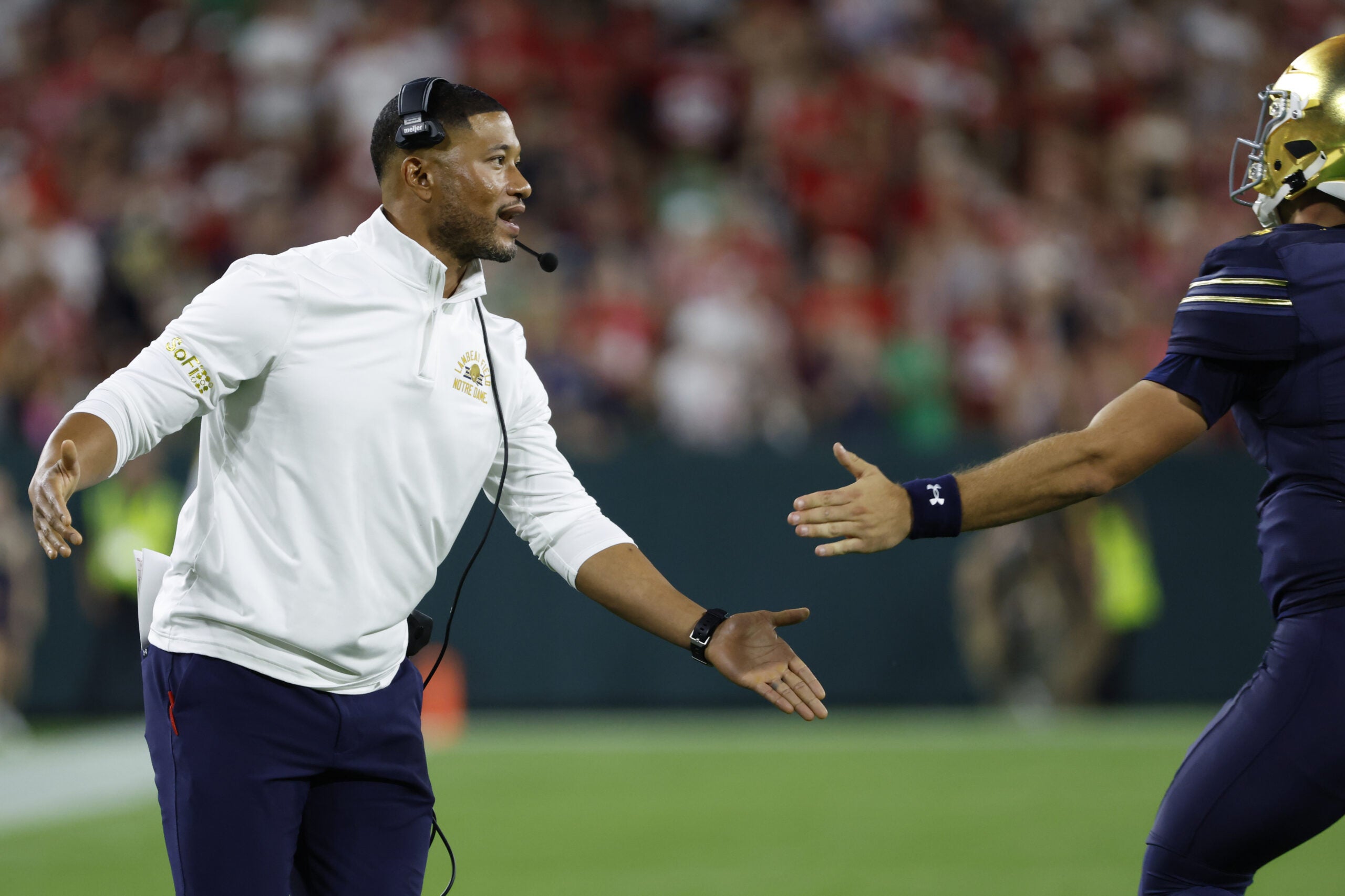
A large talking point for this Notre Dame team this offseason has been about getting off to faster starts.
The Fighting Irish entered their 2026 season opener against the Wisconsin Badgers at Lambeau Field with every reason to believe the problem was solved. Head coach Marcus Freeman spent the extended offseason testing processes, refining preparation, and being intentional about building a team capable of controlling its own fate from the jump.
Notre Dame had the talent advantage on paper, a Heisman Trophy candidate at quarterback in CJ Carr, and an incredibly talented defense returning. Wisconsin, meanwhile, entered under head coach Luke Fickell with a make-or-break feel and a head coach on the hot seat.
On paper, this sounded like a blowout.
And yet, as Notre Dame sat there staring at a 13-10 lead at halftime with an underwhelming passing game and a rushing attack that managed just 29 yards on 16 carries (1.8 yards per carry), the same old questions came flooding back. Notre Dame’s defense was solid but unspectacular, and the Fighting Irish were once again their own worst enemy.
The 41-13 final score looks comfortable enough on paper, but nothing about this game should inspire confidence heading into the teeth of the schedule.
Freeman’s September struggles aren’t going away
While Freeman has certainly done a lot of great things during his tenure, September has not been kind to him. That includes an 0-2 start last year that ultimately cost the Irish a spot in the College Football Playoff.
It also includes bad losses to Marshall and Northern Illinois in previous seasons. Freeman was not shy about addressing local and national media concerns about getting off to faster starts, both within individual games and across the opening stretch of a schedule.
When Notre Dame opted out of the Pop-Tarts Bowl after missing the playoff this past season, the idea was clear: use the extended offseason to find the right formula. Test things. Figure out the best processes. Be intentional with every action so the program doesn’t head into December without controlling its own destiny.
Many bought into the possibility of a dominant opening performance against Wisconsin. The matchup favored Notre Dame in nearly every measurable way. Freeman is in a much firmer spot foundationally compared to Fickell, who has not done a great job in Madison so far.
There is familiarity between the two coaches. Carr gives Notre Dame a legitimate difference-maker at the most important position on the field. The defense promised to be one of the best in the country.
Why this matters beyond Week 1
The 41-13 win still left Notre Dame fans feeling uneasy, and understandably so. When the Fighting Irish face off against BYU, Miami, SMU, or potentially a strong playoff opponent later this year, slow starts can be the difference between winning and losing. They could also be the difference between earning a spot in the dance and watching it from home.
The margin for error only gets smaller in the games that matter most. Notre Dame’s rushing attack producing fewer than two yards per carry against a Wisconsin team that entered with significant question marks is a genuine concern. The passing game failing to assert itself in the first half compounds it.
Freeman’s teams have now established a troubling pattern of sleepwalking through early-season moments when the talent gap should allow them to bury opponents.
The answer to the slow-start problem remains elusive. Freeman and his staff clearly prioritized solving it this offseason, and to their credit, the second half against Wisconsin showed the kind of separation Notre Dame should be capable of producing. But the fact that it took 30 minutes to get there against a rebuilding Big Ten opponent is not a ringing endorsement of the progress made.
Notre Dame has the roster to compete for a national championship in 2026. The talent is there. The coaching foundation is there. What remains missing is the ability to come out firing from the opening whistle — and until Freeman figures that out, every September Saturday will carry an undercurrent of anxiety that a team this talented simply shouldn’t have to endure.
