
Vikings HC Kevin O’Connell’s offense is so close to figuring it out, with Kyler Murray slowly getting more comfortable
The Minnesota Vikings are 4-0 with an offense near the bottom of the league, and Sunday’s fourth quarter offered real signs of life.


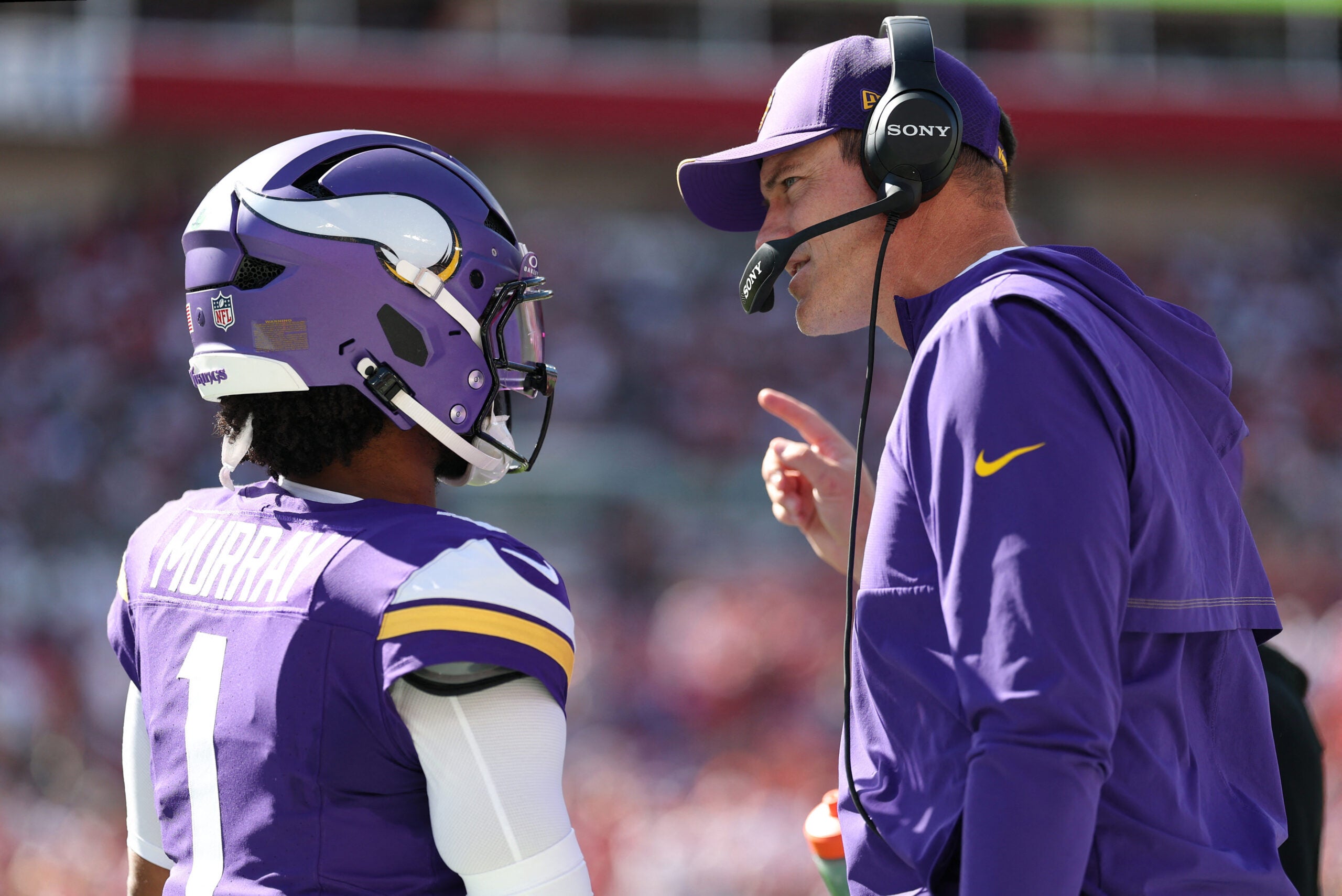
There’s no shortage of panic surrounding the Minnesota Vikings offense right now. The numbers are ugly as quarterback Kyler Murray is still finding his footing, and touchdowns have been hard to come by. However, the Vikings are closer to figuring things out than it might seem, and the fourth quarter against Miami on Sunday was a big reason why.
It’s not a surprise that fans are frustrated. Minnesota ranks 27th in EPA per play and 32nd in success rate. The offense has topped 250 yards just once, and that came Sunday with 339. Even so, the Vikings are 4-0, and winning football games is what matters most.
The numbers behind the Minnesota Vikings offense
The touchdown drought is what stands out most. Vikings head coach Kevin O’Connell‘s offense has scored one touchdown over the last three games: a deep ball from Murray to WR Jordan Addison. Minnesota hasn’t finished a red zone trip with a touchdown since Week 1, when it had two of them.
There are real concerns here, mainly that the Vikings can’t sustain drives or link plays together. That being said, you can see the semblance of a good offense.
There is an interesting caveat. Murray is only two games into his Vikings tenure. While he’s entering his eighth NFL season, this is his first year in this type of system. Drew Petzing didn’t run it. Neither did Kliff Kingsbury, Lincoln Riley, or, if you trace it all the way back to Texas A&M, Kevin Sumlin.
When everything is new, you’re thinking instead of reacting. Murray looked more comfortable as the Miami game went along, especially in the fourth quarter. That isn’t necessarily an excuse, because he absolutely needs to play better, but there’s a learning curve. Brett Favre’s first couple of games in 2009 had plenty of people questioning whether Minnesota made the right choice. His third game was the Greg Lewis miracle catch in the back of the end zone, and the rest is history.
Defenses have caught on to Kevin O’Connell’s plan
O’Connell’s system is built around explosive plays, generally defined as runs of 10-plus yards and passes of 20-plus yards. His favorite area to attack is the middle of the field between 10 and 19 yards. Deep safeties often take too much depth, with clear-out routes manipulating them.
Dagger is a staple in this style of offense. The inside receiver runs the clear, usually a go, post, or corner, while the receiver outside of him runs a dig. The clear occupies the deep safety, and the dig works free to the inside, where the ball has the shortest distance to travel.
The problem is that defenses know those concepts are coming. They aren’t biting on anything up front, and they aren’t biting on shallow routes because there usually aren’t any. With most routes living between 10 and 20 yards, why would a linebacker jump a 3-yard cross?
Take the bow concept the Vikings ran in the third quarter. One receiver runs a curl to hold the hook-flat defender while the receiver behind him runs a dig into the first window. It’s a common concept in the O’Connell, Sean McVay, and Kyle Shanahan world. With linebackers sitting a few yards deeper, though, the window shrinks and layering the ball over the top gets harder. That’s where Murray’s hesitation shows up.
I don’t expect Murray to throw into perfect windows. The real question is whether he can hit the window when he’s given proper space, and I think the answer is yes.
He’s also protecting the football at a high level. His first interception came on a slot fade to wide receiver Jauan Jennings, likely the hot read against two free rushers in a five-wide look. The decision was fine, but he skied the throw, and cornerback Keisean Nixon bailed off his man for the pick. The second one was batted at the line, and just about any quarterback probably gets that one batted.
Not having Justin Jefferson on the field matters, too. When he played against the Buccaneers, the first play of the game was a play-action dig for 22 yards. Having Jennings, who runs a 4.7, carry the clear-out doesn’t hold safeties the same way.
How the Vikings can unlock Kyler Murray
The fix is simple: take what the defense gives you. Run mesh, with two shallow crossers and a spot route in the middle of the field. Run curl-flat, pairing an arrow route to the flat with an 8-12 yard curl. Run stick and pick up quick completions to get Murray in rhythm.
Let Murray throw short for two quarters. Then dial up a stick-nod route, which looks like stick before going vertical, and T.J. Hockenson would eat on it. Curl-wheel becomes more dangerous, too. Minnesota nearly hit one to Jennings against Tampa Bay, and Addison has scored on it a couple of times, I believe, both against the Green Bay Packers.
None of that works until defenses believe you’ll actually throw short. It’s a game of chess, and O’Connell has been losing it at times because he wants to push the ball downfield. Short throws aren’t sexy, but they move the chains. Success rate climbs, EPA follows, and suddenly the intermediate and deep shots open up.
The fourth quarter against Miami showed what’s possible. Murray posted 0.58 EPA per play and a 46.2% success rate, good for fourth and 12th among quarterbacks in the fourth quarter. Pair that with the No. 1 defense and the No. 1 special teams unit, and the Vikings look like a real Super Bowl contender. Now they have to show they can execute it.

