Minnesota Vikings Trade Deadline Preview: Running back remains a main area of concern and Nolan Teasley should consider a big swing
The NFL trade deadline is approaching for the Minnesota Vikings, and I expect general manager Nolan Teasley to be aggressive. Running back keeps coming up as a position they could target, mainly due to the injury concerns the position has dealt with this season. If the Vikings make a trade at running back, it will […]


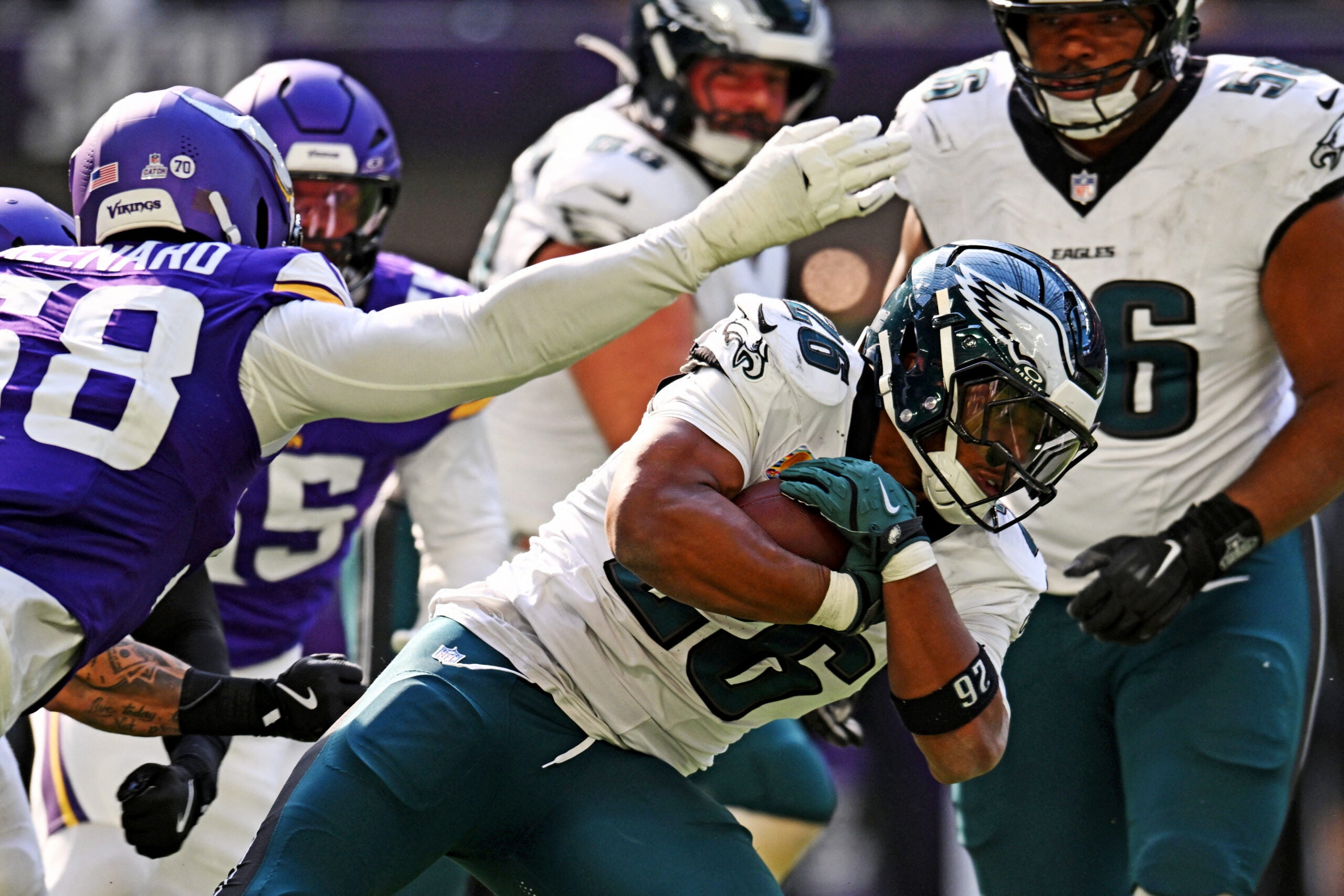
The NFL trade deadline is approaching for the Minnesota Vikings, and I expect general manager Nolan Teasley to be aggressive. Running back keeps coming up as a position they could target, mainly due to the injury concerns the position has dealt with this season. If the Vikings make a trade at running back, it will likely go one of two ways: a depth addition to pair with Aaron Jones and Jordan Mason, or a true home run swing.
I believe Minnesota will prioritize the big swing in this case. When you look at how this team is built around a ball-control offense, an impact running back makes a ton of sense. Using the A to Z Sports trade simulator, here are four high-profile trade candidates and what they could cost. The values may be different from what a trade will go for, but it gets us in the ballpark. That’s the point of a trade market. Let’s dive in.
Eagles RB Saquon Barkley
Philadelphia Eagles running back Saquon Barkley is a fascinating case. Quarterback Jalen Hurts is on injured reserve, and the Eagles are now 2-4 after losing to the Carolina Panthers. It didn’t look very good for Tanner McKee, who will likely be starting the next three games at a minimum with Jalen Hurts on injured reserve. Could Philadelphia sell off a few pieces for a mini reset? Lane Johnson is already set to retire, though the team is keeping him on the active roster so it can process the paperwork after June 1 and maneuver the cap in a less catastrophic way.
Trading Barkley carries a cost for the Eagles. He has a $13 million cap hit next year and would leave around $26.5 million in dead money, which means an extra $13.5 million they would have to allocate. However, they would save a small amount this year and add draft compensation.
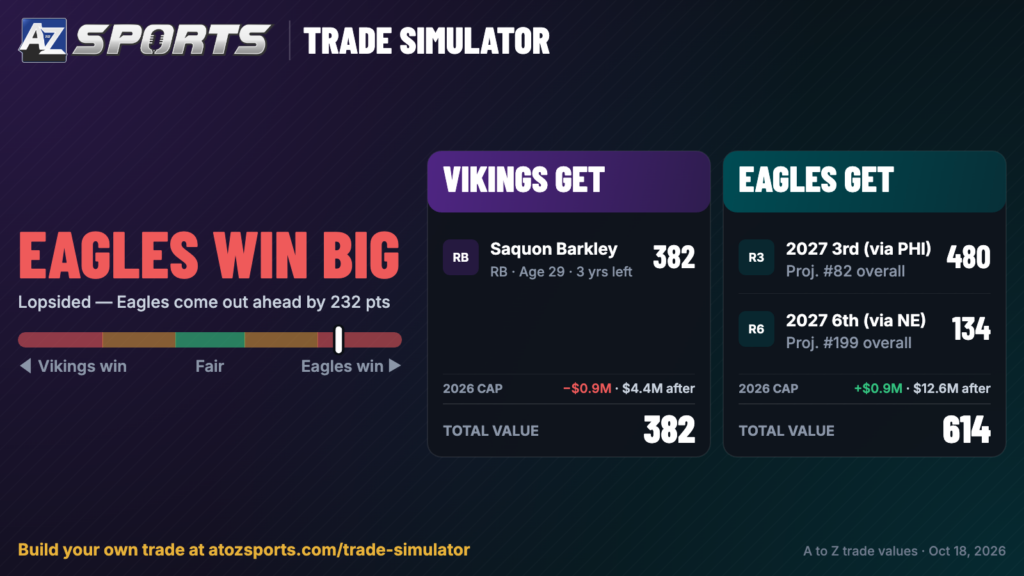
When I wrote about this earlier in the month, I thought a 2028 second-round pick plus a third and a fifth this year would get it done. Christian McCaffrey’s trade is a similar comparison, although he was a couple of years younger than the 29-year-old Barkley. The simulator values Barkley at 382 points, which matches the Eagles’ own third-round pick that Minnesota holds. I think it takes a bit more, so I added the sixth-round pick from the Walter Rouse trade. That creates a 232-point overpay (roughly a top-of-the-fifth pick), which isn’t a big deal for a player of his caliber.
Barkley thrives in the gap scheme the Vikings have leaned on this year, especially counter and duo. He can pass protect on third down, catch out of the backfield, and break the long run. Think of him as a supercharged Aaron Jones. He only has 36 carries this year after a pulled hamstring, which might mean extra tread on the tires.
Trade offer: Vikings send 2027 third (via PHI) and 2027 sixth-round picks
Salary cap hits: Pro-rated vet minimum of $1.3 million in 2026, $4.476 million in 2027
Jets RB Breece Hall
The New York Jets just gave Breece Hall a three-year, $45 million extension. Would they move on? You never know. It’s a movable contract, and Braelon Allen sits behind him at $1.1 million. He’s been good in relief of Hall, and it adds a layer of intrigue.
Hall carries an $11.48 million cap hit this year, and Minnesota would owe a prorated $5.16 million, which is his base salary. The Jets would absorb $6 million in dead money this year and $4 million next year. For the Vikings, Hall would carry a $13.16 million base salary next year and $13.5 million total with $340,000 in per-game roster bonuses. That’s easy to work with, especially if you want to keep him around long-term, as he does have two void years already built into the contract.
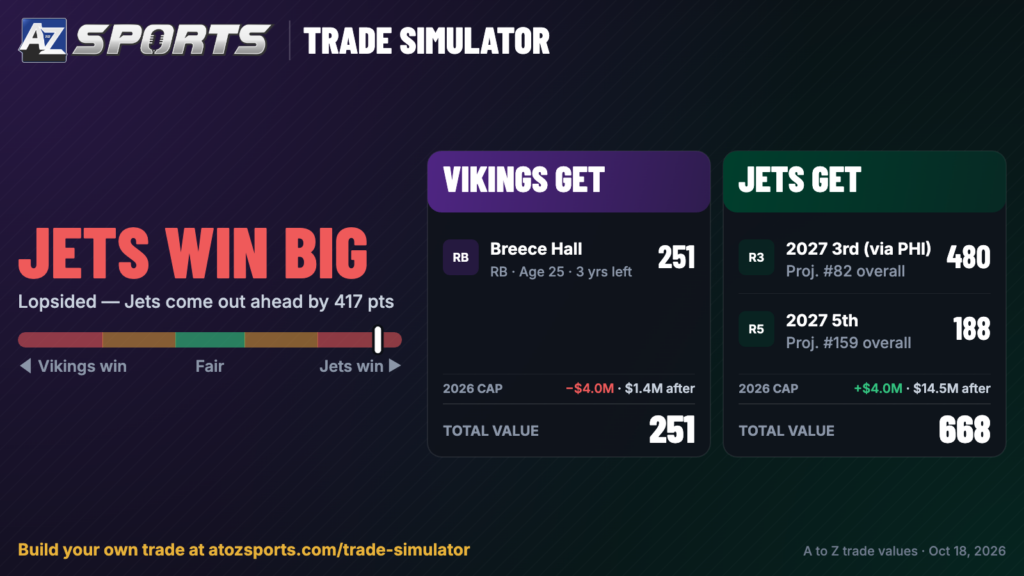
The simulator lists him at 251 points, but running backs hold more value in a traditional football sense than in analytical models. I sent the third and a fifth, which comes in at 417 points. Adjusting for the third-round lost value if Minnesota contends, it’s a 392-point overpay (around the end of the third round). Hall is only 25 and elite when he plays. Durability is the question, though that comes with most running backs.
Trade offer: Vikings send 2027 third (via PHI) and 2027 fifth-round picks
Salary cap hits: Pro-rated vet minimum of $5.16 million in 2026, $13.5 million in 2027
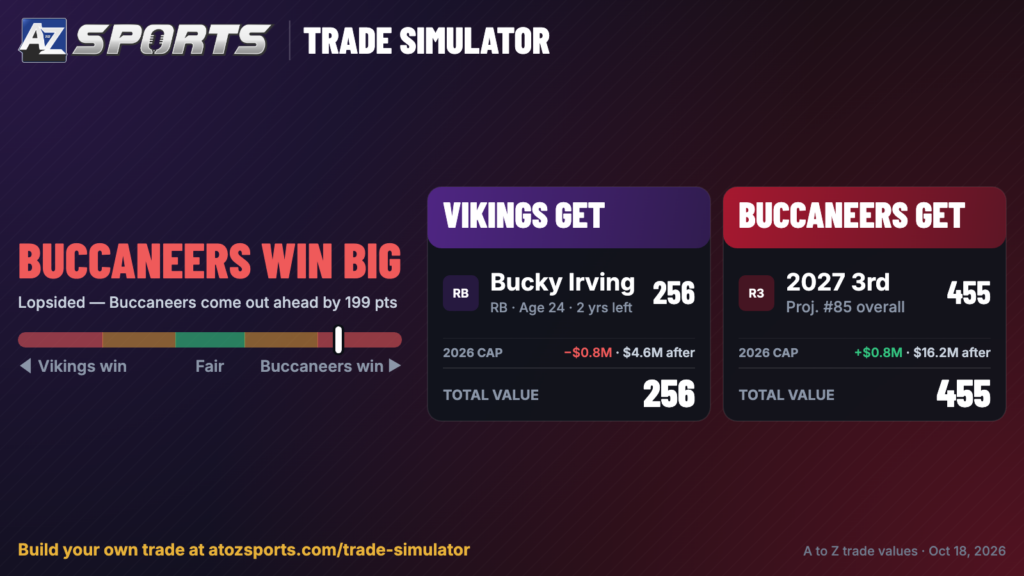
Buccaneers RB Bucky Irving
The Tampa Bay Buccaneers’ Bucky Irving is in his third year out of Oregon with one more year of team control after this season. He doesn’t have elite athleticism, but his vision, savvy, and ability to make tacklers miss are valuable.
A fifth- and sixth-round pick still gives the Bucs good surplus value, but Irving might take more. Tampa Bay lost to the Pittsburgh Steelers 26-19, and a losing stretch could change its thinking. Sending the Vikings’ third would be huge value for a former fourth-round pick. I’m not sold the Bucs would bite with that much team control remaining, but I’m intrigued by what Irving could do in both zone and gap concepts.
Trade offer: Vikings send 2027 third round pick
Salary cap hits: Pro-rated rookie minimum of $1.075 million in 2026, $1.19 million in 2027
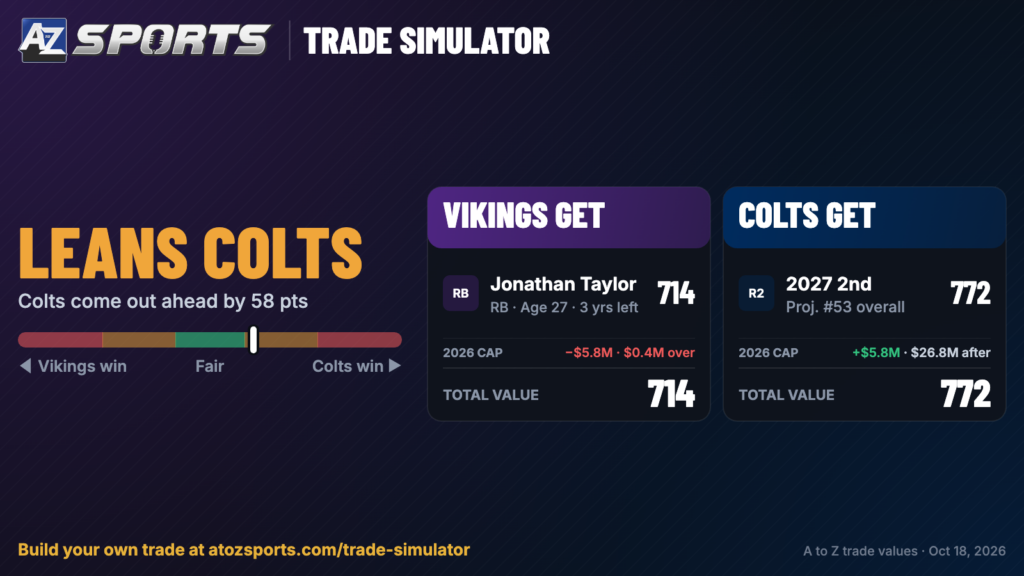
Colts RB Jonathan Taylor
The most intriguing option might be the Indianapolis Colts’ Jonathan Taylor. In my view, both the general manager and head coach are on the hot seat, so I don’t know if Indianapolis would entertain it, but they did just lose to the Tennessee Titans, and they are set to come to Minnesota next week. Even so, the 27-year-old’s extension is movable. The Colts would carry $10 million in dead money next year, but Taylor’s $6.98 million base salary and $1.02 million in per-game roster bonuses would prorate to Minnesota. With a $16.187 million cap hit, that’s roughly $8 million in savings this year.
Taylor has no more guaranteed money left on his deal. Next year is a $15 million base salary plus $1.02 million in per-game roster bonuses, and his final year is $9.46 million with a $7.5 million roster bonus, as well as the $1.02 million in per-game roster bonuses. If he falls off, Minnesota isn’t stuck with an albatross contract.
His main areas of success comes in gap concepts like duo and counter, both at Wisconsin and with the Colts. Those have been the Vikings’ best concepts so far this year. The simulator puts him at a second-round pick, and I would seriously consider it. Taylor was a high school track star and three-star recruit out of New Jersey before logging over 900 carries for the Badgers. He has also become a better receiver.
A home run threat on the ground opens things up for Justin Jefferson and Jordan Addison. It won’t fix everything, but it would make a big difference.
Running back may not end up as the priority, but it should be a serious consideration. Imagine this ball-control offense with Kyler Murray at the helm and Jefferson and Addison finally healthy together. It would be fun to watch
Trade offer: Vikings send 2027 second-round pick
Salary cap hits: Pro-rated $8 million in 2026, $16.02 million in 2027