
Kyler Murray’s growth with Minnesota Vikings was predictable, and his struggles early make a lot more sense
Things were a struggle early on with Kyler Murray and the Minnesota Vikings, but it makes sense why they have rebounded.


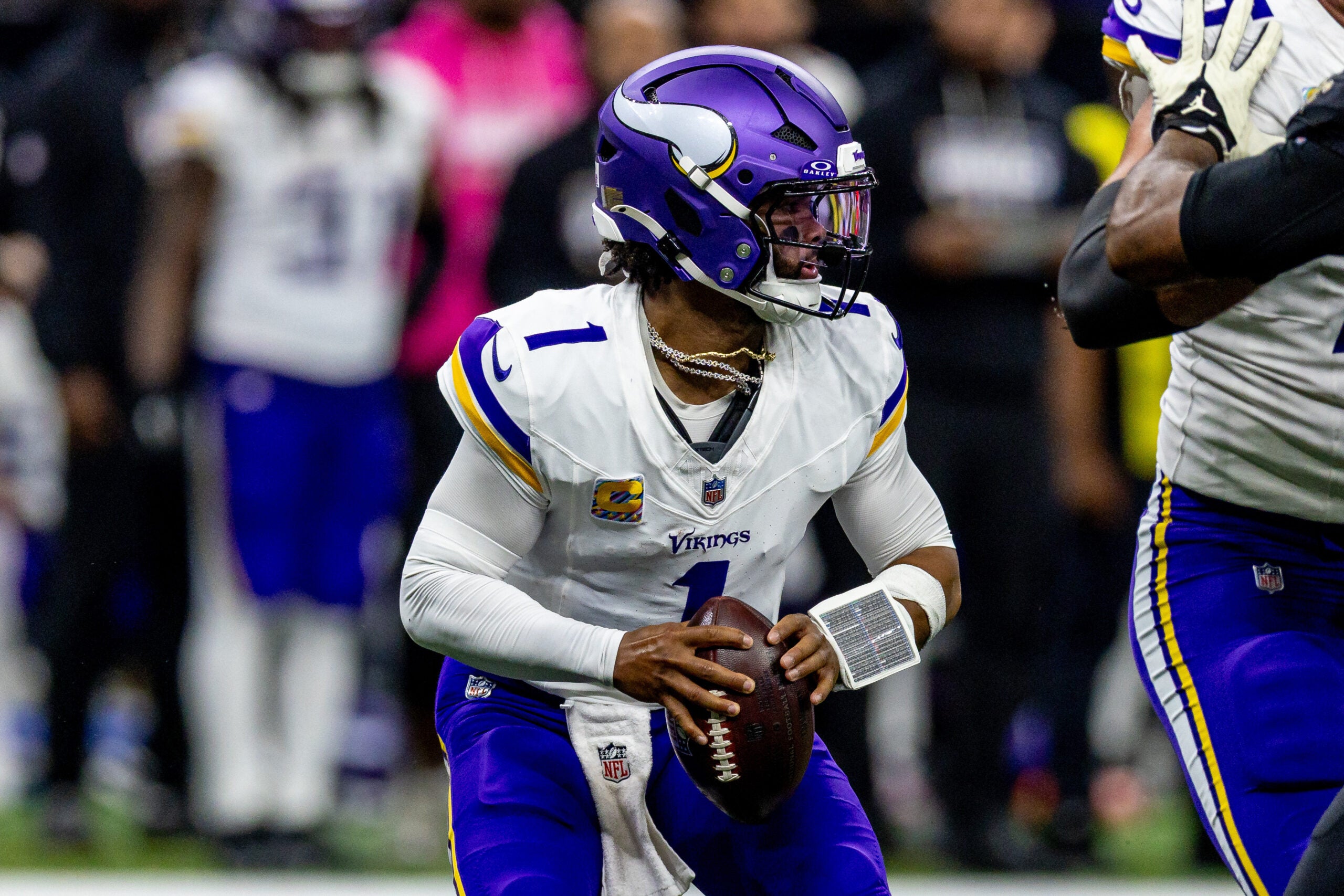
We are three full starts into the Kyler Murray era, the Minnesota Vikings hit their bye week with an offense trending in the right direction. The results haven’t been perfect, and nobody should pretend otherwise. However, the growth from game to game has been clear, and it matches a pattern Vikings fans have seen many times before.
I’ve been more optimistic about Murray than a lot of people, and history is the reason. Minnesota has a long track record of bringing in veteran quarterbacks who have spent years elsewhere and making them the starter. Randall Cunningham, Jeff George, Warren Moon, Donovan McNabb, and Brett Favre all fit that mold with varying levels of success. Sometimes it clicks right away, like it did with Sam Bradford in 2016. Other times it takes a few games.
Brett Favre is the perfect parallel for Kyler Murray
Favre’s 2009 season is the best example of why staying patient matters. That year was largely the Adrian Peterson show, and understandably so. Peterson was in his third season and playing at an incredible level. In the opener against the Cleveland Browns, Favre completed 14 of 26 passes for 110 yards and a touchdown. Nothing to write home about, and neither was his second start.
Favre had played in a West Coast offense for almost his entire career. Even so, there is a difference between knowing the West Coast system and knowing Brad Childress’ version of it. Think of it like knowing Latin and then trying to learn Italian. The base is there, but the intricacies still take time. By Week 3, the Greg Lewis catch happened, and the rest is history.
Murray’s situation looks similar. After his first full start against the Tampa Bay Buccaneers, people wanted him benched for Carson Wentz. Murray completed 15 of 29 passes for 168 yards, and the results weren’t great. The bigger issue was play calling and a lack of answers for what Buccaneers coach Todd Bowles threw at Minnesota. Bowles has his flaws, but he can scheme up a defense, and he got the better of Vikings coach Kevin O’Connell that day.
The frustration centered on Murray being an eight-year veteran who should have looked better right away. That’s not how this works. J.J. McCarthy got roughly six games of grace before people questioned whether he was the guy. Murray deserves at least some of that patience, because there is a real adaptation period between a quarterback and a play caller. Kevin O’Connell is learning what Murray likes, Murray is learning how O’Connell calls a game, and merging those two takes time.
Finding balance against Miami and New Orleans
The Tampa Bay game had an average depth of target of 10.2 yards, and the offense spent a lot of time behind the sticks because of penalties. Murray still hit Jordan Addison on two passes of 20-plus yards, including a touchdown on a go route. He also connected with Justin Jefferson on a 22-yard dagger concept on the first play of the game. The problem was leaning too heavily on O’Connell staples instead of working underneath to draw the linebackers up and open the in-breaking routes.
Against the Dolphins, the balance improved. The Vikings still ran in-breakers, but they also leaned on the tight ends. T.J. Hockenson caught all 13 of his targets for 119 yards and what amounted to a touchdown before replay ruled him down short of the goal line. Murray posted 0.588 EPA per play in the fourth quarter, which ranked fourth in the league that week.
The Saints game showed that fourth-quarter version over a full four quarters. Murray completed 24 of 30 passes for 229 yards and a touchdown, along with 10 carries for 51 yards. His value isn’t as a designed runner. It’s as a scrambler who can create outside of structure, attack the edges, and break contain.
One play stood out. Minnesota ran the same in-breaker to Jefferson that Murray hit Addison on against Miami, complete with the veer-style play-action shuffle. This time, the coverage had it beat. Murray stutter-stepped to his right, pointed Jefferson back outside, and completed it for a gain of 15-plus yards. Sam Darnold created some of those moments by looping around in the backfield. Murray is far more controlled, and that should pay dividends for the Vikings in the short and long term.
What comes next for Minnesota’s offense
Jefferson, Addison, and Murray have shared the field for just 18 snaps. Against the Saints, the Vikings were down four offensive starters, including two of their top pass catchers. This offense hasn’t come close to its full potential.
That raises the biggest question of the bye week. Does Minnesota keep throwing short, or does it go back to pushing the ball downfield? Against New Orleans, TruMedia shows what Murray looks like with a time to throw higher and lower than 2.5 seconds.
Will the approach revert back to O’Connell’s tendency to chase shot plays. My guess is that it will be game-plan specific. Against heavy two-high looks, throwing in front of the safeties makes sense. Against single-high defenses like New Orleans’ Cover 3, sending one receiver at the post safety and throwing behind him is the goal, which was much harder to do without Addison.
There are fair questions about whether Murray is the long-term answer, and three games isn’t enough to decide that in either direction. Still, the offense has improved after each of his three starts, and that is a strong sign heading out of the bye.

