
Cam Ward Week 7 film breakdown reveals some of his best work mixed in with the glaring flaws that still threaten his Titans future
I went through Cam Ward’s Week 7 tape play by play with Drew Beatty of @IronCityFilm, and what we found was far messier than a single grade could capture.


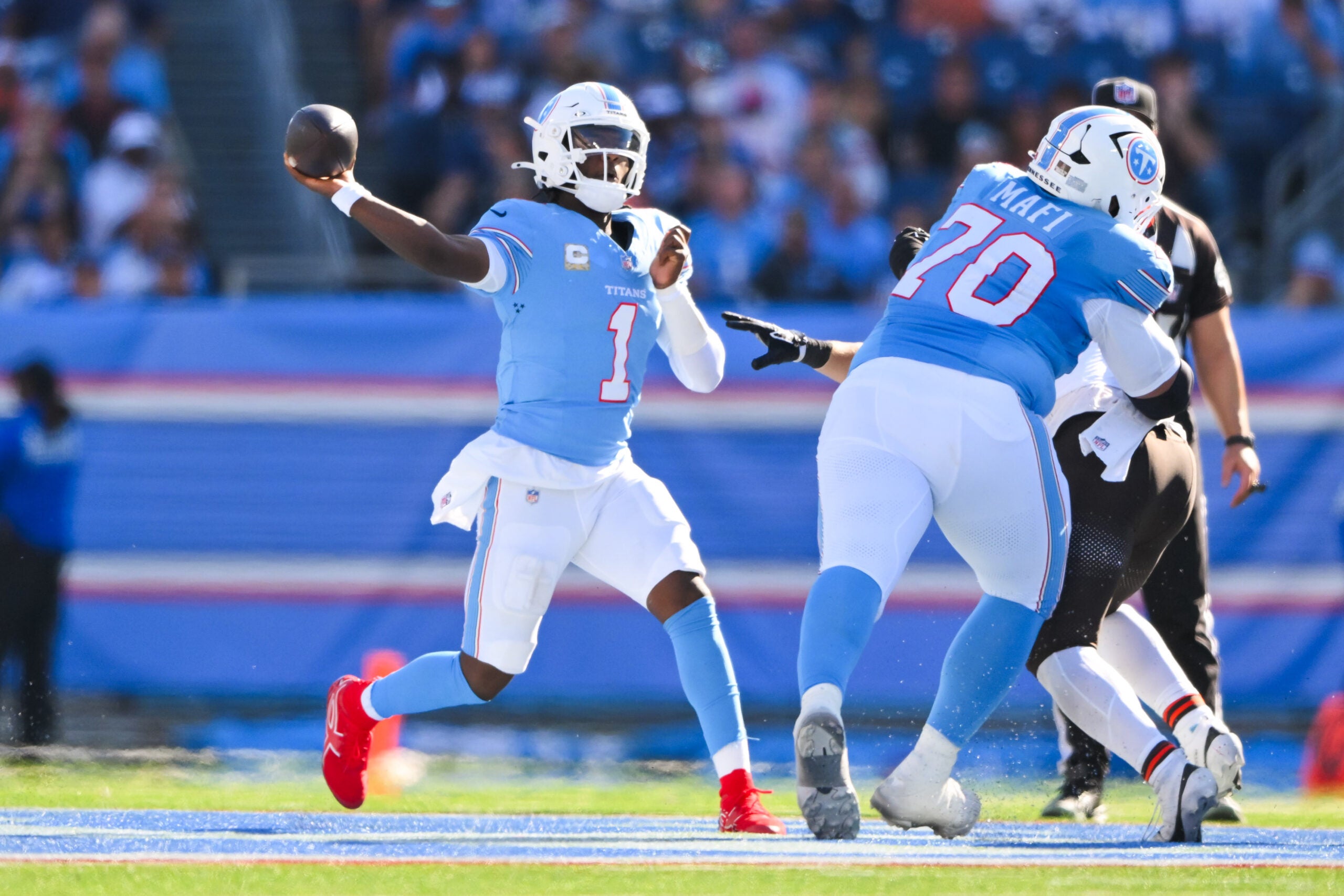
The Tennessee Titans’ Week 7 loss to the Cleveland Browns produced some of the most unique Cam Ward tape I’ve studied this season. In some ways, it was the second-year quarterback’s best game of 2026. It was also a painful demonstration of the gaping wounds in his game right now. His play in a couple of key areas is currently so poor that if it doesn’t change dramatically by the end of the season, he just cannot be the franchise quarterback going forward.
He has 10 games to fix these things. That’s a long uphill climb, but it’s doable.
This week felt like the right time to dig into the All-22 with my friend Drew Beatty, who runs @IronCityFilm on Twitter and writes a weekly tape breakdown at PaulKuharsky.com. Drew had already gone through Ward’s tape Monday morning, and his initial reaction lined up more or less with mine: watching live, it felt like the same story as recent weeks. On film, there was a bit more to like.
“You have to judge Cam like a gunslinger, right?” Drew said. “There’s gonna be bad plays, but what made last season so special to me, I think so promising going forward, is that for every bad play, there were two great ones. And that’s what’s been missing so far for me this season.”
He added a warning that frames everything we’ll discuss below: “What worries me so much is even in what I would call, weirdly enough, his best game of the season so far, I still think he looks like a shell of his rookie self.”
We went through the tape chronologically. Here’s every play we discussed, with the clips included.
A smart Brian Daboll plan and an early third-down miss
This opening throw set the tone for what Tennessee wanted to do all afternoon. Ward hit rookie wide receiver Carnell Tate on a quick in-breaker, and Tate laid out at full extension to finish the catch. Quick, one-read, in-breaking throws were the bread and butter of this game plan, and most of them worked.
Then came a third-down miss to Wan’Dale Robinson so bad that, in my opinion, it falls outside the Overton Window of reasonable inaccuracy for an NFL starter. Ward released the ball as Robinson broke near the line to gain, and it landed at his feet roughly a yard and a half past the sticks. My theory is that Ward expected Robinson to break flat on the line to gain, while Robinson ran it two and a half to three yards deep.
Drew wasn’t ready to give Ward a pass, though. “I think Cam has really lost the benefit of the doubt when it comes to the accuracy issues like this, and the footwork is not good on this rep to me,” Drew said. “I think the understepping that he consistently does in his drops, you don’t see a set base, there’s no hitch, it’s rushed.”
He was quick to add that Robinson doesn’t get a free pass either: “Both of these players to me have lost the benefit of the doubt here because I don’t necessarily trust Wan’Dale Robinson a whole lot either right now.”
That’s a fair way to put it. Ward’s footwork and ball placement have regressed, and that makes it hard to assume he had it right. But it’s also Week 7, and the timing and rhythm of the downfield passing game still aren’t in sync. Think back to the deep post to Elic Ayomanor in the Colts game last week. That’s not just a Cam Ward problem. It’s a receiver problem and a coaching problem too, and it’s the kind of thing you expect to be ironing out in September, not late October. This whole passing game is still so clunky.
Next up was a completion to Ayomanor over the middle that some fans didn’t love because of the ball placement. I don’t mind it at all. Ward put it low, where only his receiver could catch it, and Ayomanor could go down without taking an unnecessary shot from the middle-field safety. A common theme of my tape session with Drew: let’s save our frustration for the misses that count.
Another quick in-breaker to Ayomanor showed up a few plays later, and it reflected one of the better game plans Brian Daboll has put together this year. Between the testing of the middle of the field and the mesh concepts, Daboll found vulnerability in Cleveland and kept attacking it. I’m a fan of his plan in this one.
“The Browns defense is one where I think it really says a lot more about your receivers to beat that defense than it does your quarterback,” Drew explained. “Carnell Tate and Elic Ayomanor did an amazing job all day of beating that, that very press man heavy, getting Cam Ward the windows to throw those quick inbreakers.”
The interception that’s somehow more frustrating than you might think
The Browns stopped Tennessee on the half-yard line when the Titans had a chance to go up 21-7. Then rookie linebacker Anthony Hill forced a fumble to hand the ball right back to them on the ensuing drive. With a short field after a momentum-swinging turnover, Daboll saw a green light to take a shot and rip Cleveland’s heart out. Instead, Ward threw an interception.
That makes five straight games with an interception for Ward (one of them came off a Pollard drop that wasn’t his fault). He began the season with a historic streak of dropbacks without a pick, and the broadcast mentioned it right before the turnovers started piling up.
“These are correct decisions,” Drew said. “I think he can be such a good processor at times, but these accuracy issues are just terribly handicapping right now.”
On this rep, Ward made the right read. The deep safety and the intermediate defenders were all drifting the wrong direction, and Ayomanor was the right target on a deep in-breaker.
“He throws this with great anticipation,” Drew said. “Again, this is probably two full clicks before [Ayomanor] is breaking in on this.”
You see an unnecessary hitch, a little hop step that rushed the throw. It’s the same flaw that showed up against Indianapolis. Browns cornerback Denzel Ward also kept his hips open to the middle of the field the entire rep. Even so, if the ball lands on the correct shoulder, it’s a catch. At the very worst, it isn’t an interception.
“You throw this correct decision, correct anticipation, everything about the process is correct, and you just rush the footwork,” Drew said. “There’s an unnecessary hitch in there and you put it on the back shoulder and it ends up in Denzel Ward’s chest.”
Incompetence roulette
With the game tied at 14, Tennessee’s offense tried to grab a score before halftime. Ward missed Tate by a hair on a slot fade, and Drew and I agreed that this one goes in the perfectly fine miss bucket. It’s a tight-window throw where either Tate catches it or nobody does, and even a completion probably lands out of bounds. Fine miss.
The Tate drop that followed was a different story. My standard for Tate’s and Robinson’s hands is extremely high because they set it that high coming into the year. You’re supposed to be able to set your watch to them securing the ball. For Tate, that’s now a couple of key drops plus two fumbles caused by defenders he didn’t see coming from behind.
Tate’s calling card coming out of Ohio State was being a catch-point master, even with questions about his athleticism. My concern level about his hands is low. My annoyance level is rising, however. I’d just like Tate and Robinson to stop selling out their quarterback when Ward has already left himself no margin for error. Watching this game felt like incompetence roulette. Ward would do something baffling, then deliver a strong, on-time throw, only for a reliable target to let him down.
On the next notable rep, Ward ripped a double slant RPO with Denzel Ward bearing down. Drew sees it as part of a pattern, including a ball against the Colts that would’ve been a pick-six if it hadn’t been batted at the line.
“Cam has a bit of a bad habit of just kind of regardless chucking that outside slant on double slant here,” Drew said. “I think you have to understand what corner is out there and sometimes just kind of cut your loss, especially on an RPO of all things. Probably just an unnecessary risk I don’t want them taking.”
Then came the most painful clip of the day. Robinson motioned pre-snap, giving Ward the man-coverage key, and Ward delivered a crosser on time against Cover 1. It’s the prettiest throw of Ward’s day.
“The mechanics and the lower half mechanics, the footwork, everything is so clean and polished here,” Drew said. “That’s the thing I always talk about with mechanics, is can it look the same every drop back? And this is what it should look like every drop back. The hitches are clean. There’s nothing unnecessary. He doesn’t understep and he gets the ball there on target.”
Robinson had to lay out for it and couldn’t come down with it.
“Wan’Dale Robinson is [5-foot-8] and he has 27-inch arms,” Drew said. “That is a historic lack of length for an NFL receiver. And any normal receiver does not have to lay out for this. Correct decision, correct read, correct timing. Beautiful touch and layering to get it there. And that’s your receiver you’re paying $70 million that can’t come down with a perfect pass.”
That’s twice now. Two weeks ago, Kylen Granson couldn’t finish a similar opportunity on the double-corner concept. You’d expect a little more from the $70 million receiver than from a backup tight end. Please catch these.
A few plays later, Ward hit another mirrored double slant for a first down, and Tate fumbled it away. Again, Ward did his job and someone else didn’t. They had a frustrating stew cooking in this game.
Pocket problems and a fourth-quarter roller coaster
Batted balls are another new problem. Ward had three last week, and another this week. Ward’s arm-slot flexibility has always been a trademark, but it gets him into trouble with these.
Then came the most Cam Ward rep of the day: the “oh no, oh no, what’s he doing” magician act that ended in a four-yard gain on third-and-14.
Drew put more of this one on the call. “I just hate deep curls on third-and-14 against what the Browns have been running here,” Drew said. “I don’t think you’re setting up your quarterback for success on this one.”
Tight end Gunnar Helm had a proof-of-life moment late in this game, hauling in an 11-yard first down that marked some real involvement in the passing game (finally).
This next one is where Drew and I butted heads a bit. Ward put the ball in both of Helm’s hands for what should have been an explosive play, and Helm dropped it. Drew agrees that it’s a drop, but he hated the process leading up to the throw.
“This hit him square in the hands firmly, a catchable ball. It should be charted as a drop on Gunnar Helm,” Drew said. “But this is also the pocket PTSD coming back to haunt Cam Ward.”
Dan Moore got pushed a bit deep, but there is room for Ward to step up and reset. Tate was also streaking downfield on a post. That may have been a clear-out route that was never part of the progression. But if it wasn’t…
“I have a hard time believing for a guy that’s as aggressive at times downfield as Cam Ward is, if he steps up and resets his base there, that you don’t see Carnell Tate streaking downfield,” Drew said.
Now for the miss that I thought had ended the game. Tennessee was driving for a touchdown with 2:37 left on third-and-8. Ward had Daniel Bellinger wide open up the middle and airmailed it. Once again, the footwork was rushed. As Drew put it, Ward is “consistent in his inconsistencies almost because it’s never the same footwork issue.”
Cleveland’s defense was trying hard to give this game away, too. Bellinger was open for a potential house call, and Ayomanor was crossing underneath with room to run. Both options were there, and Ward has to make that play.
…then he totally redeemed himself on fourth-and-8! Ayomanor and Tate both came open downfield, and Tate probably scores if Ward picks him. I won’t fault Ward for taking the open man to extend the drive, especially because he took a hit to deliver it.
“One of my biggest kind of complaints with him coming out in the draft process is I thought he was really unwilling to sit in and take some of those shots to rip balls over the middle of the field,” Drew said. “And full credit to Cam Ward here. He took a shot on this one to get it out on a play that had to happen.”
Ward followed it up with a back-shoulder fade to Tate that got Tennessee inside the 5. It was maybe his third-best throw of the day, and Tate’s body control reminded everyone why he went fourth overall.
“You put that exactly where it needs to be on a back shoulder fade,” Drew said. “But if you look up in the receiver textbook on how to play a back shoulder fade, this play pops up.”
Where Cam Ward goes from here
Ward’s Week 7 tape had more positive flashes than anything we’ve seen from him this season, and I still don’t know that the good outweighs the bad. He has 10 games to stack some performances, and barring injury, I don’t see a world where he isn’t Tennessee’s starter the rest of the way. But if the Titans want to avoid bringing in someone to compete with him in 2027, Ward has a lot of work to do.
Drew set the bar even higher. Even with this being Ward’s best game of his sophomore season, Drew doesn’t think it would crack his top 10 performances as a rookie.
“And if you don’t see him at least get back to that baseline, but ideally surpass that baseline level of tape on a consistent basis, you’re gonna be having some difficult conversations about the future,” Drew said.
You can follow Drew on Twitter @IronCityFilm, and check out his weekly tape column at PaulKuharsky.com on Wednesdays.
