
Catholics vs. Convicts: The history behind Notre Dame-Miami and why the 2026 showdown could be a defining moment for Marcus Freeman
Notre Dame and Miami will restore their historic rivalry on Saturday in South Bend. There is a lot on the line for head coach Marcus Freeman.


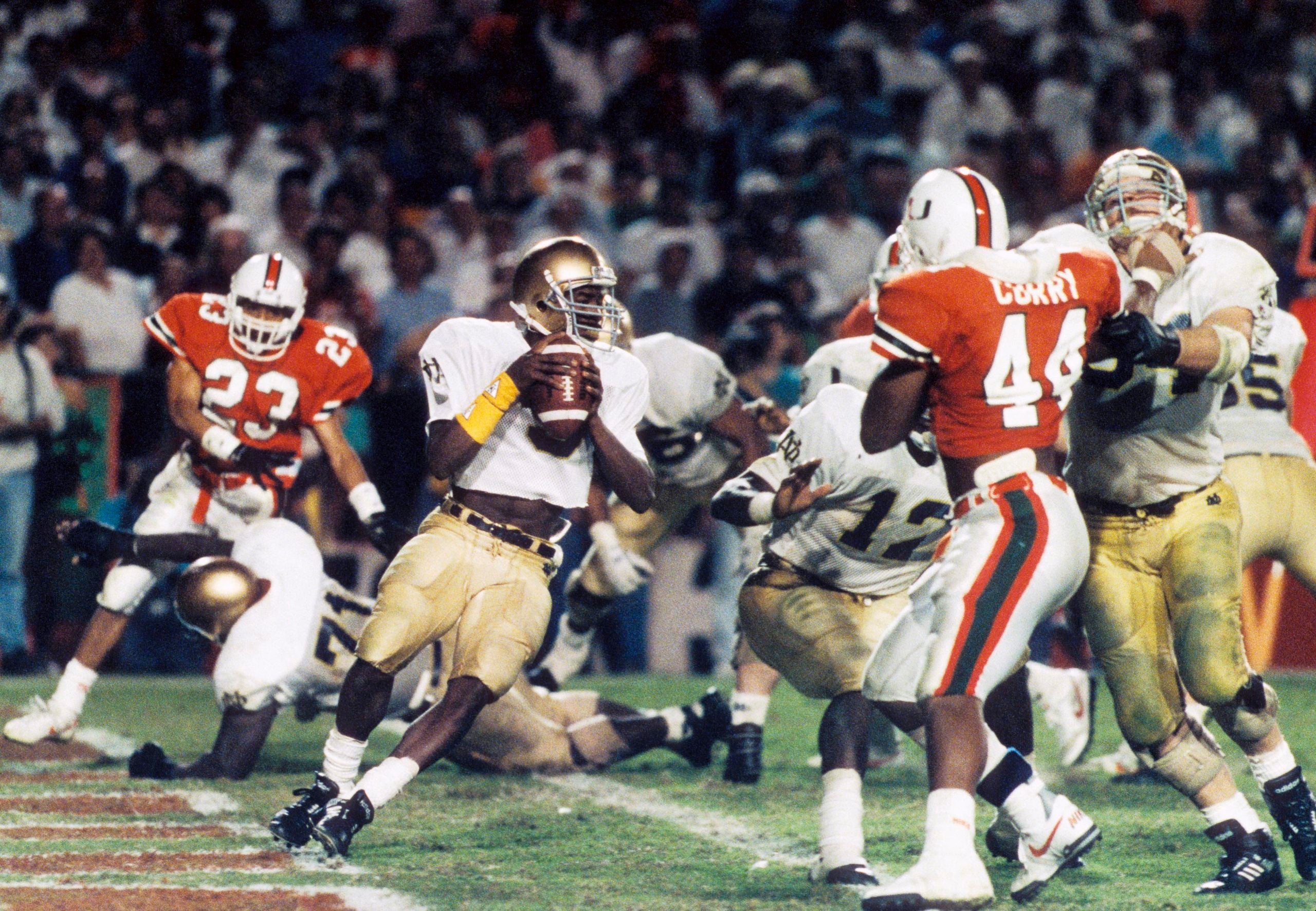
For decades, the two programs have represented different identities within college football. Notre Dame, with its storied tradition, national following and connection to its Catholic roots, has long been one of the sport’s most recognizable institutions. Miami, meanwhile, built its reputation as one of college football’s toughest, most intimidating, and unapologetic programs.
When those two identities collided in the 1980s, the result was one of the most memorable rivalries the sport has ever seen.
It eventually became known as Catholics vs. Convicts, a phrase that remains synonymous with Notre Dame-Miami football more than three decades later.
But this rivalry is about much more than a famous T-shirt, a pregame fight or a memorable 31-30 finish in South Bend. It is about two programs that repeatedly stood in each other’s way of winning national championships.
And now, after another heartbreaking Miami victory last season, the Hurricanes are returning to Notre Dame Stadium for a November 7 showdown that could have enormous implications for head coach Marcus Freeman and the Fighting Irish.
For Notre Dame, this is an opportunity to settle an old score, establish itself as a legitimate national championship contender, and potentially put itself in a much stronger position heading into the final stretch of the 2026 season.
It is also an opportunity to remind Miami that Notre Dame Stadium is a very different place than Hard Rock Stadium.
How the Notre Dame-Miami rivalry began
The history between Notre Dame and Miami dates back to 1955, when the Fighting Irish traveled to Florida and came away with a 14-0 victory.
The programs met several more times throughout the 1960s before beginning a much more consistent series in 1971.
For much of that decade, Notre Dame owned the matchup.
The Fighting Irish won 10 consecutive meetings between 1971 and 1980, establishing themselves as the superior program during the early years of the series. One particularly interesting chapter came in 1979, when the teams met in the Mirage Bowl in Tokyo, Japan. Notre Dame won 40-15, with Irish captain Dave Waymer returning two interceptions for touchdowns.
Miami eventually started to turn things around, but the rivalry didn’t reach its national prominence until the Hurricanes emerged as one of college football’s elite programs during the 1980s.
Miami won its first national championship in 1983 under head coach Howard Schnellenberger. The Hurricanes were building a different type of football culture, one that embraced an aggressive personality and wasn’t particularly interested in fitting the traditional image of a college football powerhouse.
Under Jimmy Johnson, Miami became even more dominant.
The Hurricanes were talented, confident, and unapologetic. They recruited nationally, played with an edge, and quickly developed a reputation as a program that wasn’t afraid of anybody.
Notre Dame was going through a transition of its own.
After the disappointing end of the Gerry Faust era, the Fighting Irish hired Lou Holtz in 1986. Holtz was tasked with restoring Notre Dame to the national championship conversation, and it didn’t take long for him to get the program moving in the right direction.
Unfortunately for Holtz, one of his biggest obstacles was Miami.
The rivalry reaches its boiling point
The animosity between these programs reached another level in November 1985.
Miami absolutely demolished Notre Dame, winning 58-7 in the season finale. It remains the Hurricanes’ largest victory over the Fighting Irish and was the final game of Faust’s tenure in South Bend.
Two years later, the programs met again in Miami. The Hurricanes entered the game ranked No. 2 nationally, while Notre Dame was ranked No. 10.
The result was another difficult afternoon for the Irish.
Miami shut out Notre Dame 24-0 on November 28, 1987, on its way to another national championship.
By that point, there was plenty of resentment between the programs. Notre Dame was trying to reclaim its place among college football’s elite, while Miami had become the standard that other programs were chasing.
The next meeting would become one of the most famous games in college football history.
Catholics vs. Convicts: The 1988 game that changed everything
On October 15, 1988, No. 1 Miami traveled to South Bend to face No. 4 Notre Dame.
Both teams entered undefeated, and the matchup carried enormous national championship implications.
The Hurricanes were riding a 36-game regular-season winning streak and were considered one of the most dominant teams in the country. Notre Dame, meanwhile, was beginning to look like a legitimate national championship contender under Holtz.
There was already plenty of tension leading into the game.
That tension became even more visible when Notre Dame students began wearing shirts featuring the phrase “Catholics vs. Convicts.”
The slogan was created and distributed by Notre Dame students Pat Walsh and Joe Fredrick. It was a provocative play on the contrasting reputations of the two programs, including legal troubles involving Miami players in the months leading up to the game.
The phrase quickly caught on.
It was picked up by the national media and became the defining identity of the matchup. It also carried racial and cultural stereotypes that unfairly reduced Miami’s players to a caricature. The history of the rivalry deserves to be remembered alongside that context rather than treating the slogan as an accurate description of either team.
The actual football game lived up to the buildup.
Before kickoff, players from the two teams were involved in a confrontation in the tunnel. The pregame altercation became another lasting part of the rivalry’s history and contributed to changes in how opposing teams enter Notre Dame Stadium.
Once the game started, neither team backed down.
Miami and Notre Dame traded blows throughout the afternoon in a contest that featured tremendous offensive plays, defensive stops, and several costly turnovers.
The Hurricanes appeared to be in position to extend their winning streak, but Notre Dame refused to go away.
The Fighting Irish eventually secured a 31-30 victory, with Miami’s final attempt at a two-point conversion ending when Notre Dame safety Pat Terrell knocked away the pass.
It was one of the biggest victories of Holtz’s tenure.
More importantly, it helped propel Notre Dame toward an undefeated season and the 1988 national championship.
For Miami, it was a devastating defeat. For Notre Dame, it was a defining moment.
The game became so famous that ESPN eventually produced a 30 for 30 documentary titled Catholics vs. Convicts, further cementing the matchup’s place in college football history.
Miami gets revenge, and Notre Dame answers
The rivalry didn’t end with Notre Dame’s victory in 1988. The teams met again in November 1989, with Miami getting its revenge in a 27-10 victory.
The Hurricanes went on to win the national championship that season, adding another chapter to the back-and-forth relationship between the programs.
Notre Dame got the last laugh in their next meeting.
In October 1990, the No. 6 Fighting Irish defeated No. 2 Miami 29-20 in South Bend. It was another significant victory for Holtz and another reminder that neither program was going to consistently dominate the other.
The rivalry eventually lost some of its regular-season frequency, with the programs going nearly two decades without meeting.
However, the history never really went away.
The rivalry returns in the modern era
Notre Dame and Miami finally reunited on the football field in the 2010 Sun Bowl. The Fighting Irish won 33-17, beginning a stretch of three consecutive victories over the Hurricanes.
Notre Dame also defeated Miami 41-3 in 2012, although that victory was later vacated because of NCAA eligibility violations. The Irish followed that up with a 30-27 victory at Notre Dame Stadium in 2016.
Then came 2017.
Notre Dame entered its November matchup against Miami ranked No. 3 nationally. The Fighting Irish were legitimate College Football Playoff contenders, and the game presented an opportunity to take another major step toward the postseason.
Instead, Miami delivered one of the most memorable performances in its modern history.
The Hurricanes won 41-8, forcing four Notre Dame turnovers and turning the game into a nightmare for Brian Kelly’s team.
Miami’s turnover chain became one of the defining images of that season, and the Hurricanes celebrated the victory like a program that had reclaimed its place among college football’s elite.
For Notre Dame, it was a crushing setback. The Irish never recovered enough to reach the playoff that season. The teams wouldn’t meet again until 2025.
Miami breaks Notre Dame’s heart in 2025
The most recent chapter in this rivalry came on August 31, 2025, when Notre Dame traveled to Miami Gardens for a season-opening matchup.
Both programs entered the season with national championship aspirations.
Notre Dame was ranked No. 6, while Miami was ranked No. 10. The game was expected to provide an early measuring stick for two teams with legitimate College Football Playoff ambitions.
It certainly delivered.
The Hurricanes came away with a 27-24 victory in a game that went down to the final minutes. Notre Dame quarterback CJ Carr accounted for three touchdowns, including a seven-yard rushing score that tied the game at 24 with 3:21 remaining.
It appeared the Irish might escape with a difficult road victory. Instead, Miami responded.
The Hurricanes put together a 10-play, 46-yard drive before Carter Davis connected on a 47-yard field goal with just over a minute remaining.
Notre Dame had one final opportunity, but Miami’s defense came through with sacks on the final two plays to secure the victory.
It was a frustrating result for Freeman and the Irish.
Notre Dame had battled back from an early deficit, demonstrated the ability to compete with a talented Miami team, and put itself in position to win. But the final few minutes belonged to the Hurricanes.
The loss ultimately became a significant part of Notre Dame’s 2025 College Football Playoff story.
Miami secured a place in the playoff field, while Notre Dame was left on the outside looking in. The season-opening defeat was not the only factor in the committee’s decision, but it was another major result working against the Irish when postseason selections were made.
For a program that entered the season with national championship expectations, it was a difficult way to start. And now Notre Dame gets another opportunity.
Why the 2026 matchup is so important for Marcus Freeman
Saturday, November 7, brings another opportunity for Notre Dame to change the narrative surrounding this rivalry.
This time, Miami is coming to South Bend.
The Hurricanes enter the matchup undefeated at 8-0 and are ranked No. 1 nationally. Notre Dame enters at 7-1 after recovering from its loss to BYU with a 35-13 victory over Navy.
There is plenty at stake for both programs, but the pressure is particularly significant for Freeman and the Fighting Irish.
Notre Dame has already experienced what can happen when a marquee matchup doesn’t go its way. The loss to BYU, 28-24, put another blemish on an otherwise impressive season and created questions about how the Irish would be viewed by the College Football Playoff selection committee.
Now they have an opportunity to answer those questions against the best team on their schedule. And they won’t have to leave home to do it.
1. Notre Dame needs a signature victory.
There is a difference between putting together a good regular season and building a resume that demands respect from the College Football Playoff selection committee.
Notre Dame has shown it can handle business against several opponents, but the BYU loss created some uncertainty.
Beating an undefeated, top-ranked Miami team would immediately change the conversation.
It would give the Irish one of the best victories in the country, provide an opportunity to move up the national rankings, and establish that Freeman’s team can compete with the very best.
It would also be a response to last year’s disappointing result.
2. The College Football Playoff picture could change dramatically.
The 2026 College Football Playoff features 12 teams, and Notre Dame’s independent status means it doesn’t have a conference championship game to fall back on.
Its path to the postseason is largely dependent on its overall resume and where the selection committee ultimately ranks the program.
As of November 1, both programs are in excellent positions entering November. Miami is undefeated, while Notre Dame has one loss.
A Notre Dame victory would provide an enormous boost to its playoff positioning. A second loss, particularly against a direct competitor for a national championship, would make the remaining schedule considerably more important.
The Irish don’t necessarily have to win to remain in the playoff conversation, but there is no question that beating Miami would make their path much more comfortable.
3. Freeman has an opportunity to make a statement about his program.
Freeman has made significant progress in establishing Notre Dame as a national championship contender.
The Fighting Irish reached the national championship game following the 2024 season, demonstrating that the program could compete for the sport’s biggest prize under his leadership.
But expectations have changed.
Notre Dame isn’t simply trying to get back into the playoff conversation. The expectation is to compete for championships.
Games against teams like Miami are opportunities to demonstrate that the program has reached that level.
Freeman has already experienced the disappointment of losing to the Hurricanes. Getting another opportunity at home, with the postseason picture beginning to take shape, makes this an especially important moment in his tenure.
4. The Irish have to protect their home field.
There is something different about Miami coming to Notre Dame Stadium.
The Hurricanes have enjoyed plenty of success against the Irish in South Florida, including the 2017 blowout and last year’s narrow victory.
But Notre Dame has historically been much more successful against Miami at home.
The Irish won the famous 1988 matchup in South Bend and also defeated the Hurricanes in their most recent visit to campus in 2016.
This is an opportunity to use that environment to their advantage.
With the national spotlight turning to South Bend, the atmosphere should be among the best Notre Dame Stadium has experienced this season.
Notre Dame-Miami is bigger than a rivalry game
There is a reason the phrase Catholics vs. Convicts has remained part of college football’s vocabulary for nearly four decades.
It represents an era when two of the sport’s biggest programs were consistently fighting for the same prize. It represents the personalities of Holtz and Johnson, the tension between the fan bases, and some of the most memorable games in Notre Dame history.
But the 2026 matchup has an opportunity to become something more than a nostalgic trip back to 1988.
The circumstances are remarkably familiar.
Miami is once again undefeated and sitting at the top of the national rankings. Notre Dame is once again trying to prove it belongs among the country’s best teams. And, just like the famous meeting between Holtz and Johnson, the outcome could have a major impact on the national championship race.
The difference is that Freeman has the opportunity to write his own chapter in this rivalry.
Notre Dame cannot change what happened in Miami last season. It cannot erase the BYU loss or assume that its history will automatically give it an advantage against the Hurricanes.
It has to earn the result.
That starts with finding a way to slow down one of the country’s most dangerous offenses, protecting the football and taking advantage of the opportunities that come with playing at home.
A victory would be enormous for Notre Dame’s College Football Playoff hopes. It would also give Freeman another signature win and provide the program with the type of momentum that can carry into the final weeks of the regular season.
For Miami, it is an opportunity to deliver another significant blow to a traditional rival.
For Notre Dame, it is about much more than revenge.
The Fighting Irish have spent decades trying to reclaim their place at the top of college football. Freeman has already shown that he can get them there.
Now comes another opportunity to prove it. Catholics vs. Convicts is back. And this time, the stakes could be just as high as they were in 1988.
