
Derrick Henry has trade interest from the Patriots and Giants but one deadline suitor has the stronger case
The Patriots and Giants are interested in trading for Derrick Henry, according to A to Z Sports sources. Both offer a familiar coach, but New England has the stronger football case.

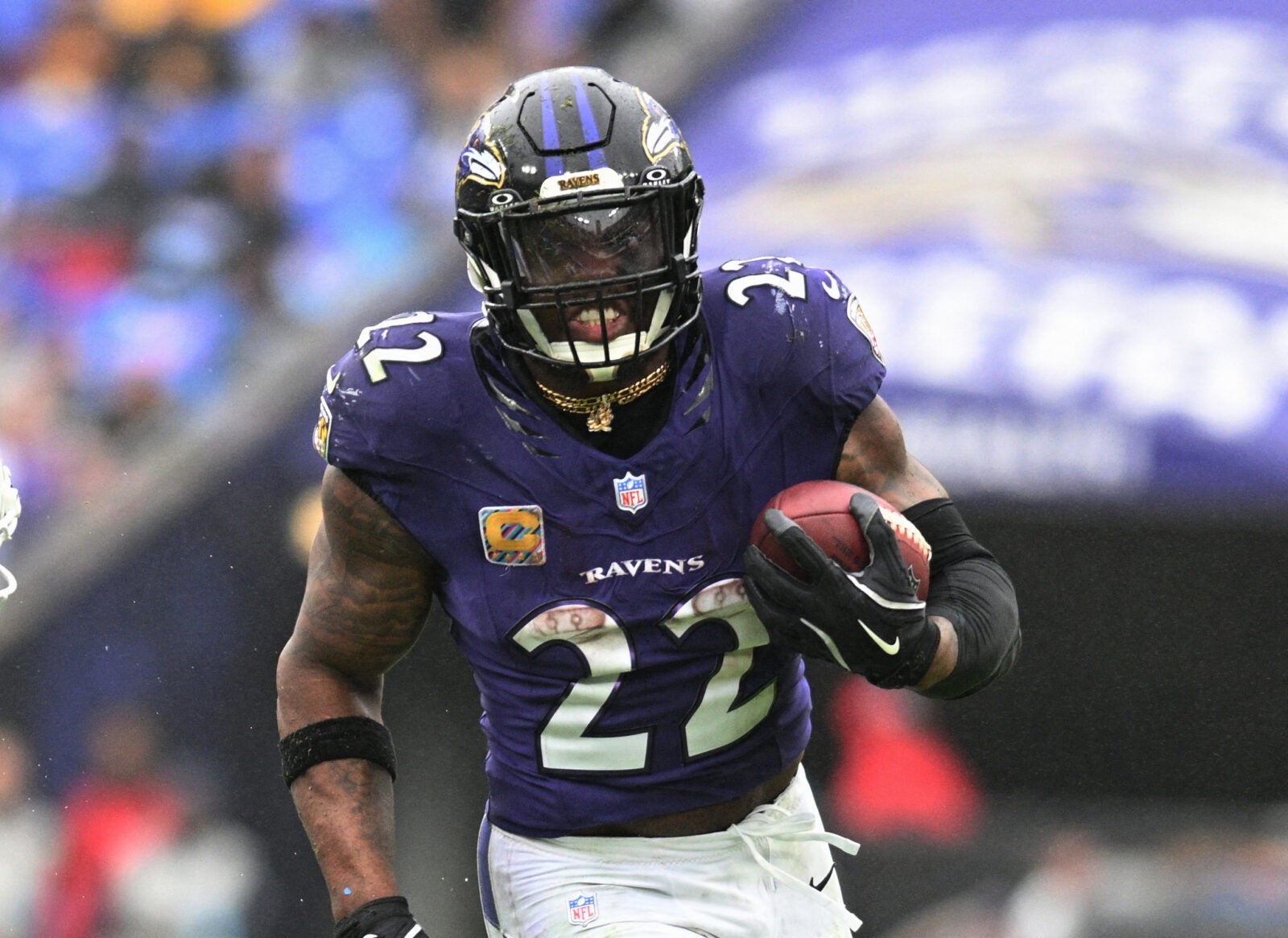
The clock is ticking on Derrick Henry’s time with the Baltimore Ravens. With the NFL trade deadline closing in, Baltimore faces a real decision on its 32-year-old running back. The two teams have surfaced as potential trade partners, according to A to Z Sports sources, and both have familiar connections: the New England Patriots and the New York Giants, coached by two of Henry’s former head coaches in Mike Vrabel and John Harbaugh.
We’re not saying Henry’s run in Baltimore is a foregone conclusion. But it’s expected that the Ravens playoff chances are trending in the wrong direction. Add Henry’s age and the suddenly uncertain long-term picture around Lamar Jackson, more new quarterbacks, and you can feel the end approaching, whether it’s now or after the season.
Why the Ravens have to think about moving Derrick Henry now
Easton Freeze: To be clear, this is not about the dreaded running back cliff where a guy wakes up washed. We’ve been talking about that cliff with Henry for, what, four years now? He has yet to find the edge of it.
The cliff I’m talking about is the cliff of perceived value. If Baltimore ever wants to move off Henry and get something meaningful in return, that window is shrinking fast. He turns 33 in January, and every week that passes makes it harder for a front office to justify paying a premium for him.
His contract also makes him an easy add for a buyer: his base salary this year is only $1.25 million because the other $9.7 million this year in cash came in bonuses, so an acquiring team would owe him roughly $600,000 the rest of the way, with an unguaranteed $12 million on the books next year. That’s an incredibly team-friendly deal for a contender. You get Henry for almost nothing, and then you can keep him next season or move on however you wish.
So it doesn’t surprise me that both national reporters and those of us on 13 Personnel are hearing that a deal could come together before the Tuesday Nov 10 deadline.
Where does Henry sit on the running back trade market? Jonathan Taylor is at the top of the wish list. He’s 27 years old, and the Indianapolis Colts would hold a lot more contract control with him moving forward. Ryan Roberts made the case that Henry has to be No. 2 behind Taylor, ahead of other names that have come up like Breece Hall, Tony Pollard, and Saquon Barkley. I agree. Once a back gets past 30, it’s a crapshoot. But Henry has defied every timeline anyone has put on him, and he can still make a massive difference for a contender.
The Giants are fooling themselves
Which brings me to the two teams we’ve heard connected to Henry. Vrabel coached him here in Nashville with the Tennessee Titans, and Harbaugh coached him in Baltimore before taking over in New York. It’s not hard to connect the dots on either reunion.
The Giants are the more aggressive of the two at the deadline as a whole. They’ve been trying to buy at the deadline ever since the Jeffery Simmons saga, and the NFC East is bad enough to give them a real shot at the division. They’re paying a lot of money to Harbaugh and his staff, and they’ve made it work with a rotating cast of quarterbacks. Does adding Henry help whoever ends up starting under center? Of course it does. Any deadline acquisition is supposed to make your team better. That isn’t the argument.
The argument is whether New York is actually a contender, and I don’t think it is. Winning a division is nice for bragging rights at the bar. What matters is advancing in the playoffs, and that’s where I have a hard time buying the Giants.
The NFC is wide open from a record standpoint. The San Francisco 49ers look fantastic, but they aren’t without some clear flaws. The Chicago Bears pushed their chips in with Simmons and looked like an unstoppable force in prime time, yet that defense is still far from a juggernaut. I understand why NFC teams that feel like they can go for it want to go for it. Is New York really going to go toe-to-toe in January with the Seattle Seahawks, 49ers, Bears, Detroit Lions, Minnesota Vikings, Green Bay Packers, and Los Angeles Rams? I’m not buying it.
The bottom line is that Baltimore should listen on Henry while his value still holds. New York, meanwhile, should quit letting its record and playoff odds fool it into thinking this is the year to push its chips in.
Why the Patriots make sense for Derrick Henry
Ryan Roberts: The Patriots aren’t a team still trying to figure things out. New England went to the Super Bowl last season.
Few people viewed the Patriots as a top-two team on paper, but the results spoke for themselves. Adding Henry to that kind of foundation is a completely different proposition than dropping him into a rebuild.
Stability is the first thing that jumps out. New England has its quarterback in Drake Maye, and coach Mike Vrabel is more than a year into the job. At this point, Vrabel isn’t just getting his program settled in.
He is building it up.
The Patriots are also ascending. After a tough start to the season, this group has started to round into form, and Maye looks like himself again. That is a great sign for a team with playoff aspirations.
The division matters, too. The AFC East still runs through Josh Allen and the Buffalo Bills, and winning the division plays a major role in how far a team can go in the postseason.
New England proved last season it can make a deep run. Henry would give the Patriots another weapon in that fight with Buffalo.
Then there’s the Tennessee connection. Henry and Vrabel spent years together with the Titans. On top of that, A.J. Brown, Kevin Byard, Harold Landry, and several assistant coaches have all crossed paths with both of them.
Henry wouldn’t be walking into an unfamiliar building.
Giving Drake Maye something to lean on
Maye struggled during the playoffs last season, even during the run to the Super Bowl. That is where Henry could matter most.
New England’s backfield hasn’t given Maye much help. Running back Rhamondre Stevenson is supposed to be a bigger, efficient back, but he has been neither efficient nor ball secure. He puts the ball on the turf far too often.
TreVeyon Henderson has home run ability, and I still like him as a player. The problem is the Patriots don’t trust him right now. Henderson can get there, but he needs some guidance before that happens. Without it, the coaching staff is right to be cautious with him.
Henry would change that equation. When a quarterback struggles, he needs something else to lean on. That includes tough weather games, the playoffs, and those moments when a young passer is a little unsure of himself.
A 6-foot-3, 247-pound back who is one of the most outrageous athletes this game has ever seen would be an ideal answer for the Patriots.
A perfect match for Vrabel’s style
This is also the type of football Vrabel loves. His teams thrive in December and January by turning games into ugly, physical, phone booth battles. They get in the mud at every turn, even when it isn’t necessary. Sometimes that means winning by two points after outplaying an opponent from start to finish.
Henry is built for exactly that kind of game. He wears defenses down, he gets stronger as the contest goes on, and he already knows what Vrabel expects from him. That kind of familiarity is hard to find in the middle of a season.
There’s a lot of intrigue around where Henry ends up. The Giants remain part of the conversation, but New England offers a quarterback, a coach, and a contending roster that already knows how to win in January.
For a Patriots team chasing another deep postseason run, Henry might be the missing piece that keeps Maye from having to carry everything on his own.
What the A to Z trade simulator says about Derrick Henry
Austin Stanley: Plug Henry into the A to Z trade simulator and he lands somewhere between a late-second- and a late-third-round pick. All three of us leaned toward the third.
Honestly, one could argue it’s even lower than that. Henry’s contract situation means whoever gets him has a decision to make very soon. There’s no long-term control here as his current 2027 season $12 million salary has no guaranteed money. In a vacuum, that’s Day 3 draft pick territory, comfortably.
But Henry doesn’t live in a vacuum, and that’s the whole problem.
When’s the last time we had a 6-foot-3, 247-pound, 33-year-old running back who doesn’t look like he was made on this planet? He keeps approaching the age cliff and then simply refuses to go over it. In a normal year, an almost 33-year-old running back is worth a late pick and a handshake. Henry is unlike any 33-year-old running back we’ve seen. Not even close.
Easton Freeze compared the situation to sports card shows. Some cards sell all the time and anyone can figure out the price. Then a card shows up that nobody has seen before, and it turns into a game of chicken. The value is whatever somebody is willing to pay.
That’s Henry. A rare card. Hard to move. No precedent.
Why Mike Vrabel and the Patriots make sense for Henry
If one buyer is going to pay strong for a 33-year-old Henry, it’s probably somebody who already experienced all the good Henry stuff firsthand. That points straight at Mike Vrabel and the New England Patriots.
If an alien dropped out of the sky and someone asked what you’d pay for it, you’d want to know what it’s made of first. Vrabel already knows. He coached the alien in Nashville. Henry’s former coaches understand this market better than anyone else in the league because they’ve seen up close what Henry is made of.
This is why a Henry deal can happen independent of Taylor. The Patriots have a need at running back. Vrabel loves Henry. Meanwhile, the Ravens are falling apart and could use an extra third-round pick, even one in the 80s or 90s, to help fix whatever Baltimore is about to go through without Lamar Jackson and without Henry.
The Jonathan Taylor trade deadline domino
Which running back trading team benefits more from being traded second?
If Henry goes first and fetches anything near a third-round pick, they’re going to throw a parade in Indianapolis despite the team being terrible. Henry is a future Hall of Famer, but he’s still 33 with no contract control. If he gets a third, what is Taylor worth?
Flip it around, and Taylor going first doesn’t really tell us much about Henry. We all have a much clearer picture of Taylor’s value. He’s the card that sells relatively often. He isn’t your average 27-year-old on the trade block, but we’ve seen versions of this deal before. The consensus on our end is that Taylor’s market looks like a second-round pick, maybe a second plus a little extra depending on how the trade is shaped.
That’s why the Colts might be smart to wait and let the rest of the running back moves play out.
The Minnesota Vikings are a player in the Taylor sweepstakes, but the simulator says their projected late second-round pick isn’t enough for Taylor straight up. There was a reported formal offer in the second-round territory that was submitted over the past weekend, and the Colts haven’t accepted it.
Henry is the card nobody can price, and Taylor is the one everybody thinks they can. I wouldn’t be shocked if the guy who knows exactly what the alien is made of is the one who ends up setting the whole running back market.
