
Alabama football could be the SEC’s most overlooked team in 2026, but question marks remain at key positions
Just how good will the Alabama Crimson Tide be going into the 2026 CFB season? The talent is there, but so are the questions.

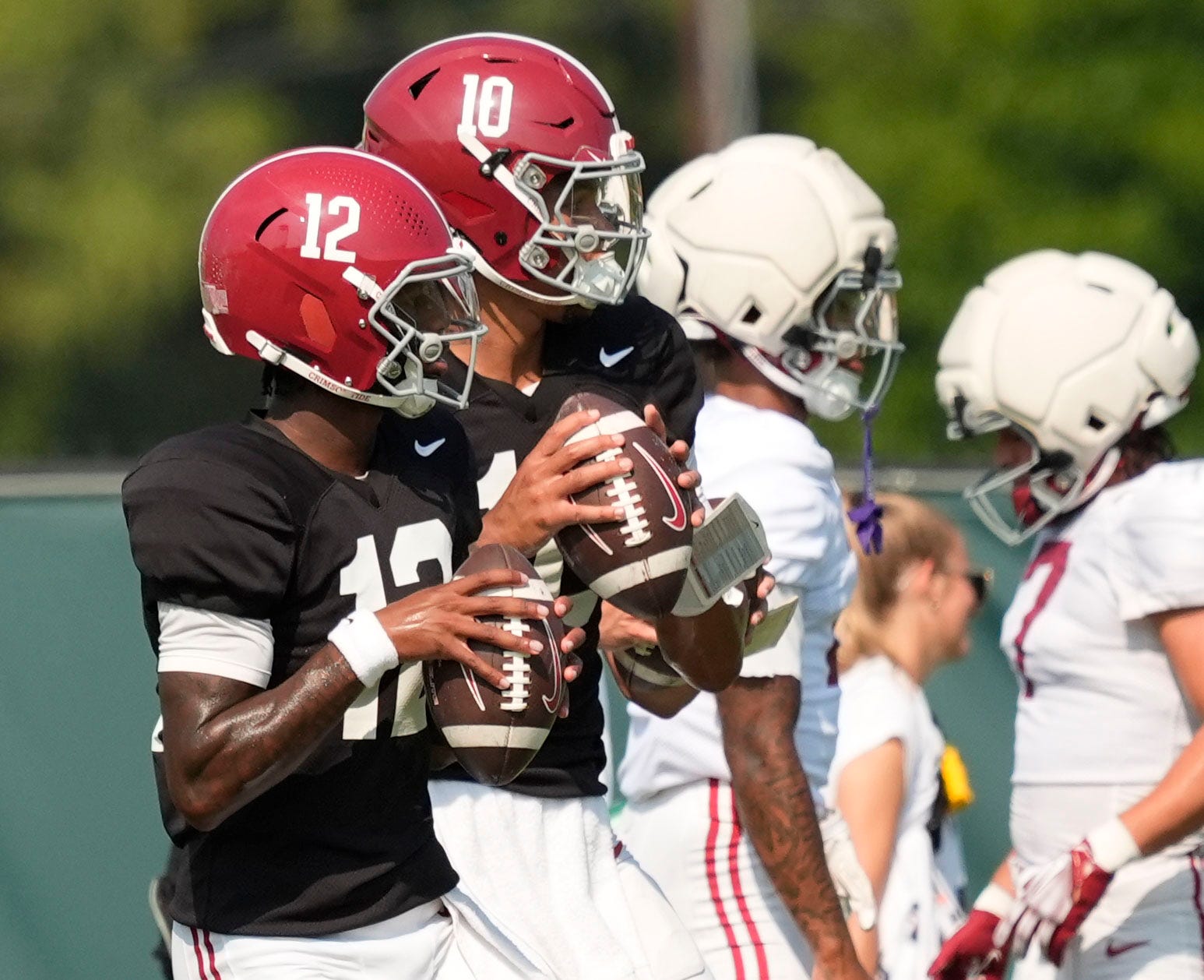
Alabama football enters the 2026 season with a fascinating blend of elite secondary talent, unproven offensive line play, and a quarterback decision that could define the Crimson Tide’s ceiling.
While most national title conversations center on programs like Notre Dame, Ohio State, and Texas, head coach Kalen DeBoer’s squad has the pieces to surprise if a handful of X-factors deliver. The question is whether Alabama’s youth-laden roster can grow up fast enough to compete in a loaded SEC.
The receiving corps has upside, but needs clarity
Alabama’s wide receiver room is deep and talented, even if it lacks a proven No. 1 option. Ryan Coleman-Williams remains a divisive figure. The first half of his freshman season suggested star potential, but his drop rate was alarmingly high in 2025, and he hasn’t consistently replicated those early flashes over the past year and a half.
The Crimson Tide brought in Noah Rogers through the transfer portal as more of a baseline addition to strengthen the floor of the room rather than serve as a headline acquisition. He’s a former highly ranked recruit who has been productive when healthy.
The real intrigue comes from the younger names. Lotzeir Brooks flashed as a tremendous athlete last season, Rico Scott has generated buzz around Tuscaloosa, and true freshman Cederian Morgan is a legitimate 5-star prospect already listed around 6-4, 220 pounds.
If Coleman-Williams can find something between his early freshman highs and his recent struggles, and Morgan proves to be the real deal, this receiving corps has a chance to be electric. The ceiling is astronomical, even if the floor carries some risk.
Running back and offensive line concerns are real
The running back room might be the position group that generates the most anxiety for Alabama fans.
The Crimson Tide lost Hollywood Smothers to Texas after pursuing him in the portal, and the production from last year’s backfield was underwhelming across the board. Daniel Hill has slimmed down and projects as a physical, short-yardage grinder, but the question is whether he can consistently break off explosive runs.
The more compelling option might be true freshman EJ Crowell, who has been a major talking point this offseason. History tells us the transition for young running backs is often smoother than at other positions. You don’t need years of experience to hit the ground running at tailback. You need to be a good athlete, and Crowell fits that description.
If he can emerge the way Bo Jackson did for Ohio State last season, taking on a larger role as the year progresses, that changes the calculus for the entire offense.
The offensive line is arguably the scariest position group on the roster. Despite having recognizable names like Kadyn Proctor and Parker Brailsford a year ago, that unit was overrated. It didn’t generate push in the run game and allowed too many pressures on quarterback Ty Simpson.
The 2026 version is younger and relies heavily on transfer portal additions like Racin Delgatty, Ethan Fields, and Jayvin James from Mississippi State, plus inexperienced but talented players like Jackson Lloyd and Michael Carroll. The combination of inexperience and portal-heavy construction at offensive line is a recipe that historically produces growing pains, especially early in the season.
Keelon Russell should be the starter
This is where the real fork in the road sits.
Austin Mack is a capable, reliable option, but Alabama’s best path to success runs through redshirt freshman Keelon Russell. With uncertainty on the offensive line and a lack of clarity in the run game, the Crimson Tide need a quarterback whose legs can mask some of those deficiencies.
Russell is a supreme athlete, far more dynamic as a runner than Simpson was, and his dual-threat ability can elevate the RPO game and create plays when protection breaks down.
We have seen the running ability for quarterbacks be a bit of a “get out of jail free card” in the past. Russell could do the same for Alabama. If the competition is anywhere close in fall camp, DeBoer should opt for the younger, more talented player. Russell’s legs can level the playing field for an offensive line with a ton of questions.
The secondary could be the best in college football
Alabama’s defense is built from the back to the front, which is a departure from the Nick Saban era’s typical construction.
The secondary features an outstanding blend of experience and upside. Bray Hubbard was very good at safety last season. Keon Sabb, while he hasn’t quite reached the ceiling people envisioned when he was at Michigan, remains a quality college player. Zabien Brown was impressive as a first-time full-year starter at cornerback, winning with tenacity and football intelligence.
The wild card is sophomore cornerback Dijon Lee. At 6-4, Lee has the physical tools of a future superstar. If he takes the leap that his glimpses last season suggested, Alabama’s secondary could challenge Notre Dame and Oregon for the title of best in the country. Lee and a fellow 6-4-plus cornerback prospect from the SEC could headline that position group in the 2028 NFL Draft, which is a remarkable thought this early.
The verdict: 9-3 with a foundation for 2027
Alabama is not a national championship contender in 2026. There are too many question marks at offensive line, too much youth at running back, and too much uncertainty at quarterback to project them into that tier. A 9-3 season feels right, with the Crimson Tide likely falling just short of a College Football Playoff berth.
The X-factors that could push them above expectations are nose tackle London Simmons taking a step after flashing in limited opportunities, edge rusher Yhonzae Pierre entering the Dallas Turner tier of pass rushers, the secondary performing at an elite level, and the young offensive tackles developing faster than expected.
If those pieces fall into place, 2026 becomes the foundational year that sets Alabama up for a legitimate title run in 2027.