
Latest Jordan Love ranking highlights surprising disconnect between league perception and on-field production
After players, now execs, coaches, and scouts also rejected to name Love one of the best quarterbacks in football. This looks like gaslighting.


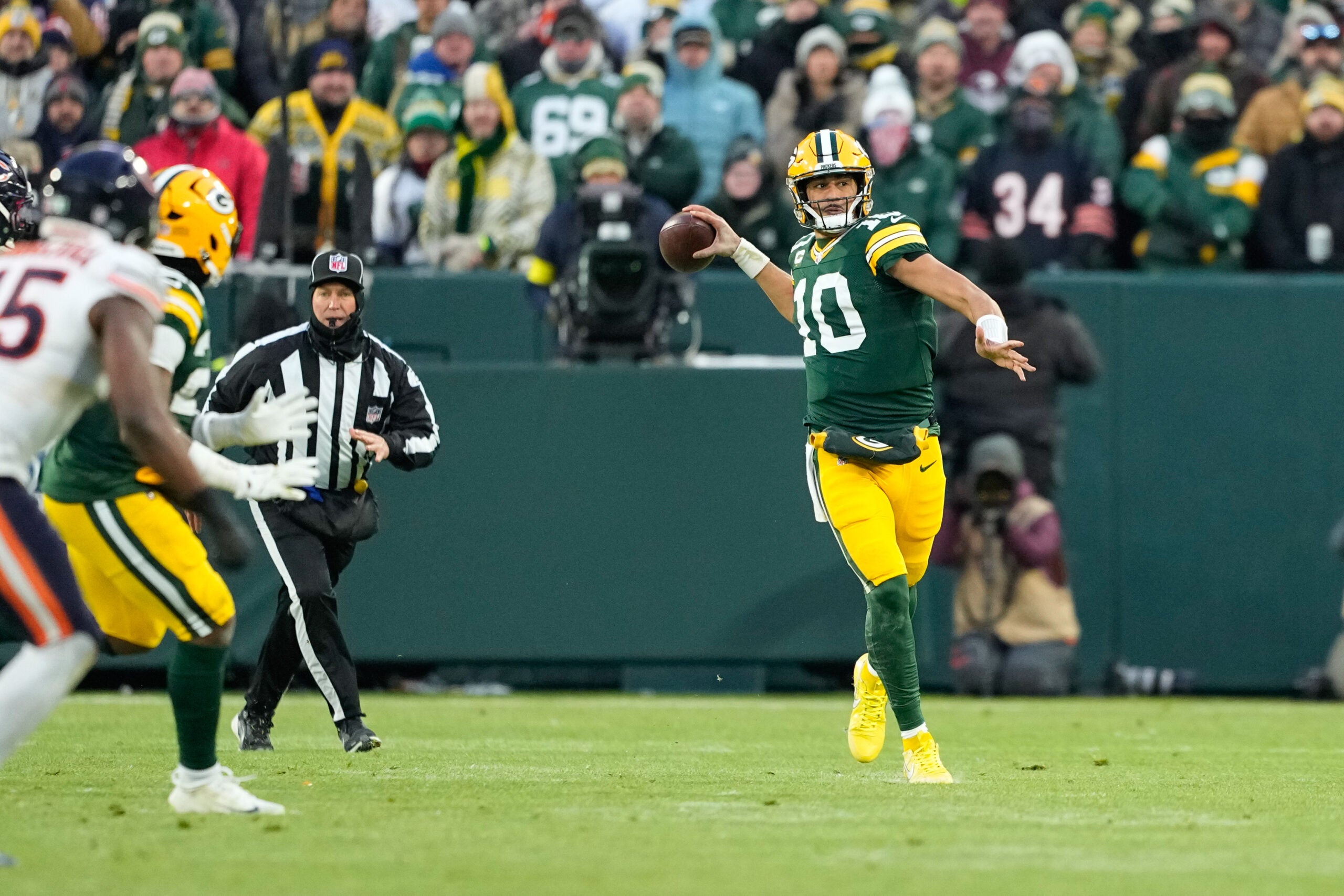
The NFL world apparently doesn’t watch Jordan Love play football, or at least doesn’t give him nearly enough credit for what he does on the field. ESPN’s Jeremy Fowler released his quarterback rankings on Monday, gathering input from executives, coaches, and scouts around the league. The Green Bay Packers quarterback landed as an honorable mention, outside the top 10. Caleb Williams, Jared Goff, and Justin Herbert all finished above him. The advanced metrics and the tape tell a completely different story, one that makes Love’s omission difficult to defend.
And that comes after players ranked Love just 72nd in the league’s top 100 exercise.
The stats are not abstractions
Last season, Love finished second in adjusted EPA per play, third in completion percentage over expectation, and seventh in success rate. Those numbers reflect real on-field production, and they dwarf the players ranked above him.
In adjusted EPA per play, Goff was 11th. Herbert was 17th, Williams finished 20th. In success rate, Herbert came in 11th, Goff 12th, and Williams 24th. In completion percentage over expectation, Goff ranked 12th, Herbert 17th, and Williams finished 29th among 30 qualifying quarterbacks.
The gap is enormous, and it exists across every major efficiency metric. These stats truly represent how well a quarterback processes the game, delivers the football, and sustains drives. The combination of them gives a clear picture about efficiency and consistency, and Love has played at a truly high level, having a leap compared to what he showed in 2023 and 2024.
The perplexing part is that when coaches and executives actually discuss Love, the language is overwhelmingly positive.
“Control of the offense, protection, and route adjustments,” A veteran NFL offensive coach told Fowler. “He has really grown in those areas.”
“I don’t think he gets enough credit for playing the position consistently well,” a scout said. “And he has got the athletic traits to match it.”
Love has the tools, and he has materialized them into production. Yet the rankings don’t reflect what the evaluators themselves are saying.
The ceiling argument falls apart
Fowler noted that Williams, Sam Darnold, Love, and Jayden Daniels were all clustered near the 10th spot, with tiebreakers from several general managers and executives ultimately placing Williams inside the top 10. The reasoning likely centers on ceiling. Williams was the first overall pick for a reason, he possesses the physical makeup and playmaking ability to become a truly elite quarterback.
But if ceiling is the argument, why is Goff above Love? One NFL coordinator justified Goff’s placement by saying, “The guy wins.” The Packers had a better record than the Lions last season, and Green Bay beat Detroit twice. The “winning” argument actually favors the Packers quarterback, not the Lions’, even though quarterbacks are obviously not a quarterback stat.
Williams played relatively well down the stretch, but his full-season production remained well below Love’s in both efficiency and impact. And while the Bears beat the Packers in the playoffs, Love outplayed Williams in that game. Chicago won because it’s a team sport, and the margins came down to special teams, kicker in particular, rather than quarterback play.
The credit keeps going elsewhere
There’s a persistent tendency to attribute Love’s success to everything around him. It’s Matt LaFleur’s scheme, it’s the front office building the roster. But LaFleur doesn’t have a monopoly on good coaching. Ben Johnson coaches the Bears, Goff has benefited from strong offensive minds throughout his career. Love doesn’t possess the same offensive weapons as Williams or Goff, and he’s still outproducing them.
At some point, the evaluation has to center on what the quarterback is doing. Love is a young quarterback who may still be developing, which means the ceiling argument applies to him too.
The disconnect between how NFL decision-makers describe Love and where they rank him is striking. For a league built on evaluating quarterback play, that gap is truly hard to explain.
