
Packers offensive line faces biggest question marks of Matt LaFleur era heading into 2026 season
Green Bay needs some developmental players to actually improve this upcoming season to avoid major concerns upfront.


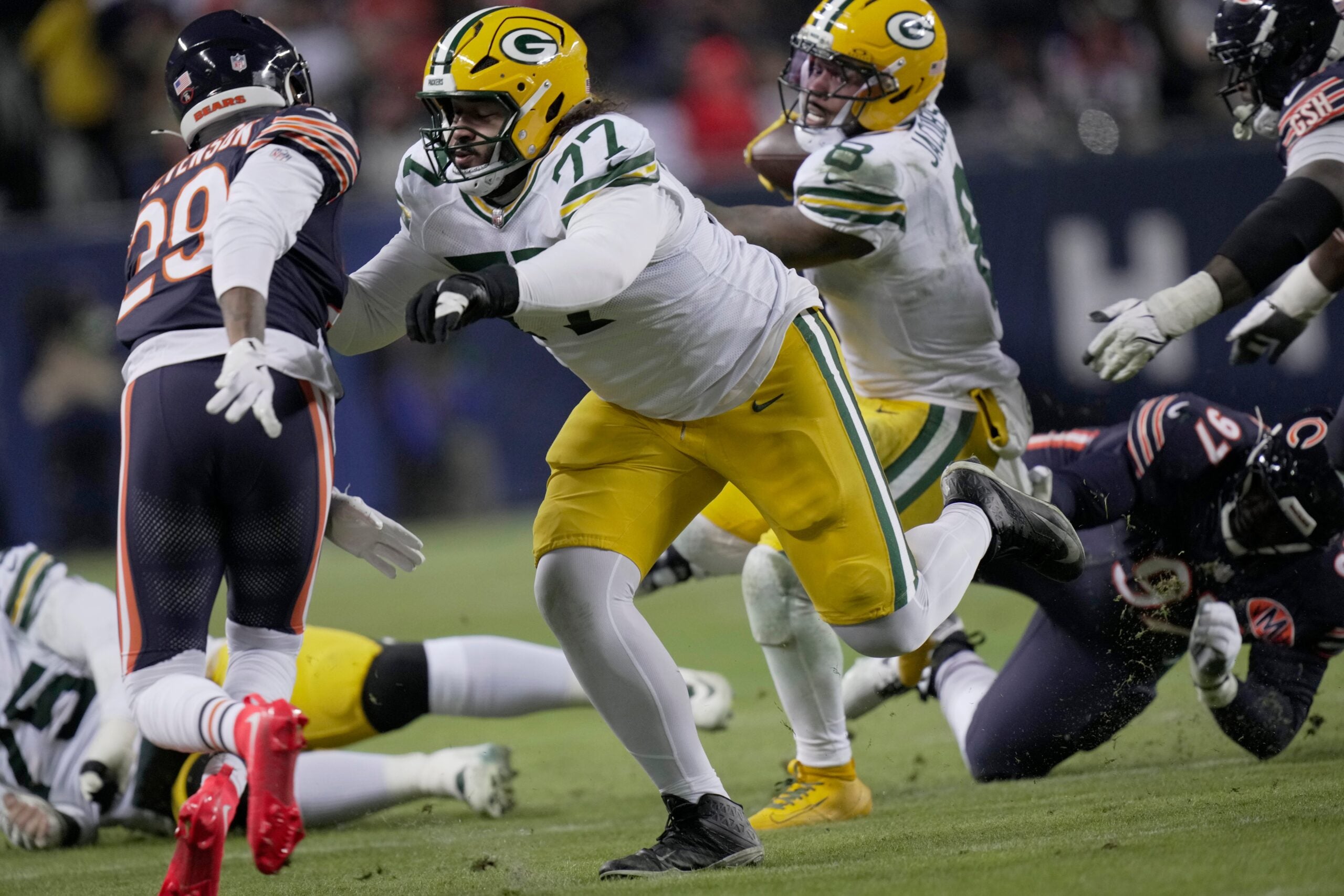
The Green Bay Packers offensive line enters the 2026 season as arguably the team’s most significant concern. After losing left tackle Rasheed Walker to the Carolina Panthers in free agency and releasing longtime starter Elgton Jenkins for financial reasons, the Packers added only one significant player to the unit this offseason: fifth-round pick Jager Burton.
General manager Brian Gutekunst is banking on internal development, but preseason projections from Sharp Football and ESPN’s Mike Clay both rank Green Bay 27th in offensive line play.
A unit trending in the wrong direction
Last season, the Packers graded as a below-average offensive line by most measures. Per PFF, they ranked 25th in pass protection and 20th in run blocking. ESPN’s win rate data painted a better picture in pass protection (sixth) but confirmed the run blocking struggles (19th). For a team that had produced consistently solid offensive line play under coach Matt LaFleur, the regression was notable.
Gutekunst addressed the situation during the offseason, emphasizing patience over quick fixes.
“We’ve been really committed to developing those guys and allowing them to develop,” Gutekunst said. “We’ve had excellent coaches in that room that have done a really good job preparing those guys to play in [the] National Football League.”
He also acknowledged the temptation to add veterans but stressed the importance of letting young players grow through adversity.
“We’ve done a pretty good job allowing guys to develop and go through the ups and downs,” Gutekunst added. “Sometimes I get on myself for not being patient enough with those guys, not just the offensive linemen, but the roster as a whole.”
Left side of the line
At left tackle, Jordan Morgan projects as the starter. The former first-round pick has spent most of his first two seasons at guard, but he played right tackle late last season when Zach Tom was hurt and shifted to left tackle in the meaningless Week 18 game against the Minnesota Vikings. Morgan played better at tackle than guard, though he hasn’t reached the ceiling the Packers envisioned when they drafted him. Darian Kinnard, acquired from the Philadelphia Eagles last year, is the likely swing tackle and primary backup at both tackle spots. Developmental options Brant Banks and Dalton Cooper round out the depth.
At left guard, Aaron Banks returns as the starter after signing a significant free agency deal last offseason. His first year in Green Bay was average at best, and injuries limited him further. Burton filled in at left guard during mandatory minicamp while Banks dealt with an injury, making him the top backup option. Donovan Jennings (entering his third year), undrafted rookie Dillon Wade, and Josh Gesky provide additional depth, though they’re more likely fighting for a practice squad spot.
Interior and right side
Center Sean Rhyan signed a three-year, $33 million contract to replace Jenkins as a bridge starter. Rhyan spent most of his career at right guard but transitioned to center late last season after Jenkins went down and played better there than he had at guard. Burton is again the backup here, making him the first reserve option at all three interior positions. Jacob Monk, a former fifth-round pick who started the Week 18 game against the Vikings, provides additional versatility, though his development hasn’t matched the team’s hopes.
At right guard, second-round pick Anthony Belton takes over as the full-time starter after bouncing between tackle and guard throughout his rookie season. The Packers moved him inside during the regular season, and while his consistency needs to improve, they believe a full training camp at the position will help. John Williams, a seventh-round pick from last year who missed his entire rookie season due to injury, gets his first real opportunity to compete. Karsen Barnhart and Dylan Barrett fill out the depth chart.
The anchor on the right side
Zach Tom is the most talented and consistent player on the Packers offensive line. He signed a long-term extension last year and remains one of Green Bay’s most reliable offensive players. Behind him, Kinnard can play four of the five offensive line positions (all but center) and logged significant snaps at right tackle last season. After being acquired for a sixth-round pick, Kinnard played 213 snaps at right tackle, six at left tackle, and 66 as a tight end in six-OL packages. Travis Glover, a former sixth-round pick drafted in 2024, is another developmental option at 6-foot-6, though he missed all of last season with an injury and is fighting for a depth or practice squad role.
The Packers are betting on youth and versatility across the offensive line. Burton’s ability to back up three interior positions and Kinnard’s flexibility at tackle give the unit some insurance. But the margin for error is thin, and Green Bay needs Morgan, Belton, and Rhyan to take meaningful steps forward for this group to climb out of the bottom third of the league.
