
Vikings HC Kevin O’Connell is fighting a narrative that falls apart under scrutiny, but it refuses to go away
Despite being 48-25 as a head coach, Kevin O’Connell continues to completely dispel the one narrative that follows him.

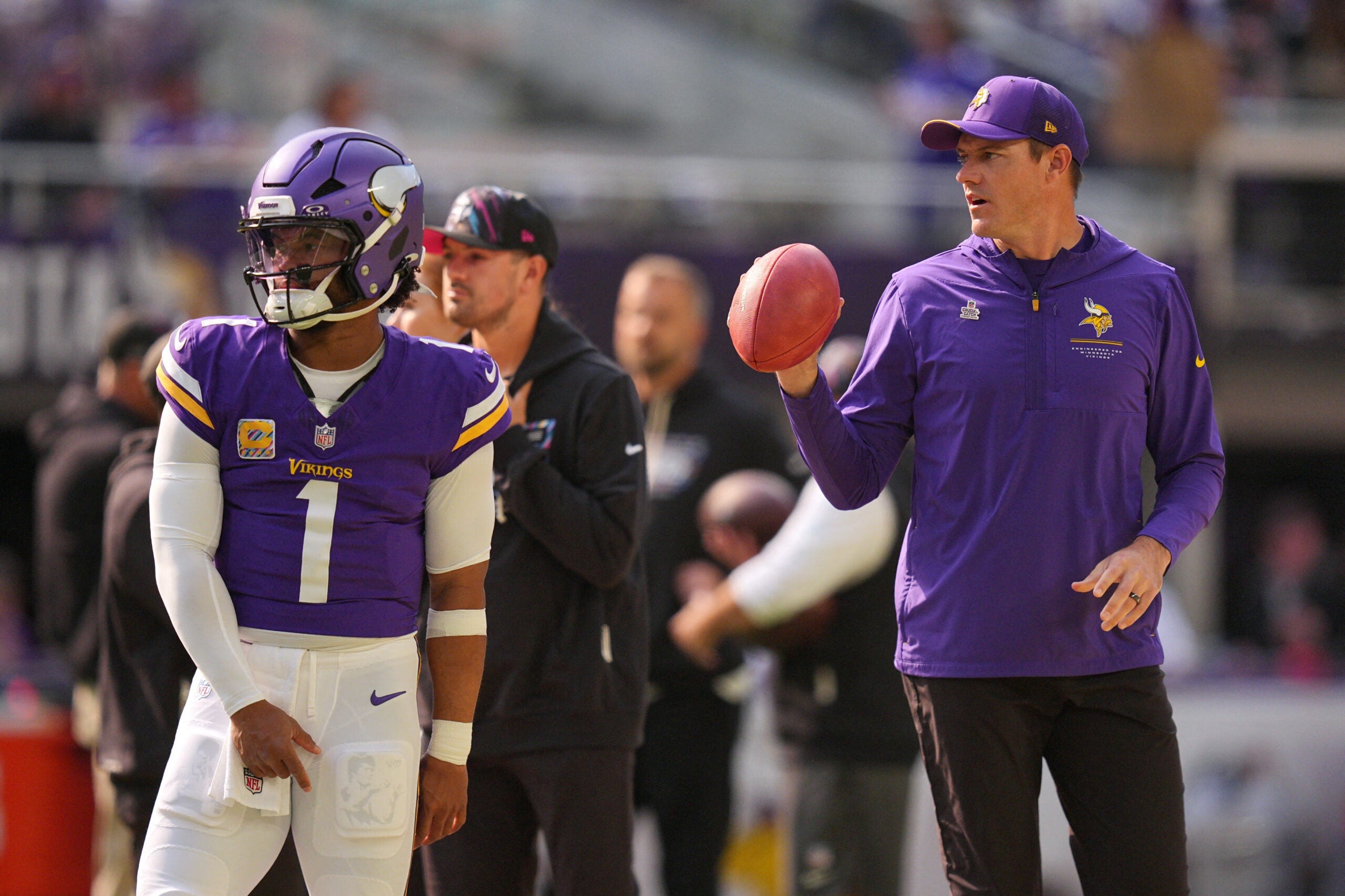
There is one narrative that has been around Minnesota Vikings head coach Kevin O’Connell during his tenure. The claim is that O’Connell doesn’t adjust his offense to fit his quarterbacks. There’s no proof of it other than vibes, and the all-22 tape tells a completely different story.
O’Connell has started nine different quarterbacks in five seasons with the Vikings. That’s tied for second-most in the NFL since he took over as the head coach. Poor injury luck forced him to start three quarterbacks in 2023 and four in 2025. In the two seasons he had the same starter all year, Minnesota won 13 and 14 games, respectively.
Those seasons didn’t turn into playoff success, mainly because the roster lacked great personnel. That roster is much improved this season, as has O’Connell’s ability to adapt to his starting quarterback.
Kevin O’Connell maximized Kirk Cousins and Sam Darnold
For starters, take a look at Kirk Cousins. Plenty of Vikings fans panned him for multiple reasons, but the debate was never that Cousins was bad. It was whether he was worth the money he was being paid, and you can make coherent arguments on both sides.
My biggest issue with Cousins was that he never consistently maximized his ability. In a one or two-game sample, he would turn into gunslinger Kirk and hit tight windows all over the yard. The problem was he didn’t want to play that way on a week-to-week basis.
O’Connell built his offense around what Cousins liked. They ran a lot of in-breaking routes and quick game, which Cousins navigated well, while still attacking the intermediate and deep levels of the field. You can argue the year and a half Cousins started for O’Connell were his best seasons. After a 1-4 start in 2023, Minnesota ripped off a string of wins, and Cousins was trending toward the MVP conversation before his torn Achilles tendon.
That approach carried over to Sam Darnold. He arrived in 2024 as the journeyman bridge starter for J.J. McCarthy, then became the guy all year after McCarthy tore his meniscus in the first preseason game. Darnold made the Pro Bowl and threw for 4,319 yards and 305 touchdown passes.
What separated Darnold was his willingness to attack vertically. On dagger, the inside receiver runs the go, and the outside receiver runs the dig. Sometimes, Darnold would throw the clear-out to Jordan Addison anyway, and they would complete it. O’Connell also wanted to chase explosives, so it was a perfect fit. It led to elevated turnover numbers, but those explosive plays produced points. We’ve since seen flashes of that same Darnold with the Seattle Seahawks.
The backups and J.J. McCarthy got the same treatment
It’s not just the long-term starters. Nick Mullens loved throwing in-breakers, so Minnesota called a lot of MOF concepts. Josh Dobbs was only around for a few weeks, so the staff leaned on base concepts with some RPO. They probably should have leaned into the RPO more, but installing packages midseason for a newcomer is difficult.
With Jaren Hall, the Vikings used more RPO and play-action. Who knows if it would have worked against the Falcons, but it didn’t against the Green Bay Packers.
Then there’s J.J. McCarthy. O’Connell crafted an entire offense around him, and he ran it well in practice. When the lights turned on, he struggled. Once the staff simplified things ahead of the five-game winning streak to close the 2025 season, he started to unlock some of his ability. Needing to simplify it that much was a major red flag. Anyone claiming McCarthy wasn’t built for the system should go back to the pre-draft evaluations, which viewed him as a perfect fit for O’Connell’s play-action approach.
Kyler Murray is the latest example
So what is O’Connell doing for Kyler Murray? The answer is simple. Minnesota is leaning on the short passing game and quick concepts, mixing in O’Connell staples with outbreaking routes and deep crossers. The Vikings have shifted to a ball control offense, ranking second in time of possession and leading the league with the slowest pace of play. It’s resonated the last two weeks with over 78 minutes time of possession and just 84 offensive plays for their opponents.
It’s a small sample, and we have to be cognizant of that. Still, Murray ranks No. 6 in completion percentage over expected at 5.7, with Lamar Jackson No. 1 at 8.1. Murray is completing 69.9% of his passes at 6.8 air yards per attempt. That yardage number is a little low, and I expect it to rise once Addison and Justin Jefferson are both on the field together. All of them His EPA per play is also trending up, including a 0.22 mark against the Saints.
Murray and O’Connell are essentially in the early stages of dating. Both sides are learning what the other likes, how O’Connell calls games, and what Murray prefers in certain situations. Practice can only simulate so much, and some of that chemistry has to develop in games. We’re starting to see it resonate on the field
Could O’Connell do a better job of adapting? That’s a different discussion entirely versus not doing it at all. Whether these adjustments make Minnesota a Super Bowl team, only time will tell. The idea that he doesn’t adapt to his quarterbacks needs to go. Turn on the All-22, and it’s clear O’Connell caters the game plan to whoever is under center.

