
Brian Callahan’s strong reason for controversial game management in Titans’ win over Cardinals, and why I still think he’s wrong
Two point conversion now, or later?


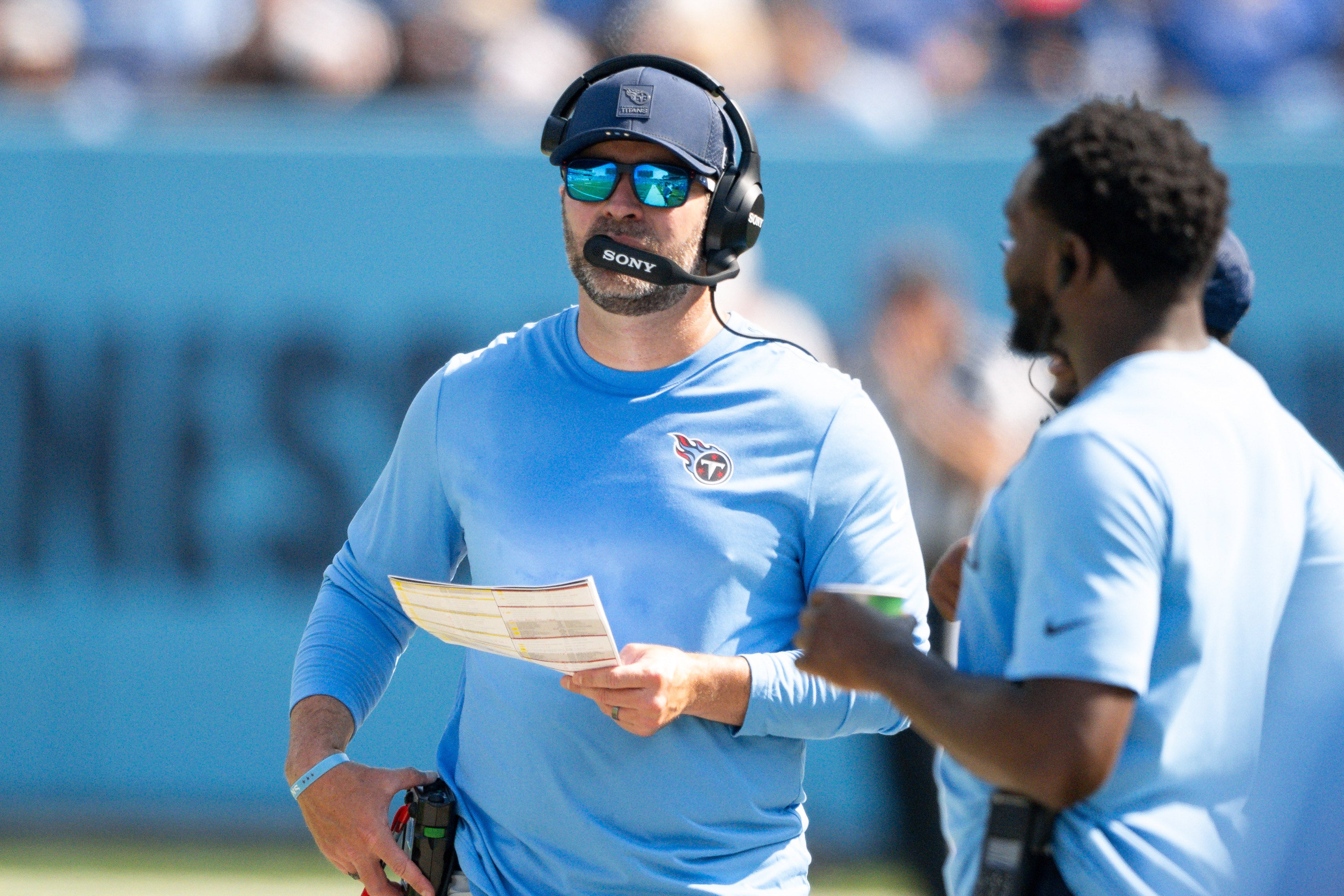
It was relatively early in the fourth quarter of Week 5. The Tennessee Titans marched down the field to score their first touchdown of the day, cutting a 15-point Arizona Cardinals lead to just nine. That’s around when I fired off this tweet:
And then Titans head coach Brian Callahan promptly held up a confident, single finger in the air. They chose to kick the extra point. And I let out a long, deep sigh of disappointment.
I’ve since spoken with Callahan about his process , and we discussed our philosophical differences on this decision. Here’s why he went for one, and why I still think he should have gone for two.
The history, math, and logic behind this decision
Alright, so maybe “idiot” was laying it on a little thick. In my defense, I didn’t expect Callahan to kick the extra point. That being said, even after talking this through, I still think he made the wrong choice. But I do feel a lot better about the process behind his decision. More on that in a second.
The analytical theory behind why you’re supposed to go for two when down 15 points is relatively simple and has everything to do with game management. Put plainly, it’s about knowing what you need as soon as possible. If you’re down 15, you know that the only way to tie the game without scoring three times is to score two touchdowns and convert on one two-point try.
The question then becomes which touchdown to try for two on. And the win probability math, as well as neutral game management logic, says that you go for two on the first touchdown to gain early clarity on game dynamics.
Going for two and converting gives you the option to act accordingly for the remainder of the game. Now you know you just need a single, standard touchdown and an extra point to tie the game. Your defense on the ensuing drive, and then offense after them, can call plays and manage the clock with that information in mind. Likewise, failing on the two-point conversion and remaining down nine allows you to hustle up and play for the two more scoring drives you need.
Choosing to wait until the second touchdown to go for two may make you feel better about your chances in the game because you ensure you’re down just one score, but it forces all of your eggs into one basket: the two-point conversion you’ll attempt on the second touchdown.
Unless you just happen to score the next touchdown quickly enough to give yourself time to score again, this leaves you no wiggle room in the case that you fail to convert.
The math and the logic are clear on this, at least in terms of game theory. But forget theory, what about in practice? What’s the history here? Well, this analytical gambit discussion didn’t really become mainstream until around 2019. And since then, 48 teams have found themselves down nine points and presented with the decision to kick an extra point or go for two.
Thirty-one of those teams kicked the extra point and converted at roughly a 90% clip, and 18 went for two, converting at roughly a 45% clip. Those are pretty representative conversion rates per try, which is good for our purposes.
Of those 48 teams, four won and one tied. It should come as no surprise that no matter how you approach being down 15 late in a game, you aren’t going to win often. And in terms of a trend, well, there isn’t one.
The Titans won in Arizona by electing to kick the extra point, missing it, scoring another touchdown, and then a field goal. The Bills beat the Ravens earlier this year after being down nine twice, and they tried an extra point and a two-point conversion before eventually winning on a walk-off field goal. The 2022 Vikings beat the Colts by kicking the extra point first, but the 2020 Cowboys beat the Falcons by going for two. Arizona and Detroit tied in overtime in 2019 after Arizona kicked the extra point first.
What’s the common thread here? Honestly, nothing. The sample size is too small and too diverse for a meaningful trend to emerge. So while a small sample size doesn’t change the soundness of the theory, the practical reality of “it hasn’t seemed to matter” is a point in the Titans’ defense here.
The Titans’ reason for kicking the extra point down 15
That wasn’t the Titans’ only reason for choosing to kick the extra point, though. And it wasn’t what made me feel better about their process, either. First of all, it was reassuring to hear that this wasn’t a flippant “vibes” decision on Callahan’s part.
It turns out the Titans decided on their lean in this scenario a couple of weeks ago, after a lengthy discussion in one of their Saturday morning Situational & Game Management meetings. This is where around a dozen of the Titans’ highest-ranking football personnel go through their thought process on all of these things ahead of time.
So they had already come to a consensus that, for this team right now, they’d lean toward kicking the extra point if they’re down nine. From a historical standpoint, they see this gambit as a dealer’s choice, and they’re willing to forego the theoretical advantage for this specific team at the moment because of a perceived psychological edge.
This is the counterargument I’ve heard from just about everybody with whom I’ve discussed this this week: you have to keep it a one-score game. That’s what the Titans thought was most important for this team in Arizona: to maintain momentum and ensure everybody’s mindset stayed positive. Anybody who has watched this team knows they’ve had problems finishing games strong, so this is a pretty reasonable concern.
Where I came down on this after exploring all sides of the argument is that while the maintenance of momentum, positive mindset, and one-score deficit are all reasonable things to worry about for this team, the logic and win probability edge that going for two early (theoretically) gives you is too important to pass up.
The momentum from scoring your first touchdown all game in this instance wouldn’t be stomped out by a failed conversion. I think calling for the two-point try would instill confidence in your players in the first place. And most of all, the proof is in the pudding: they still managed to be down nine thanks to the missed extra point, and they still won the game.
If that’s not evidence that this team can mentally handle being in a nine-point hole with time dwindling, I don’t know what is.
But all’s well that ends well, and I appreciate the Titans coaching staff’s forethought on the decision and their willingness to discuss it. I’m just glad it didn’t end up being a leading talking point on another losing Monday morning.
