
Robert Saleh’s game management decision-making is concerning, but not for the reasons you probably think
The fourth down and field goal decisions aren’t what’s most concerning. It’s the lack of a method to his madness that has me searching for answers.


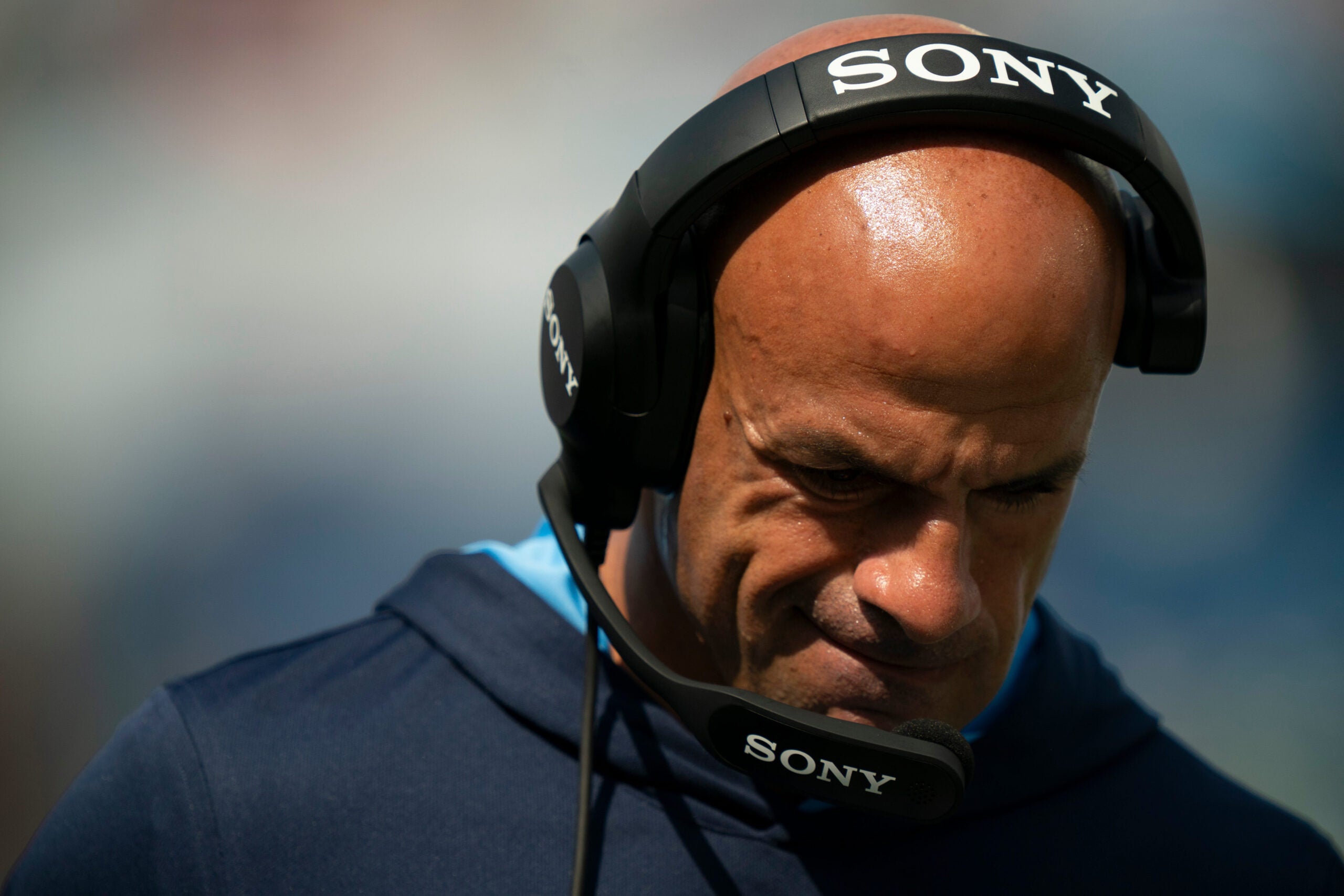
The Tennessee Titans lost a game they probably should have won, and the conversation has predictably zeroed in on two game management decisions as far as Robert Saleh is concerned: a 59-yard field goal attempt, and a fourth-down call in the third quarter.
Those decisions are worth dissecting, but the real issue I have coming out of head coach Robert Saleh’s Monday press conference isn’t the calls themselves. It’s the way Saleh talked about them, on top of his season-long decision making thus far, and what that reveals about a deeper game management question that hasn’t been answered yet.
Saleh’s answer on fourth down was right… until it wasn’t
Let me be clear: I didn’t have an issue with the fourth-down decision in the game! The majority of people covering and watching this team didn’t think it was the wrong call. But Saleh’s answer at the podium Monday was, in my opinion, an unforced error.
He was asked about both the field goal attempt and the fourth-down call, and why his previous statement about points being at a premium applied differently to each instance. Saleh thought it was a good question and he gave this answer which I want to include in it’s totality:
Yeah, really good question, because I look at both of them. Joey (Slye), got all the faith in the world in Joey to be able to kick those. Felt on the field, the wind was dying down, the rain wasn’t as–it was just misty, it wasn’t coming down as hard, like there was a dead spot in the weather right there. That was part of it. Joey’s consistency throughout, ever since the one practice he had in–I think it was the blue-white game—he’s just been nails. I mean, he’s been making everything in practice. He’s been making everything in games. And it was a tough situation, but I believe in him. I mean he hit the back of the net, the distance wasn’t going to be an issue. In hindsight, yeah, punt the ball, let’s go backed up, let’s get out of there, six nothing. But felt we were in a position with five straight three-and-outs or whatever you want to call it, and we’re in position to go get some points. Really have a lot of faith in Joey in those moments. And then to answer your other question, yeah, again, I probably wish—again hindsight’s 20-20—I wish I took points there. But to give you my reasoning, and for all you guys, when you see the decision making, I’m always someone that works in possessions. Three points, we still would have needed two touchdowns. With the way the game was going, with the ball on the ground, the clock continually moving, I didn’t think there was going to be a lot of possessions left. So in that situation, a field goal, we still would have needed to get down there two more times for touchdowns or score, which we hadn’t been able to do all game with a very limited possession. So that was all flowing in my head. In hindsight, when you look at the way the game played out, would have loved to take a field goal right there, score the next drive, and now we’re hitting a walk off a field goal to win the game. But in that moment, three points wasn’t going to change the complex of the game with regards to needing two touchdowns.
The generous read on this answer is that he’s saying if the Titans had chosen to take the points in the third quarter, they could have kicked a field goal on the last drive. But the question was clearly about process, not perfect-world hindsight. So that’s a bad way to answer that question.
My reaction when he said it was simple: don’t say that, man! Don’t backtrack on a decision that was the right call. That’s worse!
The bigger picture: what is Saleh’s guiding principle?
Here’s what’s frustrating me about Saleh, and I want to be upfront that I like the guy and I’m not out on him as a coach by any means. I find him interesting to talk to and appreciate his thoughtfulness with us in the media.
But you have to do this with every new coach you cover: figure out the method to their madness.
When Mike Vrabel was the head coach, it wasn’t hard for anybody to get a general beat on his approach. He was a defensive head coach, not a pure by-the-numbers analytics guy. There were vibes involved.
But Vrabel is revered around the league, understood to be the next generation of Bill Parcells and Bill Belichick when it comes to elite game management and elite rules knowledge. He was a master manipulator from the headset. While every decision he made wasn’t always analytically driven, and sometimes he gave infuriating (answers or non-answers) about specific choices, two things were always true: He had a good gut feel for it, so his gut was right a lot of the time.
And you could lean on a guiding principle: this is a high-level game management feel guy and a high-level rules expert. That was enough to wrap your head around how he operated.
With Brian Callahan, I went through the same exercise early on. He made some decisions I didn’t understand, and he was willing to talk about his specific decision-making at practice with some of us. While I didn’t always agree, I could at least wrap my head around his roadmap. He had a guiding principle. I didn’t have to agree with it 100% of the time, but there was a process.
With Saleh, we’re only three games in, so I’m not planting the flag or coming to a final decision. But I am lost right now! I don’t know yet what his guiding principle is. I don’t know what his process is or how much of a process there is. When he does certain things in the game and then says certain things about those decisions at the podium, it leaves me scratching my head too often. The unpredictability in any given game management situation is concerning.
The 59-yard field goal was the right call
I have some sympathy for Saleh’s position because this team is so bad that you have to second-guess aggressiveness at every turn. The margin for error is razor thin, and the potential for a snowball effect to get out of hand is enormous. But you still have to stick to your process, and I don’t know what his process is right now.
To the actual decisions, I’m more riled up about the way Saleh answered questions at the podium Monday than I am about the calls themselves. I didn’t have an issue with the 59-yard field goal attempt. I do have a problem with him foregoing a similar long attempt in much better weather at him in Week 1. And I have an issue with some of his punt vs. go decision making so far too.
The bottom line is this: the individual decisions aren’t what worry me most. It’s the absence of a clear, identifiable process behind them. Three games is a small sample, and Saleh still has time to show what his approach actually looks like under pressure. But the picture isn’t clear right now.
