
Selection committee advances controversial Chiefs legend as senior finalist for 2025 Pro Football Hall of Fame
A Kansas City Chiefs legend has advanced to the senior finalist round for the Pro Football Hall of Fame class of 2025, but this particular legend and his potential selection are steeped in controversy.On Tuesday, the NFL announced contributor, coach, and senior finalists for the Pro Football Hall of Fame Class of 2025. Among them is […]


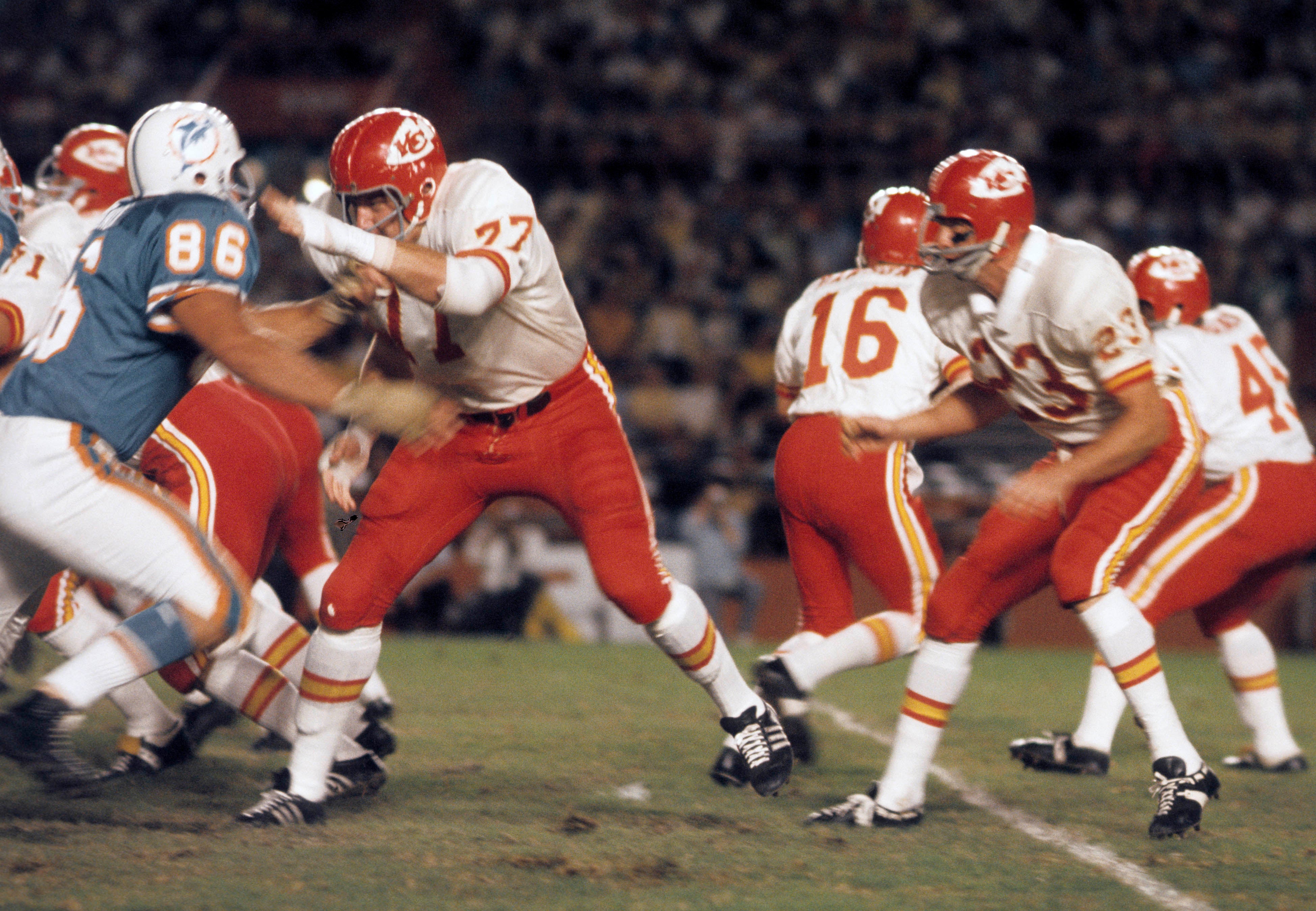
A Kansas City Chiefs legend has advanced to the senior finalist round for the Pro Football Hall of Fame class of 2025, but this particular legend and his potential selection are steeped in controversy.
On Tuesday, the NFL announced contributor, coach, and senior finalists for the Pro Football Hall of Fame Class of 2025. Among them is former Kansas City Chiefs left tackle Jim Tyrer.
Tyrer has been widely regarded as one of the era's leading offensive tackles. He was chosen for the AFL's All-Decade Team of the 1960s, appeared in nine AFL All-Star Games, and contributed to three AFL championship teams spanning a 13-year career (1961-1973) with the Dallas Texans/Chiefs. He, of course, was a member of the Super Bowl IV champion team for Kansas City.
His football resume is stronger than perhaps any other senior candidate up for selection into the Pro Football Hall of Fame in 2025. Unfortunately, his football-playing legacy is tainted by what came afterward.
On Sept. 15, 1980, Tyrer shot and killed his wife, Martha, before turning the weapon on himself in an apparent murder-suicide, leaving behind four children. This tragedy rocked Kansas City and the NFL world. So why is the NFL even considering Tyrer for enshrinement in the Pro Football Hall of Fame? The answer to that question is a complicated one. . .
Chiefs LT Jim Tyrer presented symptoms of CTE before anyone knew what it was
Pro Football Hall of Fame selector Ron Borges sent a letter to his fellow selectors on the senior committee about Tyrer. The information in that letter was compelling enough to advance Tyrer to the finalist round. Not only did it quantify his ability and impact on the football field, but also strongly points to undiagnosed CTE in Tyrer.
No one knew much then about depression and nothing about CTE, chronic traumatic encephalopathy. The latter is the debilitating, degenerative brain disease found in nearly 91 per cent of the over 400 retired football players who in recent years have had their brains examined by Boston University’s Concussion Legacy Foundation.
CTE is a disease that leads to depression, anger, impaired judgment and volatile, irrational behavior. It is widely believed to be caused by the kind of repeated blows to the head that were a staple of the existence of Tyrer and the men who plied his violent trade.
In those days offensive linemen could not legally hold as they can today. Instead, they were told to lead with their head, becoming human battering rams. To combat that, defensive linemen were allowed to head slap, crashing their forearms into the side of a lineman’s helmet while often driving their fists up into their jaw and facemask, snapping their necks back violently. It was a savage business that Jim Tyrer engaged in and few did it better or more violently than he.
CTE caused Junior Seau to commit suicide. It caused Dave Duerson to commit suicide. It led to the death of a homeless Mike Webster and so many others, as we now know. For Jim Tyrer, it’s far too late to examine his brain but one can certainly theorize he suffered the same fate.
Some of the most interesting pieces of the letter come from Dr. Douglas Paone, who saw Tyrer three days prior to the murder-suicide. Tyrer was compelled to visit the doctor by his wife, who told Paone, “There’s something terribly wrong with Jim.”
Tyrer claimed he suffered from "headaches that often left him unable to think." Asked if he felt depressed, the former Chiefs O-Lineman told the doctor, “No. It’s worse than that.”
What happened in the ensuing days haunted Paone, who says that given what we know now, Tyrer was presenting symptoms of CTE.
“His symptoms check all the (CTE) boxes," he told Borges. "The clinical presentation. Mental status. History of head trauma. Headaches. Lethargy. Irrational decision making. You couldn’t ever pick a person that had a better presentation of the disease. As an internist, I have to make diagnosis without slides and without scans. If it walks like a duck, quacks like a duck, water runs off its back and its name is Daffy, it’s not a zebra. He had CTE. No doubt in my mind.”
All of Tyrer's four children have attempted to find peace in the years following this tragedy. While confused about what happened, they each never harbored any resentment toward their father because they knew the violent act that took place and took their parents from them wasn't a reflection of who he truly was.
“That was not my Dad," Jim's son Brad Tyrer told Borges. "My Dad’s legacy is inaccurate. The thing my family has struggled with all these years is we knew long before we heard of CTE the man in that bedroom was not our Dad. He was a guy who never cussed, never raised his voice, never argued with our Mom. We have always held him in high regard. The four of us went to family counseling once after it happened. We never went back because we had no anger toward our Dad.”
There's little denying that his football-playing legacy should qualify Tyrer for the Pro Football Hall of Fame. The committee states clearly that play on the field is the only accepted criteria for selection into Canton. Should the violent crime that occurred afterward disqualify him from the Pro Football Hall of Fame, given the facts and information now known? That's up to the selection committee to decide. Tyrer's advancement to the senior finalist round puts him one step closer. Up to three of the five finalists (Tyrer, Maxie Baughan, Sterling Sharpe, Mike Holmgren, and Ralph Hay) can be elected with at least 80% approval from the committee.
The Pro Football Hall of Fame's Class of 2025 will be announced in its entirety during the "NFL Honors" ceremony on Feb. 6.
