
Now 25 years later, Texas’ response to Texas A&M Bonfire tragedy still one of the best unifying moments in state history
Mack Brown on 1999 Bonfire tragedy: ‘When you lose your children, there is nothing worse than that in the world’

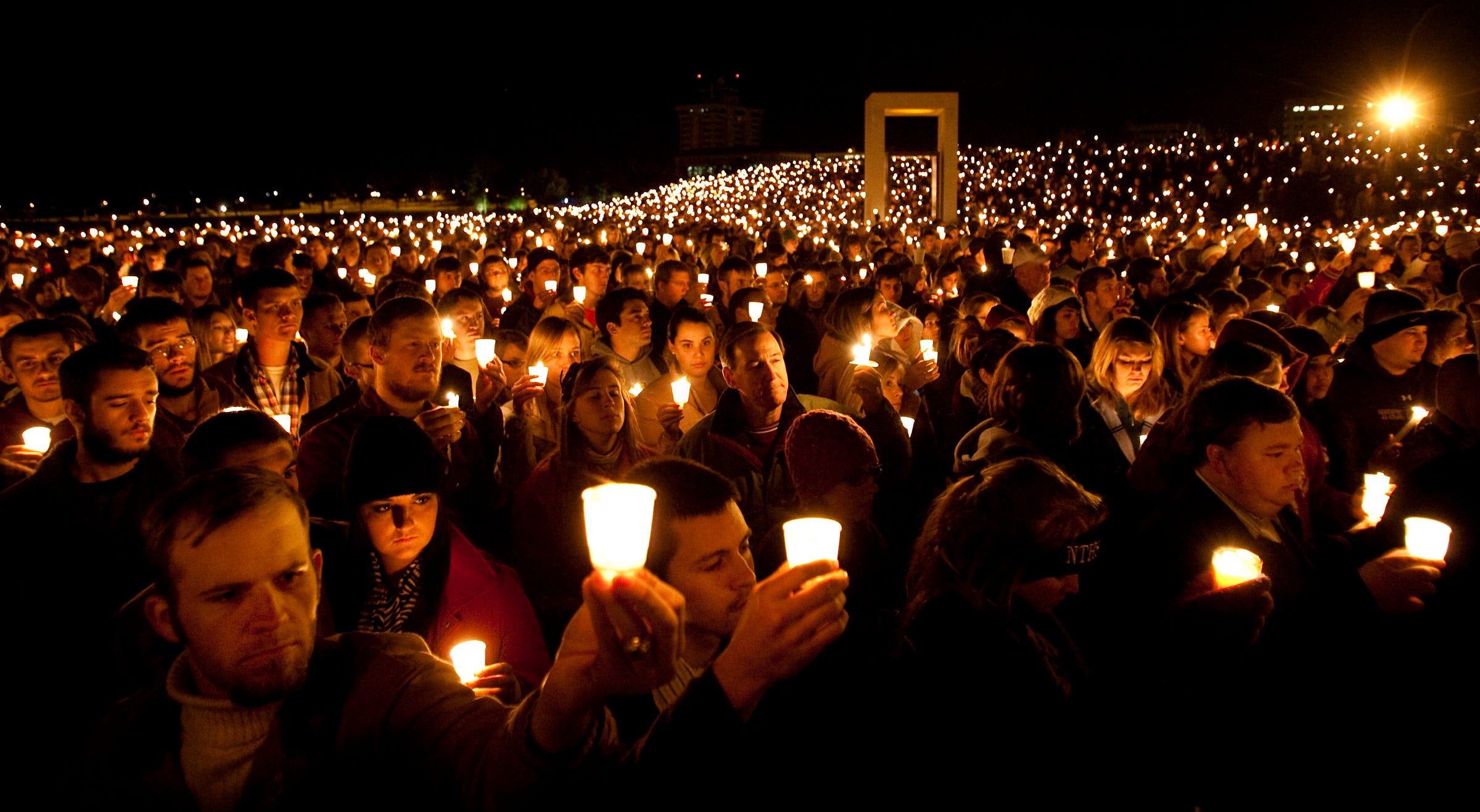
It’s been 25 years since the Bonfire collapse that forever changed Texas A&M University. For some, it still feels like yesterday. For the families who lost loved ones, the pain will never go away.
There are students on campus now who weren’t even born yet when stack began moving at 2:42 a.m. on Nov. 18, 1999. They have no clue how quickly the stack of logs, arranged in a tiered, wedding-cake formation and bound by wires, collapsed and killed 12 Aggies and injured 27 others.
They have no knowledge of how A&M students, faculty, family members, first responders and those in College Station rushed to the scene and started digging through rubble, which was estimated to weigh as much as two 747 jumbo jets.
They also have no idea how that moment, one of the darkest in Aggies history, became one of the most unifying between Texas A&M and the University of Texas.
WATCH AND SUBSCRIBE: Follow A to Z Sports’ Texas Longhorns channel on YouTube.
The Bonfire tradition was A&M’s visible marker to the world, a 55-foot-tall beacon meant to highlight A&M’s “burning” desire to beat UT. It started in 1907 as a scrap heap meant to congratulate the Aggies for a win but would soon come to mark the upcoming Texas-A&M football game.
The stack reached a record 105 feet in 1969, but administrators put in a 55-foot limit out of safety fears. Typically, Bonfire would attract upwards of 50,000 to 70,000 people to this open field just to watch the spectacle and have an A&M pep rally.
For decades, A&M students went to Bonfire leading up to the annual grudge match hoping they would “beat the hell outta t.u.!”
The 1999 stack was meant to hold about 7,000 logs when completed, according to reports at the time. An A&M investigation revealed how little oversight there was at the construction site, a shocking discovery at a school known for its engineering accolades. Now, A&M faithful are split on whether the tradition should return.
Longhorns rushed to help fellow Aggies
When the stack collapsed that early morning, the Longhorns didn’t turn away. They rushed to help fellow Texans. UT football players organized a blood drive. The school cancelled its annual “Hex Rally” and organized a Unity Gathering instead.
A flag of the state of Texas was hung at the UT Tower and the Aggie War Hymn was played for the only known time in UT history.
Then-Texas coach Mack Brown and A&M’s R.C. Slocum talked about postponing or cancelling the game. “I told R.C., whatever you all want, we’ll do,” Brown has said numerous times over the years. It was decided the football game would be played at Kyle Field on Thanksgiving eight days later as scheduled.
“I’ve never been a guy that hated our rivals,” Brown said in December 2020. “I’ve always liked our rivals. They’re two great programs in a state that cares about football, maybe more than any other state in the country. It’s because it’s like a religion there, and both programs are so good. I would never say anything bad about Texas A&M.”
The game itself was supposed to be a top-25 matchup. No. 7 Texas had already clinched a spot in the Big 12 championship game, but No. 24 A&M wanted to spoil it all. The game’s buildup was deflated instantly as bodies were discovered deep under the logs right on A&M’s campus.
A&M players missed practice for two days and helped dig through the stack right alongside other A&M students.
‘Bonfire’ game was played as scheduled
When the game finally arrived, thousands of maroon balloons were released along with 12 white doves, one for each current and former A&M student killed in the collapse. Four F-16 fighter jets flew overhead in the missing man formation.
At halftime, the University of Texas Longhorn Band played “Amazing Grace” before a full house of A&M faithful. The record crowd of 86,128 was the largest to ever see a football game in the state of Texas at that time.
It was widely viewed that A&M needed that game for a catharsis. The Aggies delivered. Running back Ja’Mar Toombs rushed for 126 yards and two touchdowns. Randy McCown hit Matt Bumgardner from 14 yards out for the winning touchdown with 5:02 remaining.
A&M lineman Chris Valletta had the names of all 12 victims written on the shirt he wore under his shoulder pads. “I hope this win can ease the pain a little bit. I personally want to send this to all of them, from all of us,” he said after the win.
The game took an emotional toll on everyone. For years, it was referred to as the “Bonfire game.” The Aggies would have a similar emotional game right the attacks on Sept. 11, 2001, when the stadium was decked out in red, white and blue.
But nothing can eclipse how everyone — Aggies and Longhorns — were affected by the Bonfire tragedy.
At his final press conference at Texas after the 2013 season, Brown was asked what would be the one thing he would change during his tenure with the Longhorns. First, he mentioned the tragic death of Cole Pittman, one of his players.
“And I would want the bonfire (collapse) to not have happened at A&M,” Brown told a room of reporters and UT faithful. “Those are two horrible things in my life that I will never forget.
“Playing A&M on Thanksgiving, I thought about the families. … When you lose your children, there is nothing worse than that in the world. I think about that every Thanksgiving because there are 12 families that don't have a good Thanksgiving. That'll never go away.”
