
Texas tweaks rules to give donors more loyalty points by giving to Longhorns’ NIL fund
For every $100 UT donors give to Texas One Fund, they can earn five Longhorn Foundation points

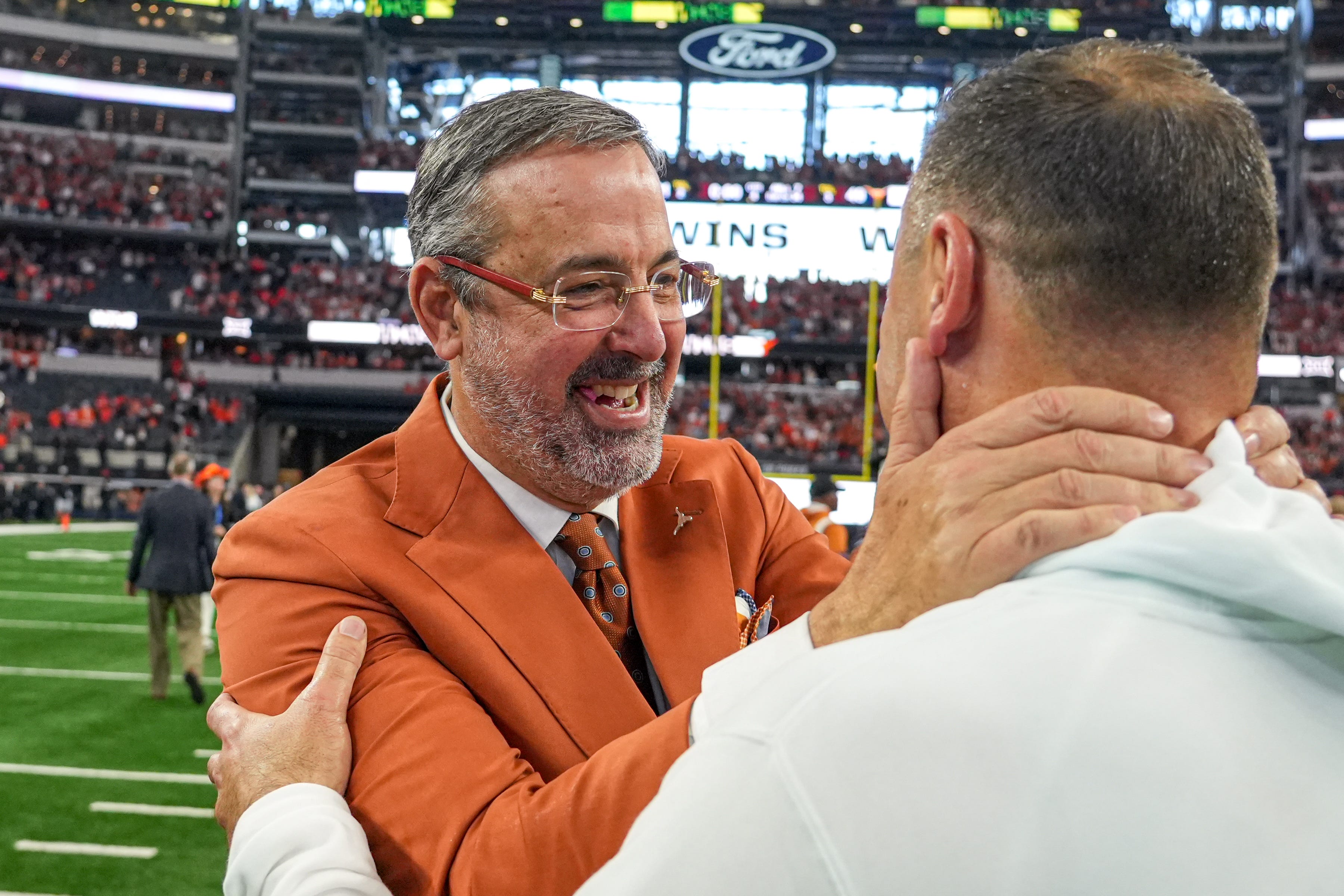
University of Texas officials have long used the Longhorn Foundation loyalty points system to determine the pecking order when it comes to season ticket sales, bowl game tickets and seating priority, among other things.
Now, the athletic department has figured out a way to reward donors with Foundation points if they can help fill the Longhorns’ NIL coffers.
Effective immediately, donors who contribute $100 to the Texas One Fund will also receive five Longhorn Foundation loyalty points, the school announced. By giving to the Texas One Fund, donors will be contributing directly to the athletes.
“It’s a great way for us to show our gratitude for your never-ending support and for you to be further recognized for your continued commitment to the success of our athletics programs,” UT athletic director Chris Del Conte said in his weekly email to fans.
NIL collectives started out totally independent from the schools and athletic departments they support. But quickly, those same collectives have been moving closer to the athletic department purview.
State lawmakers are getting involved by changing the rules, too. New laws are granting collectives nonprofit status, thereby giving donors a chance to give money to the athletes while getting tax credits as well. Now, some collectives are scrambling to either get nonprofit status or face possible extinction.
Walk of Champions, a private entity set up to start Alabama’s NIL machine, announced it will be shutting down, according to AL.com. Walk of Champions received guidance from the Internal Revenue Service stating that entities “serving the private interests of student-athletes” do not qualify as nonprofits because the athletes essentially don’t count as charity.
On the Texas One Fund website, the organization lists itself as a “proud partner/sponsor” of Texas Athletics.

“The Texas One Fund has been granted tax-exempt status as an organization under the Internal Revenue Code Section 501(c)(3) and continues to operate under its IRS approval,” the site says. “However, we encourage donors to consult a tax professional regarding the tax deductibility of donations to Texas One Fund.”
Donations to Texas One Fund can be marked for a specific sport. However, the fund does not accept donations earmarked for a specific athlete. Those who wish to give money to any specific athlete must contact that athlete directly and follow the appropriate rules.
The Longhorn Foundation priority points system was first implemented in 2016. Every donor who contributed to the Foundation since 1986 received points in the new ranking system.
At the time of the program’s conception, donors received five points for every $100 contribution since Sept. 1, 2014. Donors could also get two points for $100 in seat-related contributions during that time.
The department awarded three points for every $100 in donations from 1986 to 2014, and one point for $100 in ticketed sports since 1987. Also, every UT letterwinner received 150 points automatically as a one-time bonus.
The school has long kept its priority points rankings private, fending off reporters who battled via the state’s open records laws and the Texas Attorney General office decisions. Former UT athletic director Steve Patterson once said the top five “wouldn’t be a big surprise” if you look at who’s names are on buildings around campus.
But with each generation, new donors emerge, thus a need to have a points system. Those who wish to get better seats simply need to stroke a check to the Longhorn Foundation.
Or now, give to the Texas One Fund.