
Is the Patriots' new offensive tackle acquisition a viable starter?
The 2022 Patriots season was dominated by the drama surrounding Matt Patricia and Joe Judge. However, an overlooked aspect was the inconsistent and struggling performance of the offensive line. Undoubtedly, the coaching difficulties played a role in the team's poor performance and lack of cohesion. Communication issues within the offensive line were apparent as early […]

The 2022 Patriots season was dominated by the drama surrounding Matt Patricia and Joe Judge. However, an overlooked aspect was the inconsistent and struggling performance of the offensive line. Undoubtedly, the coaching difficulties played a role in the team's poor performance and lack of cohesion. Communication issues within the offensive line were apparent as early as day one of training camp.
Furthermore, it should be noted that the Patriots lacked top-tier offensive tackle personnel, which contributed to the problem. Rather than investing heavily in upgrading their personnel, the Patriots opted for a different approach to remedy their offensive line. They brought in a mix of older veterans and "project" players, hoping that with the right coaching, these players could develop enough to provide stability on the team.
During the Patriots relatively quiet free agency period, one of the their earliest offseason signings was Calvin Anderson, a former offensive tackle for the Denver Broncos. Interestingly, Anderson initially entered the league as an undrafted free agent with the Patriots in 2019 but was released soon after. He then spent four seasons with the Denver Broncos, where he finally had a chance to be a long-term starter this past season. In 2022, Anderson played in ten games and played a total of 439 snaps.
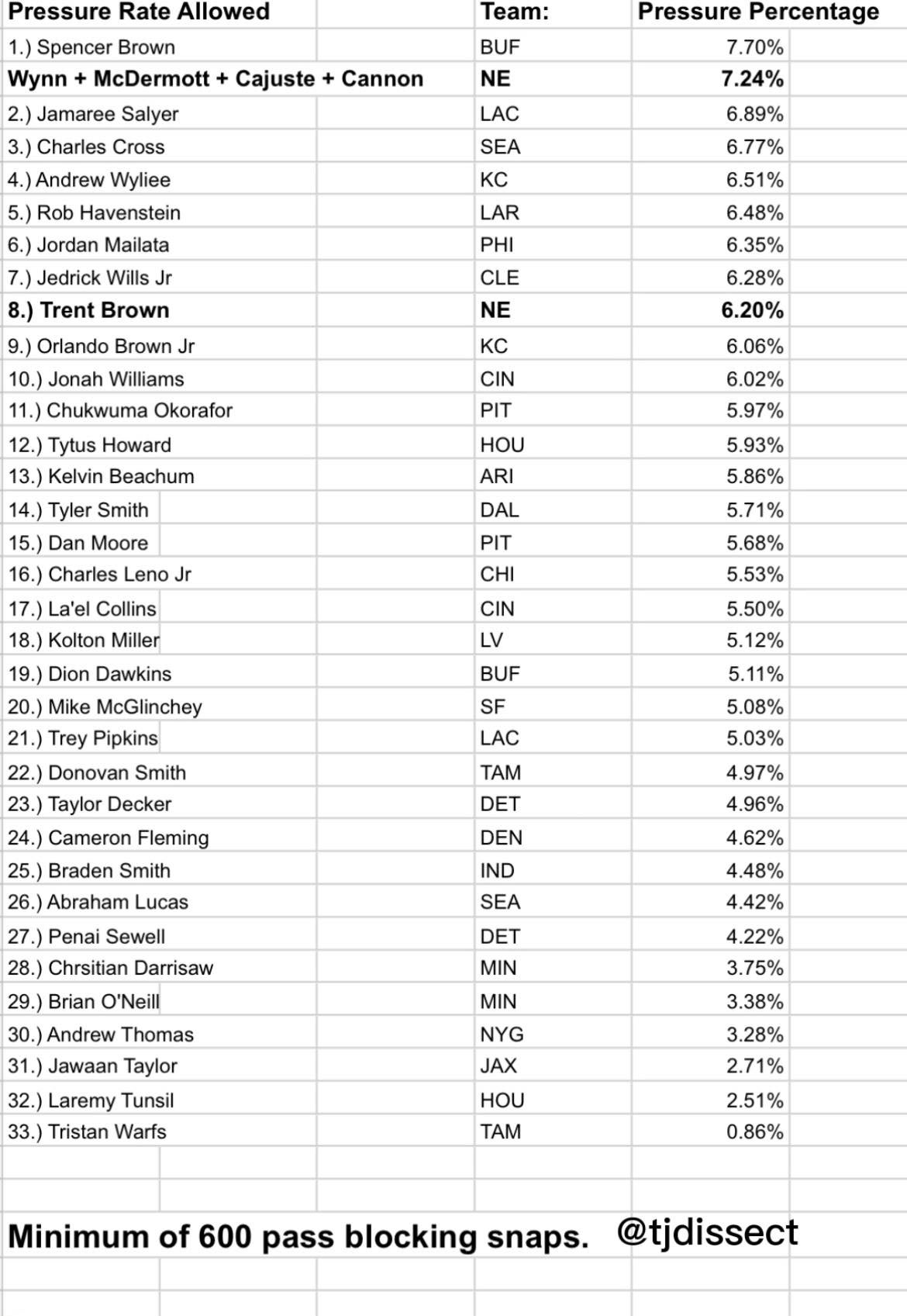
In his limited playing time as a starter, Anderson struggled and was plagued with inconsistency. Anderson allowed a total off 22 pressures in 289 pass blocking snaps. I assembled a chart for the 2022 season that reflects how that stands up versus the rest of the league.
In this chart, I put together the performance of every starting offensive tackle in the NFL who had a minimum of 600 pass-blocking snaps. To determine their pressure percentage, I divided the number of pressures allowed by their total pass-blocking snaps. A higher percentage indicates a higher rate of pressure allowed by the player.
Taking a closer look, Spencer Brown had the highest pressure percentage in the NFL, allowing pressure on 7.70% of all his pass-blocking snaps. This means that no other offensive tackle allowed pressure at a higher rate than Brown did in the 2022 season.
On the other hand, Tristan Wirfs boasted the lowest pressure percentage by far, allowing pressure on just 0.86% of all his pass-blocking snaps. Wirfs' performance stands out as the best in the NFL, with no other offensive tackle allowing pressure at a lower rate.
Although Anderson did not meet the qualifications of 600 pass-blocking snaps, I included him in the list to gauge his performance against full-time starters. Anderson's pressure rate was 7.61%, making him the second-highest in terms of pressure allowed per snap in the NFL, just behind Spencer Brown.
Pressures alone isn't a replacement for watching film and making a sound judgement, but data coupled with film can give you a clearer view. One of Anderson's worst games came again the Chargers, he only played 19 snaps before being benched. The film is worse than the numbers would suggest.
Although Anderson experienced some difficulties, he also had moments of brightness. It's no easy task playing in front of Russell Wilson, who is known for making life harder for his offensive linemen.
Currently, Anderson's strongest suit is likely his ability as a run blocker. However, even in this aspect, he has occasional inconsistencies. In both pass protection and run blocking, a notable issue is his tendency to lose leverage against defenders, which enables them to knock him off balance and power past him.
While Anderson did showcase some good moments in both pass protection and as a run blocker, it was not frequent enough. The Denver Broncos often alleviated the pressure on him by assigning an additional blocker, but relying on such assistance is not a sustainable strategy for a crucial position like Left Tackle, which demands high-level performance.
It remains uncertain how much Anderson will improve through his personal workouts and training camp. However, based on the film from last season, I do not see a player who is currently prepared to be the definitive solution at either tackle position. While he possesses above-average quickness and strength, he struggles with establishing a solid anchor and lacks the technical refinement needed to be a top-tier starter at this stage.
Featured image via Jayne Kamin-Oncea-USA TODAY Sports
