
Matt LaFleur’s stance related to past offseason move confirms Packers’ biggest free agency mistake, but there’s light on the horizon
Left guard Aaron Banks is still around, but he might not even start because of a knee issue and Jager Burton’s ascension.


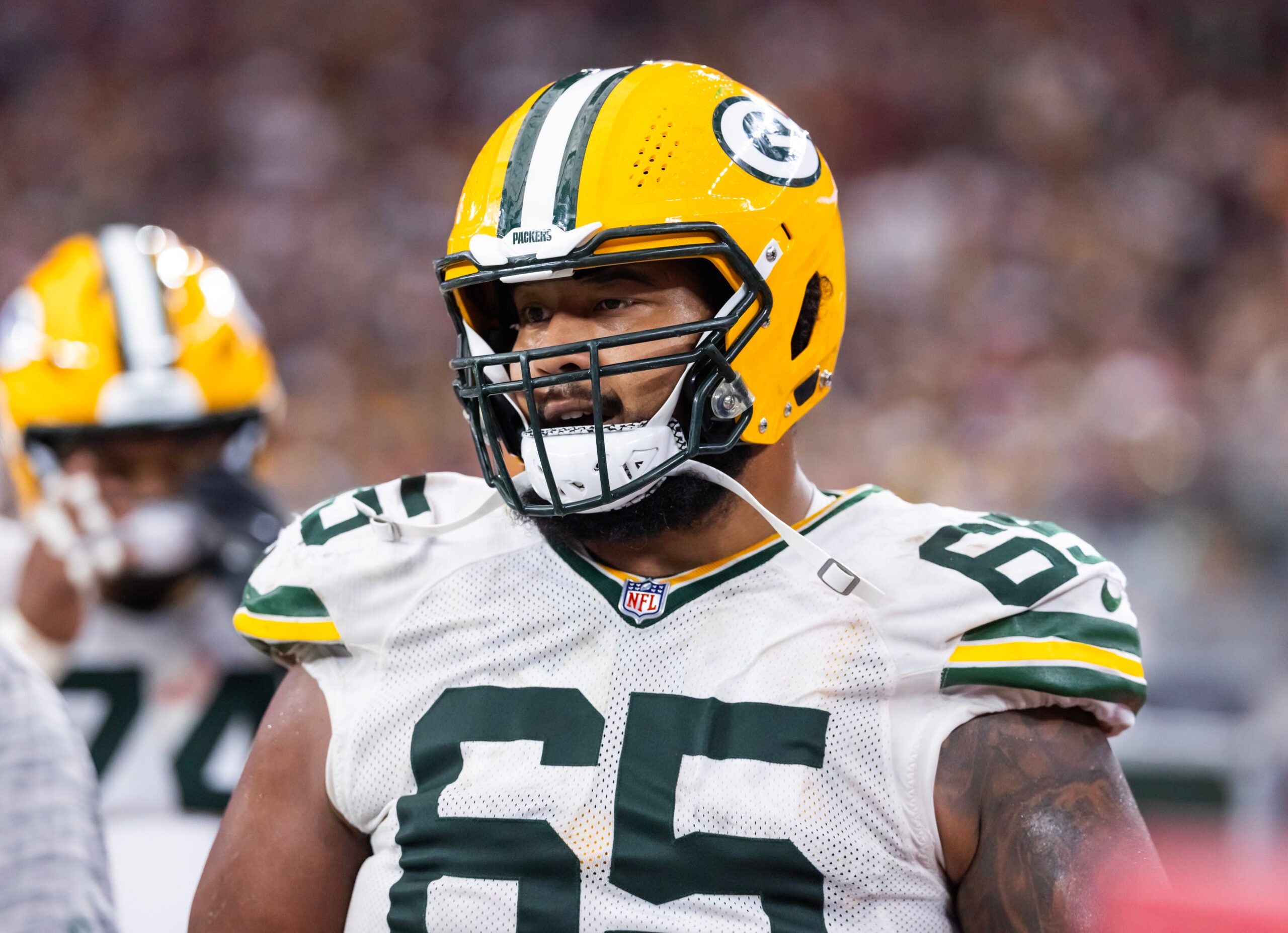
The Green Bay Packers signed left guard Aaron Banks to a four-year, $77 million contract last offseason, and the deal has (expectedly) aged poorly. Banks arrived from the San Francisco 49ers coming off a career year in 2024, but his tenure in Green Bay has been defined by injuries and availability concerns rather than production.
Now, with Banks absent throughout training camp and fifth-round rookie Jager Burton pushing for his starting job, head coach Matt LaFleur’s comments have only reinforced the growing sense that this contract was a significant miscalculation by general manager Brian Gutekunst.
LaFleur tips his hand on Banks’ status
Banks missed two games last season and has not practiced during training camp because of knee issues. He did not play against the Pittsburgh Steelers in the preseason opener. LaFleur stopped short of confirming it, but he indicated Banks may have undergone offseason surgery.
Meanwhile, LaFleur said that Burton is making it “really difficult” for the Packers to decide who will start at left guard. A player earning $18.1 million this season should not be in danger of losing his job to a Day 3 rookie, and yet that is the reality Green Bay faces.
The Packers doubled down on Banks this offseason by paying his $9.5 million roster bonus in March. That decision makes it nearly impossible for Green Bay to move on from him now, and the pain extends into future seasons because of an unusually front-loaded contract structure.
Banks earned $29.3 million in cash last season. This year, his total earnings reach $18.1 million including the roster bonus. His cash compensation decreases to $15.5 million in 2027 and $14 million in 2028, but those figures remain steep for a player who has never been more than an average guard across his NFL career.
The cap implications make the situation worse. Banks carries a $12 million cap hit in 2026 and a $25.4 million cap hit in 2027. If the Packers release or trade him next offseason, the dead money would be $26.2 million, which is more than keeping him. However, Green Bay could use a post-June 1 designation to spread the damage, reducing his 2027 cap hit to around $10 million while absorbing $16.3 million in dead money in 2028. That is still a significant charge for a player no longer on the roster, but it could prove more palatable than paying Banks an additional $15.5 million in cash next season.
Ultimately, the money will be the same even after the restructure this offseason. With cap rollover, it’s just a matter of when the figures will hit. And that’s the light on the horizon, because it’s realistic to move on from a bad deal to avoid more damage.
The mistake compounded itself
The original error was signing Banks to this deal in the first place. He had mediocre seasons and dealt with consistent injuries during his time with the 49ers. His 2024 campaign was above average, but it was not the type of production that warranted top-of-market money at the position. The Packers bet on Banks reaching or exceeding that level, and the bet has not paid off.
The second mistake came this offseason when Green Bay chose to pay the roster bonus rather than exploring an exit. There was a potential out. Releasing Banks would have turned the contract into a painful one-year, $29.3 million commitment, but it would have spared the Packers from the $18.1 million they are spending this season on a player who may not even start.
Other guards on the market last offseason signed far more team-friendly deals. Teven Jenkins, the former Chicago Bears guard now with the Cleveland Browns, signed a one-year, $3 million contract last year and re-signed this offseason on a one-year, $4 million deal. Jenkins has dealt with his own injury concerns, but he has been at least the same caliber of player as Banks. The difference in cost between the two is staggering, and Green Bay could have allocated those savings elsewhere on the roster.
Where the Packers go from here
The Packers lost Elgton Jenkins and Rasheed Walker this offseason, so offensive line depth is already a concern. That reality made it likely Green Bay would keep Banks around for 2026 and potentially even 2027 depending on his cap situation. His future beyond this season will hinge on health and performance, though.
This was Gutekunst’s biggest mistake in free agency as a general manager, and it has been a costly one for the Packers.
