
Moving on from J.J. McCarthy may be the right move for the Minnesota Vikings, but it will have consequences
If the Minnesota Vikings were to move on from J.J. McCarthy, it would carry some real salary cap consequences.


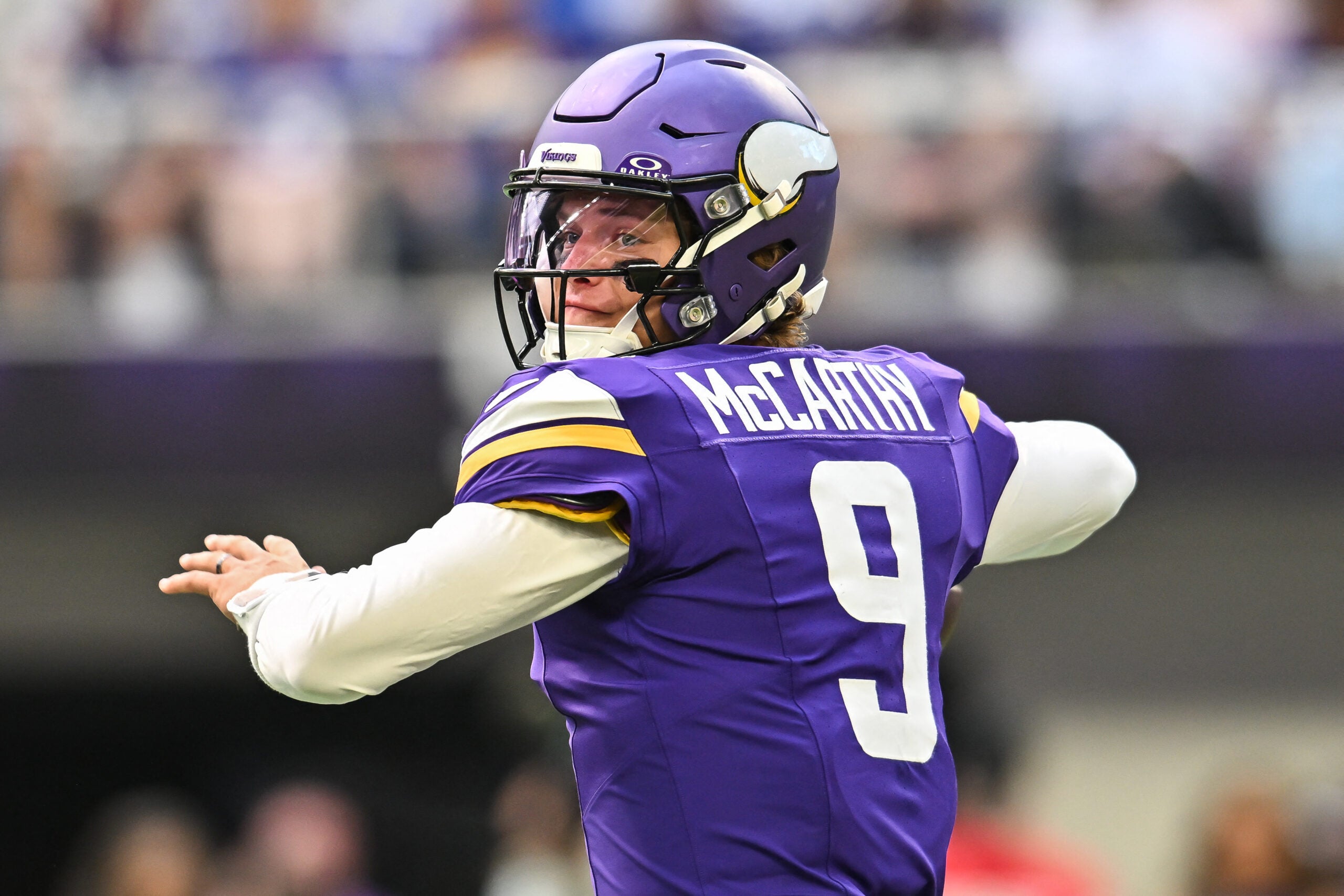
The Minnesota Vikings are approaching an unfortunate crossroads with quarterback J.J. McCarthy. After selecting him 10th overall in the 2024 NFL Draft, Minnesota is getting close to moving on from him just two years later. McCarthy struggled during the 10 starts he made and did not show enough for the Vikings to trust him heading into the 2026 season, leading to his replacement by quarterback Kyler Murray.
If the Vikings were to move on from McCarthy, the decision would carry a number of consequences, both financial and from a public relations perspective. The PR perspective is something we’ve litigated before, and this time, let’s discuss how the money works.
Cutting McCarthy would cost the Vikings cap space
McCarthy currently has a salary cap hit of approximately $5.96 million for the 2026 season, per Over The Cap. If the Vikings were to cut him outright, they would take on an additional $3.775 million in dead cap space in 2026, and have $3.178 million dead in 2027. Some of that could be given back to the Vikings in a salary cap credit with potential offset language, which is standard for rookie contracts.
That’s far from an ideal scenario, but Minnesota does have the room to absorb it with about $22 million in salary cap space currently available.
A trade is where things get interesting
The Vikings could save up to $2.781 million in 2026 by trading McCarthy. However, there is a question about his roster bonus. We don’t know when the $1.706 million roster bonus has been paid. If the Vikings have already paid it, that amount remains on Minnesota’s salary cap, bringing this year’s dead cap hit to approximately $4.9 million. That would translate to only about $1 million in savings this year with a trade.
Next year, the Vikings would still carry $3.178 million in dead money from the prorated signing bonus. The new team would inherit McCarthy’s base minimum salary this year of $1.075 million, his base salary next year of $1.19 million, and the roster bonus of $2.58 million.
Trading makes far and away the most sense for McCarthy, but the Vikings still have to find a buyer. The question becomes: who is willing to trade for him? It would need to be a team with the flexibility to allow him to grow slowly, something Minnesota doesn’t have the flexibility to do. Now, you can argue that they still have that flexibility, but it’s different when you are a failed first-round pick than someone you acquire in a trade like this.
Ultimately, the Vikings were wrong in their calculations that McCarthy would be able to take the next step without having to wait multiple years for a return on their investment. They thought they were drafting a player who could be an impactful contributor early on in his rookie contract.
It’s an unfortunate situation for both sides, but overall the Vikings do have the flexibility to move on. They’re just going to have to eat a little bit of crow.

