
Minnesota Vikings have a lot to be excited about after 2-0 start, and the film proves they are ready for the next step
The Minnesota Vikings’ Week 2 win over the Chicago Bears was improbable, but the film reveals positive steps from several key players.

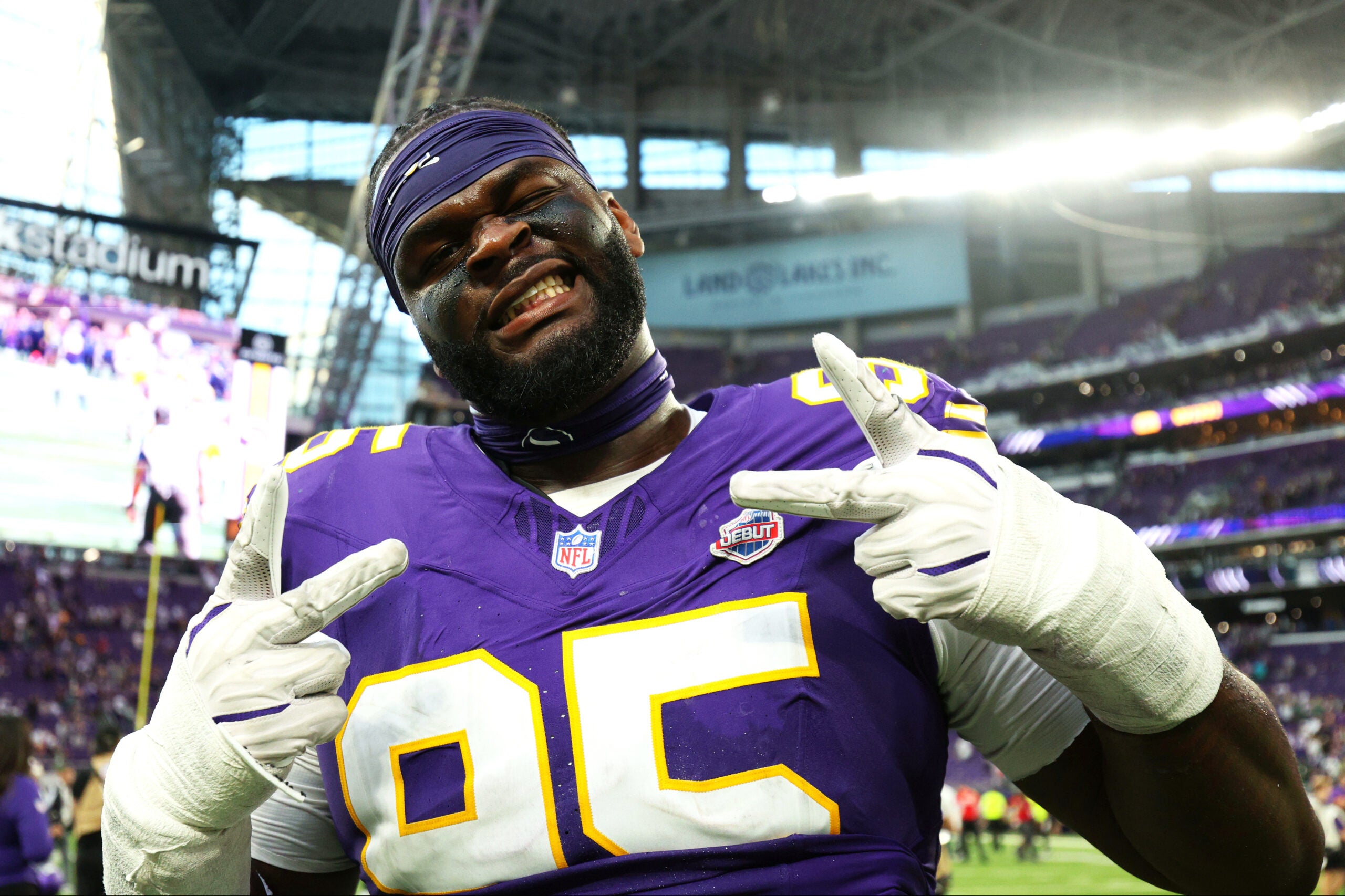
The Minnesota Vikings improbably beat the Chicago Bears, and the film from Sunday’s game reveals some fascinating takeaways that point toward a potential playoff run and Super Bowl foundation. That foundation, though, is far from a finished product.
There are still questions to answer and consistency to prove across the roster. The Vikings’ have a defense ready to compete with anyone, but there are still a number of questions to be answered on the offensive side of the football.
Even with those questions, one thing that stood out to me was how the Vikings have started building a foundation for a Super Bowl run. It’s far from complete, but a foundation is never the full structure.
Dallas Turner was an electric machine
The No. 1 point of conversation has to be edge rusher Dallas Turner. He was electric on Sunday, racking up 11 pressures and two sacks, including the game-winner against quarterback Tyson Bagent. The numbers are impressive in totality, but the question becomes whether they’re sustainable and how he’s generating them.
When you watch the film, Turner isn’t necessarily getting a lot of one-on-one opportunities against offensive tackles. When he does face them, he spent a lot of time contain rushing against Caleb Williams, because that’s what the scheme demands. Williams does Superman things outside the pocket, and Turner was one of the players tasked with keeping him contained. When it looks like Turner is struggling against offensive tackle Darnell Wright, he’s holding fort. He’s not trying to bull rush Wright, but rather trying to hold position and keep Williams in the pocket. That creates a false negative on film where it appears he’s not winning a rep, but he’s not trying to win one.
The way the defense schemes Turner to attack tight ends, running backs, and get free paths to the quarterback is where it gets fascinating. D.J Wonnum had similar free paths to the quarterback during his tenure in Minnesota from 2020-2023. The difference between Wonnum and Turner is about 0.3 seconds faster in the 40-yard dash. Turner is an insanely explosive athlete who gets off blocks fast and closes on the quarterback with rare burst.
Multiple times on Sunday, Turner had a free path around the offensive line and didn’t get over his skis. He slowed down with stutter steps, made Williams declare, then got a hand on him. That’s exactly how the final sack of the second quarter came about. Turner had one of those free paths, didn’t allow Williams to do his standard escape act, instead, he slowed down and made Williams try to duck under him. That slight hesitation slowed Williams enough for Andrew Van Ginkel to come in for the easy sack.
Those pathways are schemed up 100%, but not every edge rusher can do what Turner does and get there in time because of how long the path is. Turner is a unique player in that sense. You can build a defense around what he offers, and his emergence in this role is significant even without a high volume of one-on-one wins. When award season comes around, people might knock him for the lack of one-on-one victories. To a point, that’s fair. But you don’t need him to win one-on-ones when he can do so many things without them. Beating a tight end isn’t necessarily that impressive, but not every edge rusher can dominate tight ends the way Turner is doing. It allows Brian Flores to design a defense around his unique abilities.
He’s doing a great job overall, but he’s not a flawless player, which he shouldn’t be at 23 years old.
Carson Wentz is not the long-term answer
On the offensive side, the conversation about quarterback Carson Wentz is simple: he shouldn’t be the starter long term. Wentz was pressured on eight dropbacks with his blockers allowing only six pressures, meaning he was responsible for a couple himself. He was sacked three times for a pressure-to-sack rate of 37.5%. Not exactly great.
The simplest way to frame Wentz is this: he gives you a baseline of competency paired with the variance of somebody who can deliver high-level play. You may get a game here and there where Wentz looks like a fringe Pro Bowler. He’s experienced, has arm talent, and a bevy of weapons to throw to. However, he’ll then make plays that remind you exactly why he isn’t a starter in the NFL.
Sunday showcased the full Carson Wentz experience. The zone blitz where Chicago sent the corner, who triggered just early enough on a jab-step fake to sell Wentz, led to an attempt to layer the ball over linebacker Devin Bush. It didn’t work, but wide receiver Jordan Addison made a fantastic play to bail him out.
There was also the play where Addison ran a route they have hit multiple explosive on, doing a little hitch before looping around into a wheel route. Addison was wide open, and safety Dillon Thieneman couldn’t get there quickly enough. But Wentz threw it more toward the sideline while Addison ran it more toward the hashes. That miscommunication or lack of understanding of where the receiver was heading caused the incompletion. Whether that’s on Wentz or Addison is debatable, but it was incomplete, and it was a throw Sam Darnold and Kirk Cousins hit multiple times with Addison. That chemistry simply isn’t there with Wentz.
Wentz is a good backup. There’s nothing wrong with him in that role, but it’s evident he should not be the guy long term. That doesn’t necessarily mean Kyler Murray will be the bona fide starter long-term, but it doesn’t mean he won’t be either.
Caleb Banks took positive steps
Defensive tackle Caleb Banks is a fascinating player to evaluate. At 6-foot-6 and 5/8, 327 pounds out of the University of Florida, Banks broke his foot the night before testing at the NFL Scouting Combine and still ran a 5.04-second 40-yard dash. For somebody that size, that kind of movement ability hits differently.
Banks is far from a finished product, and nobody expects him to be one. He did get a pressure on Sunday, and his PFF grade was a brutal 30.1. But PFF grades aren’t necessarily going to give Banks proper credit because they’re looking for different things. Banks needs to improve in a multitude of ways, but his impact, his ability to stop people, slash inside, get penetration, and use his 35-inch arms makes a big difference.
The most important thing Banks did on Sunday was take positive steps. He didn’t really have a standout play against the Green Bay Packers in Week 1, but against the Bears, he kept his pad level better, held up against double teams stronger, and got penetration in the run game. That was his biggest asset at Florida. He wasn’t finishing a lot of those plays, but when you get into the backfield, that matters. If you send the running back on a different path or force the quarterback to sidestep the pocket and take his eyes away from downfield for a split second, that can completely change the dynamic of a play.
Banks will eventually be in a place where he’s a better finisher. That’s the hope, but making an impact is the most important thing, and he did that while also holding up at the point of attack in a much stronger fashion. The stark contrast between this and what we saw in Week 1 against Green Bay is like two different players. That’s a great building block, but the Vikings need to see it consistently.
The offensive line is proving it can be trusted
The offensive line has been ragged on for multiple reasons, and last week the conversation centered on guard Will Fries. At $18.5 million in average annual value, he was brought in to replace Ed Ingram and did not play nearly up to that price tag early on. In his first year with the Vikings, Fries spent the entire offseason rehabbing a broken leg he suffered in Week 5 of the 2024 season. Some early struggles were understandable, but as things progressed, he didn’t showcase an elite level of play. Too many elements of variance. He did only miss 12 snaps the entire year, which is great, but you would have liked a better return on investment.
Against the Bears, Fries was solid. He allowed two of the offensive line’s four total pressures and was a good run blocker, mauling defenders and being a mover of men. The offensive line as a whole has proven it’s ready. This may be the best unit the Vikings have had since Steve Hutchinson left. The mauling in the run game on the left side with Christian Darrisaw and Donovan Jackson is bonkers. They’re doing a tremendous job moving people. The pin-and-pull toss with either Hockenson or Oliver cracking down on the left side so Darrisaw can get out and run has already proven to be effective.
This offensive line is something to be reckoned with this year. They may not be an elite group, but by the end of the year, this could be a bona fide top-10 unit in football. Paired with this defense and the potential the offense has with a renewed focus on the run game, things could be great.
Once Kyler Murray returns this Sunday against the Tampa Bay Buccaneers, the question becomes whether he can take the step forward the Vikings signed him to take. He was signed because he was cheap, but also because the organization believed he could be good for this team. How that manifests remains to be seen. A lot has to happen before anyone determines who is a Super Bowl contender or pretender. One thing is for sure: the foundation being built in Minnesota is worth paying attention to.

