
Minnesota Vikings’ biggest issue on offense isn’t Kyler Murray, and the fix is staring them in the face
Everyone wants to point to Kyler Murray being the problem with the Minnesota Vikings’ offense, but it’s far from the truth.


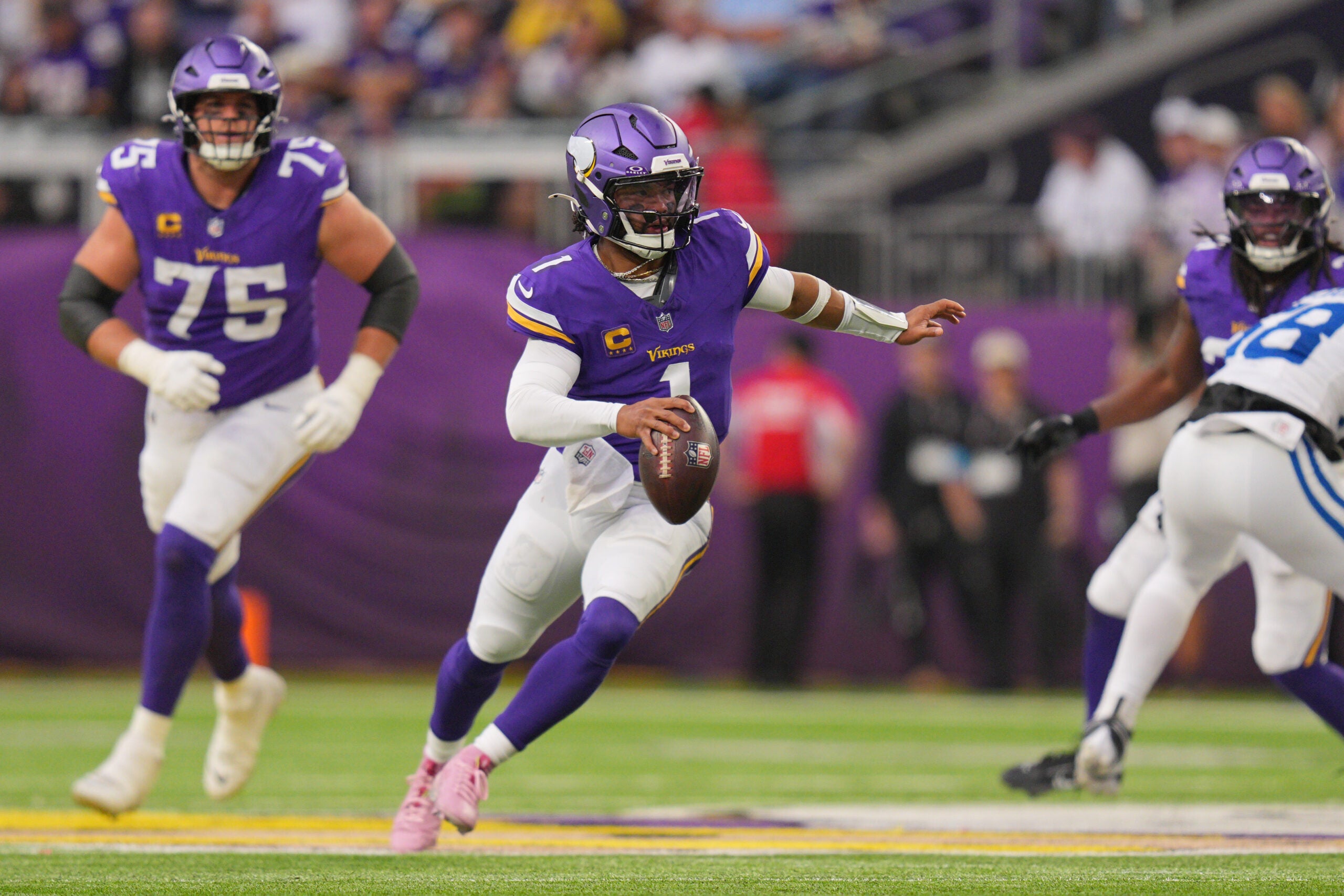
Most of the conversation around the Minnesota Vikings’ offensive struggles have centered on Kyler Murray. Those conversations are valid. However, the biggest issue on the Vikings’ offense isn’t the quarterback. The run game simply isn’t good enough.
It’s not from a lack of effort, either, and that might be the most frustrating part. Minnesota ranks 27th in the NFL in EPA/rush and 27th in rushing success rate. That’s despite having one of the lower neutral pass rates in the league. The Vikings are committed to running the football, and it isn’t paying off.
Minnesota Vikings offensive line isn’t doing the run game any favors
The issues are multifaceted. For starters, the Vikings lost tight end Josh Oliver after he tore his biceps against the Tampa Bay Buccaneers. Oliver is one of the best blocking tight ends in football, and his absence has been impactful.
You can’t equate it one-to-one, though. Minnesota ranks fourth in the NFL in run-block win rate, which says the line is holding blocks on an overall scale. The margins are thin, however. The Vikings sit at 75%, while the Miami Dolphins rank 26th at 71%. When this line lets defenders through, it gets ugly. Pro Football Focus grades are far from perfect, but they’re rooted in film, and they have the Vikings 25th in run-blocking grade. The tape backs that up.
Zone concepts haven’t been nearly as fruitful as gap and power concepts like counter, power, wham, trap, and crunch. A couple of weeks ago, Minnesota ran what Ben Goessling called the “triple trap.” It’s essentially crunch, which is a really fun concept to pair with the zone scheme they like to run, and it works almost like a power-zone hybrid. The coaching staff is getting creative, but the interior simply isn’t holding up.
Losing Donovan Jackson has been a tough pill to swallow. Jackson is one of the best young left guards in football. There was even discussion about trading for and extending Quenton Nelson, then moving Jackson to right guard, a spot he played a bit early in his career at Ohio State. Nelson ended up with the Seattle Seahawks, so that idea died.
Joe Huber has played relatively well in Jackson’s place. The bigger problems are at center and right guard, where high-priced free agent Will Fries hasn’t worked out, and Blake Brandel has been very inconsistent. The only consolation is that the Green Bay Packers’ deal with Aaron Banks, from the same free-agent class, hasn’t panned out either.
The Vikings probably would have been better off keeping Ed Ingram, which feels strange to say. Ingram played well for the Houston Texans, especially as a run blocker, and earned a three-year, $39 million contract. That looks a lot better than the five-year, $92.5 million deal Fries signed, and he hasn’t played well enough to justify it.
Aaron Jones and Jordan Mason haven’t elevated the backfield
The offensive line isn’t the only culprit. The running backs haven’t been good enough either, and that’s a hard conversation to have.
Aaron Jones has been a stalwart for Minnesota. He plays with heart and toughness, and he deserves credit for that. At a certain point, though, the question becomes whether he’s good enough to lead this backfield as the top guy, and I don’t think the answer is yes.
Jones is averaging 4.2 yards per carry, but his rush yards over expected sits at -0.6 per attempt. His rush EPA is a whopping -23.7 on 105 carries, which works out to roughly -0.23 EPA per rush. Because Jones has handled the majority of the carries, Minnesota’s success rate reflects his struggles.
Jordan Mason was supposed to help. He’s averaging 4.5 yards per carry, but his rush yards over expected is -0.2. That metric compares a back’s actual yardage to what he should have gained based on blocking and the situation on each play. A positive number means the back is creating beyond what was blocked for him. Mason’s rush EPA is -4.1 on 30 carries, a small sample, but far less damaging than Jones’ numbers.
Mason is a strong complementary back. He breaks tackles, wears defenses down, handles zone concepts well, and can run through contact on power. What he lacks is real juice, and pairing that with vision is hard to find.
A trade might be the only fix
That’s why Jonathan Taylor is getting more than $22 million per year on his two-year extension. Backs who combine explosiveness and vision are rare. It’s also why Taylor’s name, along with Saquon Barkley’s, keeps coming up around the Vikings.
Landing Taylor would be a massive coup for Minnesota. He could handle a workhorse role while the Vikings distribute carries more effectively between Jones and Mason, keeping everyone fresher and healthier.
This doesn’t need to become a top-five or top-10 run game. It just can’t be bad. Moving from 27th to somewhere around 18th would make a meaningful difference. Some of that will come from better blocking, and some of it will come from adding another running back.
The Vikings need more explosive plays on the ground, and a trade is probably the most realistic path to get them. If Minnesota pulls it off, it could do wonders for the offense as a whole, Murray included.

