
Minnesota Vikings’ offense under Kyler Murray is dealing with the same issues they had for years with Kirk Cousins
The Minnesota Vikings have been very interesting on offense, but Kyler Murray is too similar right now to Kirk Cousins.

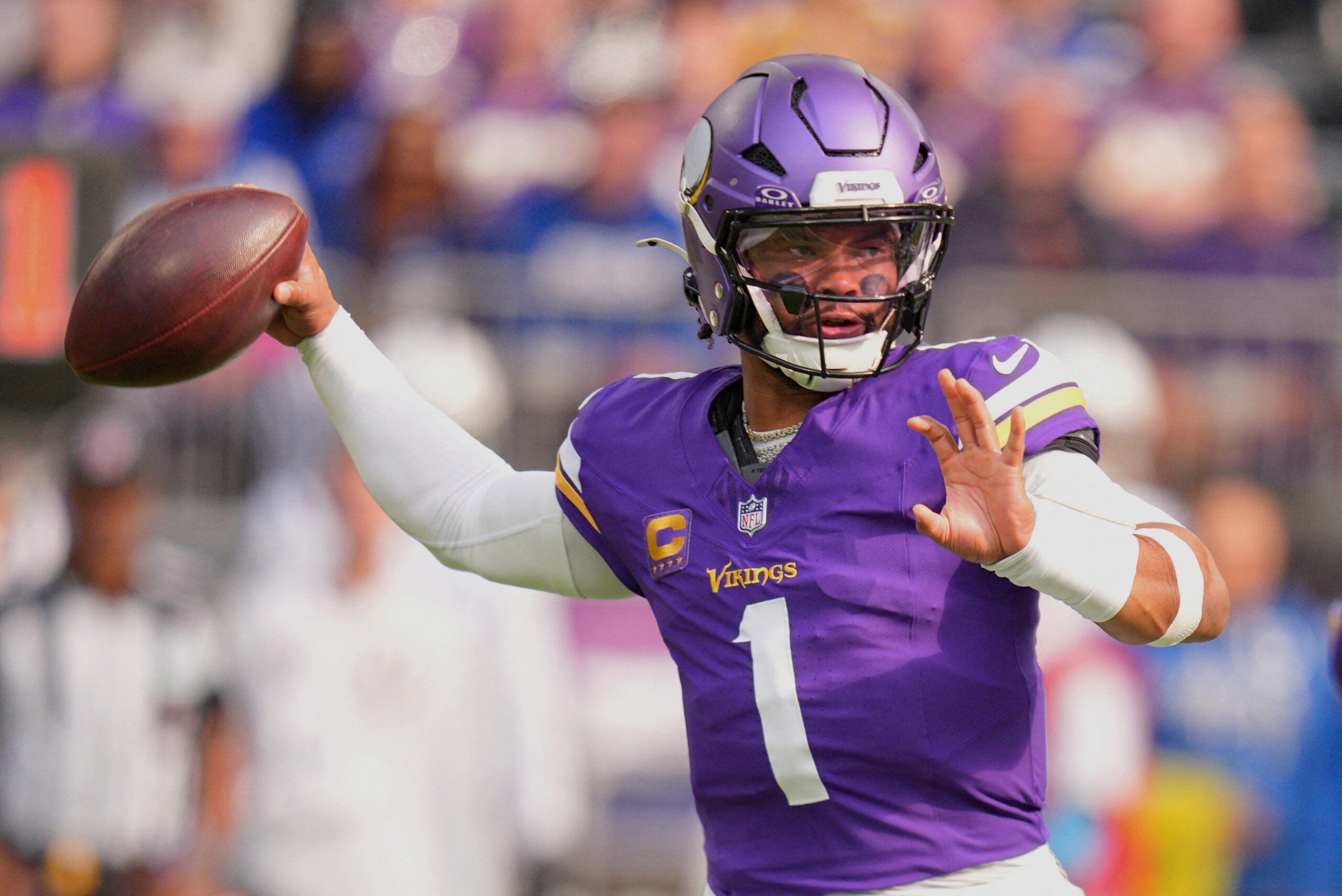
There’s no sugarcoating it: frustration with the Minnesota Vikings’ offense is everywhere right now. Diagnosing what’s actually wrong with it is more complicated than simply blaming quarterback Kyler Murray. It also doesn’t help that J.J. McCarthy has played well in his first couple of games with the New York Giants.
The conversation has to start with Vikings head coach Kevin O’Connell. He addressed several aspects of the offense after the game, and play calling has become a major topic. Some are calling for him to hand it off entirely.
Kevin O’Connell is still the best play caller for the Vikings
If you want somebody to stop doing something, you need somebody worthy of taking over. Right now, Minnesota doesn’t have that person. Taking play calling away from O’Connell would be a change for the sake of change, not necessarily a move to make the team better.
Offensive coordinator Wes Phillips has called plays in the preseason and quarterbacks coach Josh McCown has never called plays at the NFL level. That doesn’t mean either coach is bad or that they aren’t good at their other responsibilities, but trusting turning over play calling to someone who hasn’t done it in a regular season game for a 6-0 team doesn’t make much sense. It means O’Connell is still the best option, even with clear room for improvement.
One area he pointed to was the opening four-play sequence, which went run, run, run, run. That traces back to a process called “canning.” In the huddle, O’Connell gives the quarterback two plays. Murray then reads a key at the line, such as a defender in the box or someone aligned over the slot, and checks into whichever play gives the offense the better look. When you see a quarterback yelling “can can” and teammates signaling back, that’s what is happening.
There’s a lot of merit to the system because you want your best play against what the defense shows you. However, O’Connell acknowledged he might be giving his quarterbacks too much latitude.
“I think the hardest thing is a lot of our plays are can system plays where it’s maybe run-pass, maybe it’s run-run, maybe it’s activating Kyler in some capacity. So the ultimate hard thing as the play caller is just we just got beat up front. Maybe we just didn’t get the push we were expecting,” said O’Connell.
“But it’s part of committing to [the run game]. I think a big part of it, though, is how are we putting the plays together; it might look like run, run, run, run to start the game, but we can’t put it so much in the defense’s hands on ultimately what play we end up running when we have two plays called, and that totally ends up being on me. And I thought it was a huge early momentum chance lost coming off of Jugs or Myles Price’s return, and not getting that new set of downs was very disappointing.”
A defense can essentially force you to run the ball all day if you let its alignment dictate everything. You still have to be willing to throw against some of those looks.
Kyler Murray’s turndowns and inaccuracy stand out on the All-22
It isn’t all on Murray, but a lot of it is this week. O’Connell said he feels like the offense is close, and the All-22 backs that up. The tape shows high-level quarterbacking, along with turndowns that leave you very frustrated.
In the fourth quarter, Jauan Jennings was streaking wide open on a seam route. The defense shifted from Cover 2 into a Cover 1 look, and the safety opposite Jennings bailed out of that space entirely. That’s a touchdown. Murray went elsewhere, and the play produced far less.
Late in the game on third-and-16, the Vikings threw a deep curl to Tai Felton that got batted down. Justin Jefferson was on the outside on the opposite side of the field against Charvarius Ward, who was bailing hard in Cover 3 to avoid getting beat deep. It’s something that he was doing all game to prevent anyone from getting behind him. Once Jefferson stopped, a throw with timing and anticipation would have picked up the first down and closed out the game.
The misses were just as costly. Both throws to Jordan Mason in the flat sailed high. On the first, Mason appeared to slow down, and Murray seemed to expect him deeper. On a Jefferson RPO glance route, Jefferson was open on his break, but the ball went to his outside shoulder. On a third-down hitch just past the sticks, Jefferson was wide open again, and the throw landed way outside his frame.
Inaccuracy defined the day for Murray, which was very uncharacteristic of him. Even when Murray made the right decision, he didn’t complete the pass.
Bad game or bad quarterback?
That raises the real question: how much of this is a bad game versus a bad quarterback? I don’t think Murray is bad, but this wasn’t his strongest performance.
Isolating this one game is dangerous with such a small sample, but the numbers weren’t disastrous. Minnesota ranked 15th in EPA per play (0.156) and posted a 45.5% success rate. You can win with those numbers, though you don’t want a success rate that low over a full season.
There were genuinely impressive moments too. Murray threw a couple of deep outs to Jefferson with anticipation and ripped a seam to T.J. Hockenson. On the final drive, he rolled left and threw across his body to Jordan Addison for an explosive gain that would have set up first-and-goal inside the 5. A Blake Brandel hold, while ticky-tack but still the right call, wiped it out.
That’s why O’Connell isn’t wrong when he says the offense is close. The question is how many times you can say that before accepting it isn’t there.
Kyler Murray looks like a modern Kirk Cousins
When I look at it from that perspective, one comparison keeps coming up: Kyler Murray is a modernized, more athletic version of what we had in Kirk Cousins.
Vikings fans had these exact conversations throughout the Cousins era. He would pass on deep shots, hesitate on receivers breaking open, take the check down, or miss the mark. Then he would make the big-time throw, and everyone wondered why he couldn’t do it regularly.
You can win with that quarterback, but how much? Minnesota reached the divisional round once with Cousins. The Vikings missed the playoffs in 2018, 2020, and 2021, and the 2022 run ended with a wild card loss to Daniel Jones and the Giants. Cousins tore his Achilles in 2023, which directly resulted in another non-playoff season. Nobody debated his talent; it was always about mentality and what he was willing to attempt.
Murray is at that same crossroads. If the Vikings can get the best version of him consistently, this team has Super Bowl potential, especially with a defense that has shown no signs of slowing down. That being said, the offense still has a real chance to get better, even if it doesn’t feel that way right now.

