
Titans’ no-huddle explosion has a hidden efficiency hack that the rest of the NFL hasn’t caught onto yet, but there’s a catch
The Titans are running no-huddle at a rate nobody else in the NFL is even close to. I sat down with Fantasy Points’ Ryan Heath to figure out why.


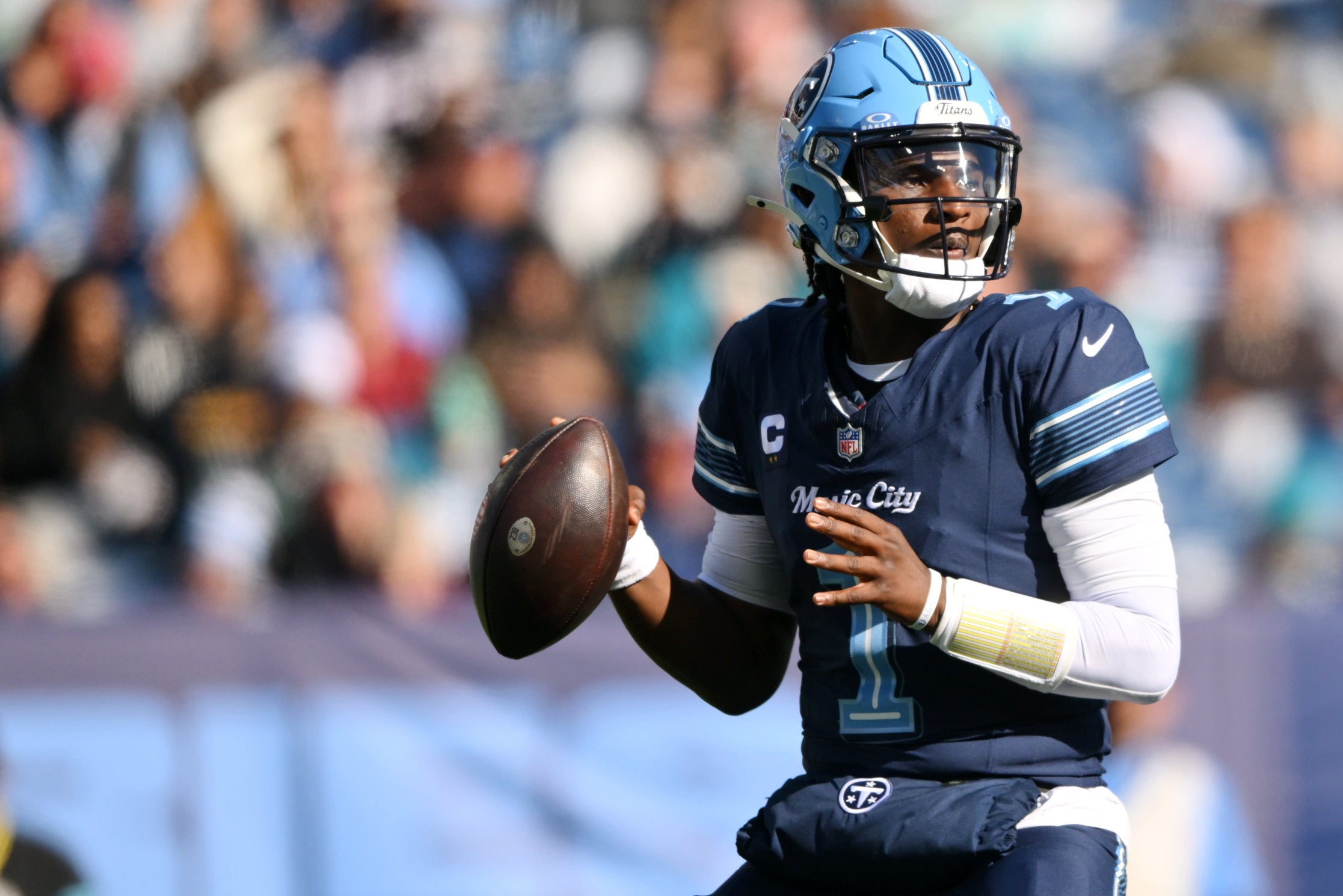
The Tennessee Titans have suddenly become the NFL’s kings of no-huddle, and the shift lines up with an offense that has finally found a pulse. Over their past three games, the Titans have lapped the league in no-huddle rate.
Their season-long rate sits at 23.3%, and it keeps climbing. Tennessee has been north of 40% in each of its past two games. Nobody else in the league is running their offense remotely similarly right now.
And the results have been fruitful so far! The Titans scored 84 points in their first six games, and have 83 in their past 3. The message from the podium in Nashville has been about giving quarterback Cam Ward more time to identify what the defense is doing, get comfortable with his checks, and string plays together in a rhythm. All of that is real.
But the whole offense has improved, including the run game and running back Tony Pollard. And in talking with Ryan Heath, the lead data writer at Fantasy Points, I think he identified the real skeleton key to why this is working.
The no-huddle efficiency hack starts with the Titans’ run game
Heath started with the bigger picture. For the last couple of seasons, NFL offenses have been obsessed with dictating personnel. You want to throw into run-stopping personnel and run into pass-stopping personnel, which has driven the league’s love affair with heavy looks and tight ends.
The no-huddle is another way to get those favorable looks without a deep tight end room.
Fantasy Points Data charts every play, and Heath’s team ran a research project this offseason looking back over the past five years of the NFL.
“What we found was that if you’re running out of the no huddle very often, you are trapping the opposing defense into these nickel and dime packages,” Heath said.
The numbers are striking. Runs from the huddle produce about -0.06 EPA per carry, which tracks with running generally being a negative-EPA decision. Runs from the no-huddle jump to a positive 0.02 EPA per carry, largely because those runs face a nickel look 77% of the time.
“It’s just much harder for defenses to stop the run,” Heath said.
That’s exactly what has shown up in Tennessee. Fantasy Points’ data suite has the Titans at 6.71 yards per carry on 28 no-huddle attempts with two touchdowns. Not to take anything away from Pollard, who is playing very good football right now, but the aggressive lack of huddling is absolutely feeding that efficiency.
Daboll has always had a reputation for pace and no-huddle, but not like this. This is personnel-driven, at least to a degree. Gunnar Helm and Daniel Bellinger are fine players, but they don’t bring the blocking heft and dynamic versatility that the best heavy-personnel teams lean on. When you don’t have that advantage, this is a clever way to zag.
Why isn’t every team doing this?
There is a counter, but it isn’t what most defenses want to do. They’d have to be willing to play more base personnel, which coordinators generally dislike because most units get in trouble defending the pass this way. It’s a catch-22, and Heath wondered whether a league-wide counterpunch could eventually swing the NFL back toward a pass-happier era.
So why are the Titans the only ones doing this?
Heath’s answer was simple. Teams don’t lean into plenty of efficiency hacks nearly enough, at least in his estimation. Whether that’s play-action rate, or throwing on second-and-short, or any of a handful of other metas. He also pointed to the copycat nature of the league.
“If the Titans were 8-2 right now, my guess is that more teams would be doing this,” Heath said.
Here’s where I land. I don’t think the people in Tennessee aren’t smart. I just question whether they’re a full step ahead of the McVays and the Shanahans of the world. I suspect the trade-off is what keeps most teams from going this far. Against the Jaguars, Tennessee hung around for most of the game and the offense scored, but the Titans ended up on the wrong side of a nearly 17-minute time of possession differential.
Now technically, when talking about time or possession in terms of workload and stamina, it’s really the cumulative number of snaps each unit gets. But the Titans have allowed the most plays per game of any defense in the NFL too.
That cost doesn’t show up in an offense’s EPA per play, and it’s fair to wonder if head coaches (especially defensive-minded ones) wouldn’t view it as a worthy trade-off, even with a PowerPoint full of numbers shoved in front of them.
There’s a chicken-or-egg element here, too. How much of that workload comes from the no-huddle, and how much comes from a Titans defense that stinks right now? Would a well-above-average defense get run this ragged? I don’t know.
The bottom line is that the Titans needed a spark on offense, the data says they found a real one, and it’s going to be interesting to see how it evolves down the stretch of the season.
