
Notre Dame’s offensive line change against Wisconsin proves that the easy decision is sometimes the correct one
Notre Dame made a bizzare offensive line decision prior to the opener against Wisconsin. A halftime fix made it look even worse.

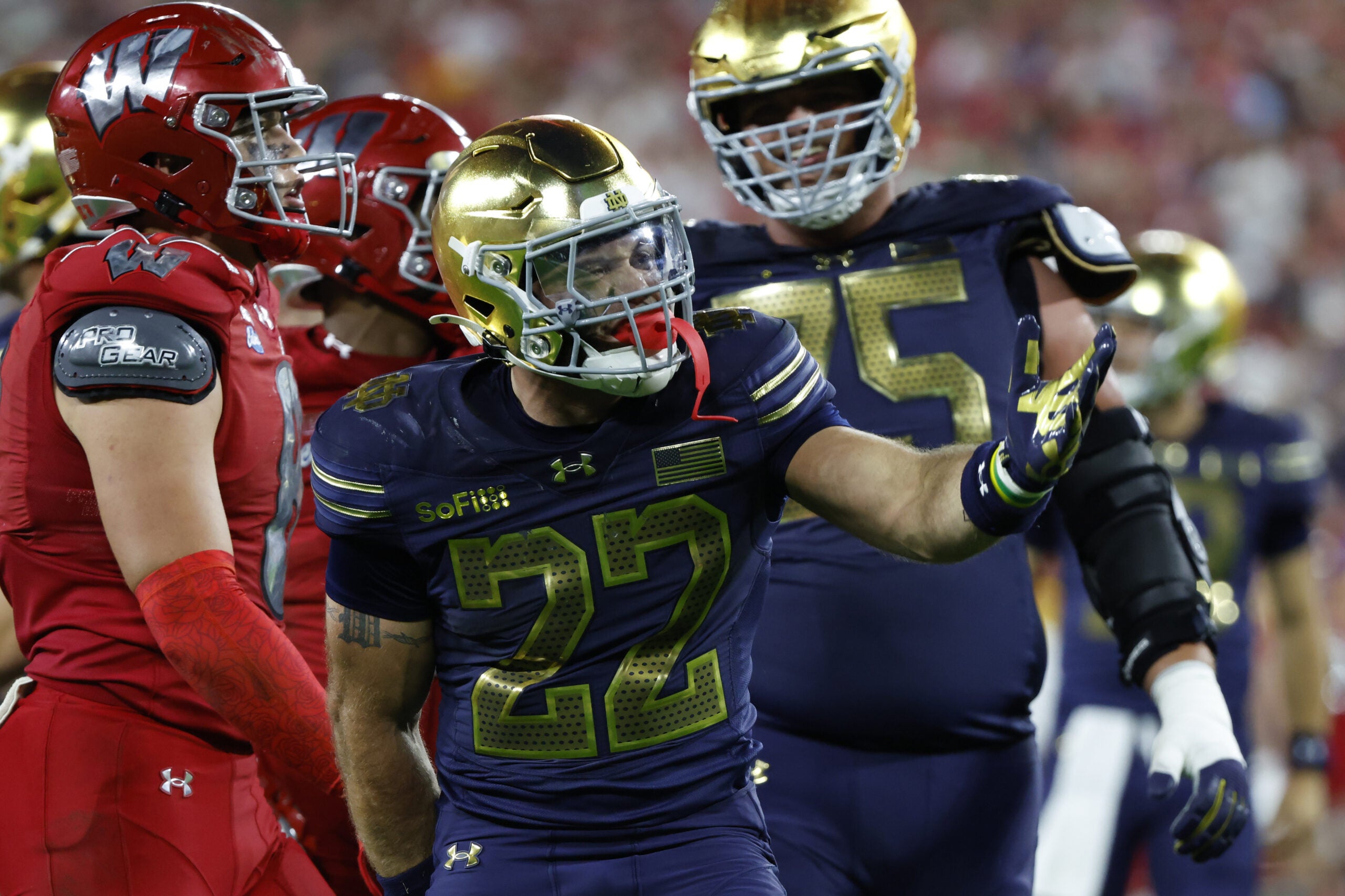
Notre Dame football put together a sloppy first half during the team’s 41-13 victory over the Wisconsin Badgers at Lambeau Field.
It was a troubling start for head coach Marcus Freeman, offensive coordinator Mike Denbrock, and an offensive unit that looked nothing like a group built to dominate on the ground. Then the second half happened, and one personnel change made all the difference.
Sitting with a 13-10 halftime lead, the Fighting Irish had run for just 29 yards on 16 team carries, a mere 1.8 yards per attempt. This is a team built through its offensive line and ability to run the football, something Freeman addressed during his halftime interview.
The passing game was equally stagnant, which makes sense when you consider that Notre Dame’s offense is still constructed around the ability to win on early downs. At the break, quarterback CJ Carr had completed just 10 of 17 passes for roughly 100 yards and a touchdown. The pass protection was incredibly inconsistent.
The offensive line in general did not live up to the standard we expect from a Notre Dame offensive front.
The second-half transformation
Then the second half happened, and this team went on a 28-3 run. Notre Dame averaged over 5 yards per carry after halftime, and Carr found a rhythm, especially with senior wide receiver Jordan Faison. The question most people ask themselves is simple: what changed?
The easiest change to pinpoint came on the offensive line. Redshirt sophomore Styles Prescod got the start at right guard, where he was fine but did nothing to set the world on fire. To begin the second half, redshirt junior Sullivan Absher was inserted into the lineup, and the team quickly profited from it.
For whatever reason, offensive line coach Joe Rudolph did whatever he possibly could to avoid playing Absher in this game, despite the 6-foot-7, 320-pound offensive lineman starting double-digit games a season ago and doing a solid job. The staff had been eyeing different options up front.
If not for a foot injury to redshirt freshman Matty Augustine, he likely would have been the starting right guard. That injury is still going to keep Augustine out for a little while longer. Notre Dame also toyed with the idea of moving Ashton Craig to right guard and letting Joe Otting start at center.
Then Prescod got inserted into the conversation, going from a player getting a look to starting the season opener for the Fighting Irish.
Why Prescod never made sense at guard
Rudolph and his staff are with these players every single day, so they know their progress far better than anyone on the outside. The only thing I can go on is that when Prescod came out during the 2025 recruiting class, he was a player that I had coined as a tackle-only prospect who lacked overall strength and a power profile.
That type of profile doesn’t, in a vacuum, seem to fit ideally at guard. While different running systems can make certain skill sets more advantageous, the ability to work at the point of attack and have some knockback power is a huge aspect of playing on the interior. Prescod just seemed like a very strange fit.
I don’t think it is a coincidence that Notre Dame inserted a bigger, stronger player to begin the second half and all of a sudden created more consistent movement at the point of attack. When Augustine got hurt, it felt like a no-brainer that Absher should have been the starting right guard. But like we’ve seen in the past, Rudolph seemed to overthink this process and made a cloudy decision.
The path forward for Notre Dame’s offensive line
If Absher isn’t the starting right guard, at least until Augustine returns healthy, then there is a problem on this Notre Dame offensive line. The easy decision is sometimes the correct one. The Prescod move to guard never made much sense, and it was verified before our very eyes during this game against Wisconsin.
Notre Dame’s offensive line has a chance to be really good in 2026, but only if the staff makes solid personnel decisions. That has been spotty in the past, and this opener provided yet another reminder.
