
Marvin Harrison Jr.’s Arizona Cardinals funk resurfaces scouting questions coming out of Ohio State
Marvin Harrison Jr. has been very underwhelming so far for the Arizona Cardinals. Was he over-hyped as a prospect all along?

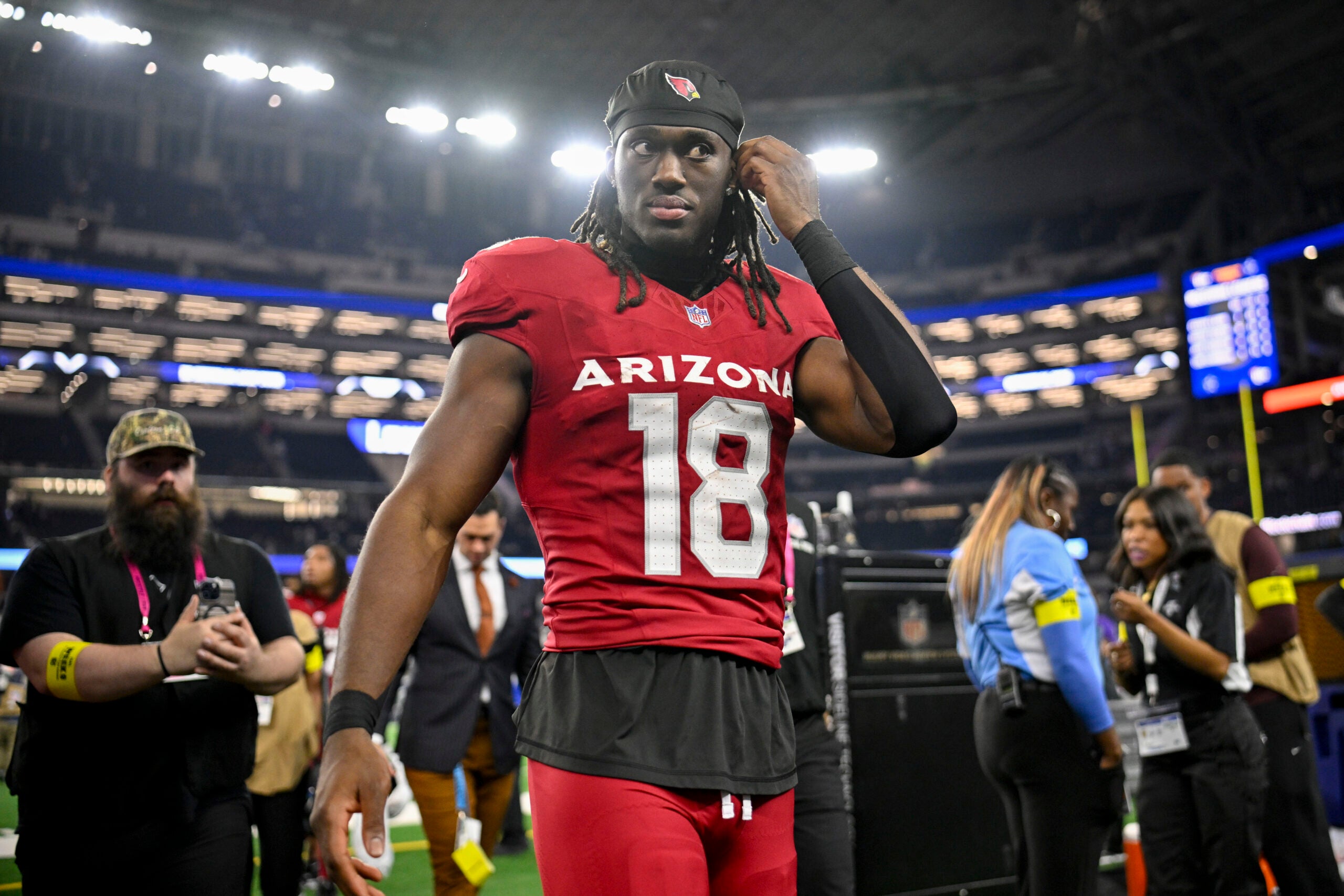
Marvin Harrison Jr. entered the NFL as a top-5 pick with elite college production, a Hall of Fame father, and the kind of pedigree that makes scouts feel safe.
Now, after a rocky start to his professional career, a deeper question is emerging about the Arizona Cardinals wide receiver: Did evaluators give him too much credit for intangible traits they never actually confirmed?
The conversation starts with a simple scouting flaw. When you watched Harrison at Ohio State, you saw the detail in his route running, the precision in his hands, and a frame that dwarfed his father’s.
Marvin Harrison Sr. was roughly 6-0, 180 pounds. He won with technique, with detail, with an obsessive work ethic. He was a pristine worker and a great technician. His son showed up with three-plus extra inches and 30-plus additional pounds, ran routes like his dad, and the natural conclusion was obvious: that’s a Hall of Fame player.
No doubt about it.
But the question nobody could answer with certainty was whether the bias of knowing his father painted a false picture of the mental aspects, the confidence, and the love of football for Harrison Jr. Only the scouts and Harrison himself know those details well enough to confirm or deny them.
Looking back on the evaluation process, there’s a real possibility that too many people gave him the benefit of the doubt, assuming his mentality mirrored his dad’s simply because his dad was who he was.
The name game with Marvin Harrison Jr.
This thought experiment has circulated since draft season and still carries weight heading into 2026. If Harrison was not Marvin Harrison but was just some talented wide receiver without the pedigree and the reputation, would evaluators have felt the same way about him as they did about Malik Nabers in that same draft class?
It’s a fair question.
The absurdity of the current perception gap is telling. Fantasy analysts are now debating whether Harrison or Cardinals teammate Michael Wilson should be ranked one peg above the other on their boards.
One was a top-5 draft pick, elite in college, had a Hall of Fame dad, earned the “Maserati Marv” nickname, and carried a great aura. The other was better at football last year.
That disconnect between draft capital and on-field production is hard to reconcile.
The wide receiver personality factor
There’s a broader scouting principle at play here that goes beyond Harrison’s bloodline. Most elite wide receivers carry a certain personality.
They’re loudmouths. They have a weird aura. They’re a little bit diva-ish. Randy Moss had it. Terrell Owens had it. Even Jerry Rice, who was more soft-spoken, carried an unmistakable aura and was never afraid to flex on someone on the field.
Harrison was always described as a quiet assassin. Soft-spoken. Not the type to show someone up on the football field. Very monotonous with everything he did. That’s not inherently a bad thing, but players like Larry Fitzgerald and Andre Johnson who thrived without the diva element are rarities.
Most elite receivers talk. They don’t reach Antonio Brown levels of chaos, but they have a little bit of that crazy factor.
Former NFL wide receiver Derrick Mason, who holds the record for the most receiving yards for two franchises, offered a valuable perspective on this topic to A to Z Sports’ own Easton Freeze recently.
Mason is self-aware enough to acknowledge that he was crazy and it was part of why he was good at what he did. His point was that wide receivers earn that edge over time. They ease into it naturally once they’ve done something at the professional level.
That’s what makes Harrison’s situation so complicated. In college, he didn’t just do something. He did everything. He was the man. Then he came into the NFL and stumbled out of the gate. He went from being the player who earned that confidence to trying to slide right back into that role and mindset at the next level, with unbelievable pressure on him because of his namesake.
When things didn’t go well early, it created a mental rut that he hasn’t quite climbed out of yet.
What this means for Harrison going forward
The evaluation of Harrison coming out of Ohio State wasn’t wrong on talent. The route running, the hands, the size, and the athleticism were all legitimate. The concern is whether the scouting community over-evaluated the mental and emotional components of his game by leaning on his father’s reputation as a shortcut.
That’s the kind of bias that’s difficult to identify in real time and even harder to correct once a player is already in the league.
Harrison still has every physical tool to be a dominant NFL receiver. The question is whether the mental side catches up, or whether the weight of the Harrison name continues to be both his greatest asset and his heaviest burden.
