
Is the Cowboys defense getting better? Not until they fix the same old problem that keeps opponents moving the chains
The Dallas Cowboys defense just put together its best three-game stretch of the season. And Christian Parker’s reaction to his game ball suggests he knows the work is far from over.


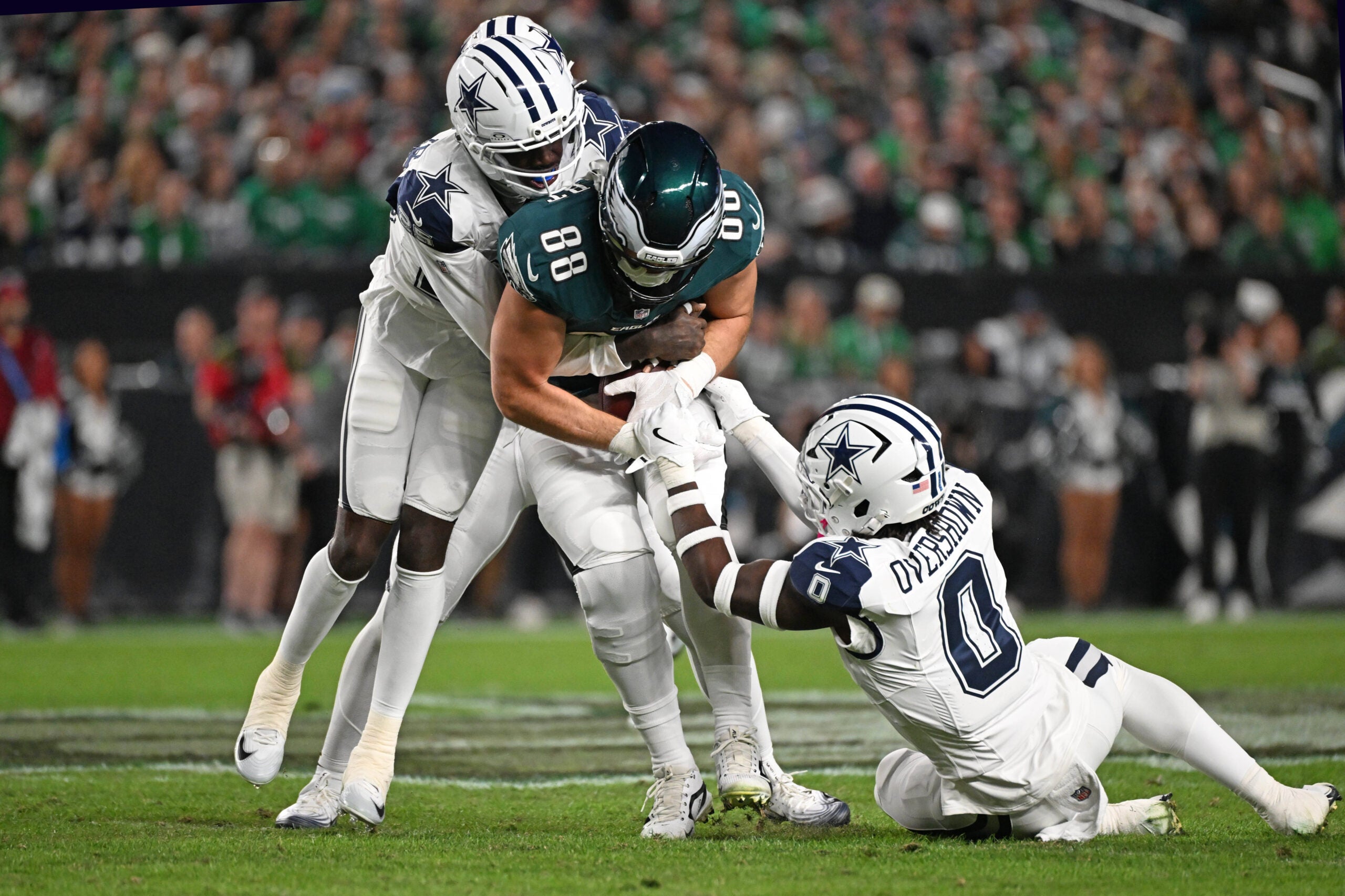
Is the Dallas Cowboys defense getting better? On paper, the answer is yes. The Cowboys went from allowing more than 30 points per game to giving up 21, 23, and 24 points in their last three matchups.
The advanced numbers back it up, too. For the first time in consecutive weeks, Dallas posted negative EPA per play performances (negative is good for a defense). The unit also posted its highest success rates of the season.
I’m not sold yet, though. My gut tells me the numbers are a little too optimistic.
Look no further than Cowboys defensive coordinator Christian Parker. He received a game ball after the win over the Philadelphia Eagles, and his reaction was telling. Parker is a stoic coach who rarely shows emotion in front of the media, good or bad. Still, he looked almost uncomfortable, like someone accepting a gift he doesn’t feel he has earned. It sure seemed like Parker knows his defense has to be better.
So I thought exploring this topic further would be a good midweek project.
Opponents have done the Cowboys some favors
The level of competition has a lot to do with the improved numbers.
The Green Bay Packers entered Week 6 as an inconsistent offense, and they dropped multiple touchdowns in the end zone against Dallas. That doesn’t show up in EPA per play or success rate. A dropped touchdown counts as an incompletion, not as four or six points left on the board. In other words, Green Bay should have posted better numbers, which means the Cowboys’ numbers should be worse.
The same goes for the Eagles game. EPA per play doesn’t reflect that Philadelphia played with Tanner McKee at quarterback and without multiple starting wide receivers. It also doesn’t reflect that Saquon Barkley was coming off an injury, got banged up again, and missed a good chunk of the game on Monday night.
Three Cowboys defenders are raising the floor
To be fair, Dallas is better in some areas, and three players stand out.
The first is cornerback Joey Porter Jr., who has been everything the Cowboys wanted from that trade. Dallas leans on his ability to play man coverage, leaves him on an island, and expects him to win. He does. In three games as a Cowboy, Porter has allowed only two catches. Both came against the Eagles, both went for 5 yards, and he held Dallas Goedert short of the sticks on one of them (Philadelphia converted on fourth down anyway).
Porter erases one side of the field, and it shows. Over Weeks 1-4, the Cowboys ranked dead last in both EPA per play and success rate against the pass on early downs. Over the last three weeks, they rank fifth in EPA per play and second in success rate, according to SumerSports.
Quinnen Williams is the second player raising the bar. Dallas is slowly letting him play more freely as a penetrating defensive tackle, which is what he does best. As a result, he is beating double teams, generating pressure, and stuffing the run more often.
Then there’s DT Otito Ogbonnia. He doesn’t play many snaps, but when Dallas calls his name to stop the run, he is one of the most consistent defenders on the roster. He shoves offensive linemen aside and keeps ball carriers to gains of a yard or less. Unfortunately, the Cowboys don’t have multiple Otitos.
The run defense is still holding Dallas back
While the Cowboys have improved versus the pass on first and second down, this defense can’t stop anyone on third down. Why is that? Because you can run on it, regardless of down and distance.
The Cowboys rank among the bottom five defenses in average distance to go on third down. They consistently face third-and-short, and offenses eat on the ground and through the air as a result.
One year after the Cowboys traded Micah Parsons in part to improve their run defense, it remains the biggest issue on the team. Kenny Clark, Williams, and Ogbonnia give Dallas real talent up front, and yet the linebackers aren’t finishing plays.
I keep thinking about a preseason clinic that surfaced on social media, in which Parker explained the relationship between the two position groups. He explained in his scheme, defensive tackles work for the linebackers.
The film against the Eagles didn’t reflect that. In his first game as the green dot defender, linebacker Shemar James had holes to hit but hesitated. He was flat-footed instead of attacking downhill, which led to broken tackles or running backs cutting past him. James was in position to make plays multiple times and couldn’t finish.
Gap integrity is another problem. On one snap, a climbing center reached linebacker Jaishawn Barham, and Barham squared him up instead of attacking the A-gap. The result was a huge running lane. That happens consistently on the Cowboys defense. It’s not all on linebackers though. Defensive tackles get reached, offensive linemen climb free to the second level, which puts linebackers in a losing position.
And the edge rushers really struggle to contain consistently, whether it’s Rashan Gary, Donovan Ezeiruaku, or else. All of this is the basics, which is the particularly concerning part of the Cowboys defensive struggles.
The Cowboys are also better in success rate than in EPA per play against the run. On a down-to-down basis, they’re holding up at an around league average rate. When they don’t, offenses rip off huge chunks due to their poor fundamentals.
Better players and better health have closed many of the holes in the secondary. But until the front seven masters the fundamentals, particularly versus the run, this defense won’t earn anyone’s trust. Can Dallas fix that at the end of October, or is it too late? November football will provide the answer.
