
Packers coaching staff has sent contradictory messages about the offensive line, and that’s worse than its Week 1 performance
Lack of clarity for Green Bay’s offensive line plan has affected the development of the players and the unit as a whole.


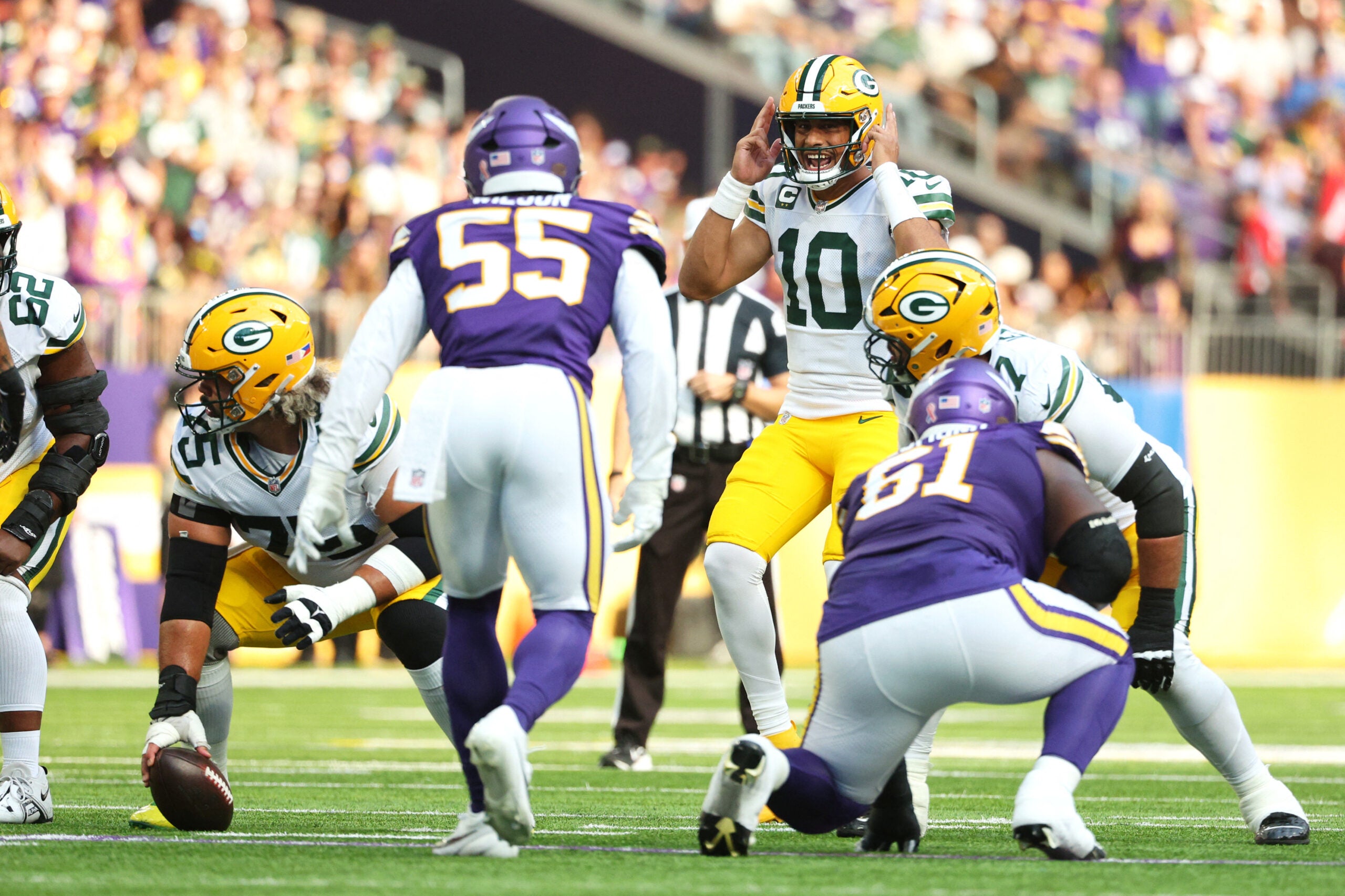
The Green Bay Packers’ offensive line turned in one of the worst pass-blocking performances in recent NFL history during their Week 1 loss to the Minnesota Vikings, and the coaching staff’s decision-making around the unit raises more questions than it answers.
Green Bay posted a 9% pass block win rate according to ESPN, ranking 32nd in the NFL. No other team was below 22%. Packers quarterback Jordan Love was hit 18 times, per offensive coordinator Adam Stenavich, and the franchise is fortunate he walked away healthy.
Brian Flores’ Vikings defense is aggressive, but that alone doesn’t explain how poorly the Packers’ offensive line performed. The bigger issue lies in a series of inconsistencies from the coaching staff about how they’ve managed the group heading into the season.
The ‘best 5’ philosophy didn’t apply
Head coach Matt LaFleur has historically preached the idea of building the best five, putting the five most capable linemen on the field and then figuring out where each one plays. That philosophy didn’t materialize on Sunday.
Anthony Belton started at right guard for Green Bay last season and is difficult to envision as worse than Donovan Jennings or Jacob Monk. Yet Belton was a backup tackle in Week 1, and the Packers played lesser options at guard instead.
Jager Burton spent most of training camp and the preseason as the starting left guard. With Aaron Banks expected to reclaim that spot once healthy, the long-term weak link on the offensive line is right guard. If Burton is the best player among himself, Monk, and Jennings, why didn’t the Packers allow the rookie to compete for the right guard spot? Instead, Burton was stationed on the left side as a placeholder until Banks returned, and in Week 1 he didn’t start at all.
The ‘time on task’ reasoning quickly falls apart
LaFleur said Tuesday that the Packers started Jennings over Burton at left guard because Jennings had more time on task. The implication was that Jennings, who has been with Green Bay since 2024, brought more experience to a difficult matchup against Minnesota’s aggressive defense.
That reasoning holds only to a certain extent. You wouldn’t necessarily want a rookie playing his first NFL game against that kind of pressure, and that’s fair. But Jennings is not an experienced player either. Before that Week 1 game, he had logged only six regular season snaps throughout his NFL career. If the decision hinged on experience, Jennings didn’t truly provide that answer.
Burton had significantly more time with the first-team offense during training camp and the preseason than Jennings did. And the biggest problem for the Packers on Sunday wasn’t individual technique, but communication. At times, linemen appeared unsure of their assignments and uncertain about who to block. The lack of continuity played a direct role because those players barely practiced together in that configuration. Jennings spent most of his preseason reps with the second team, so the starting group had only one week of practice or so together before facing one of the NFL’s most complex defensive structures.
The Belton situation makes the least sense
Perhaps the most confusing element of this entire discussion is the handling of Belton. The Packers expressed through their actions that the former second-round pick couldn’t compete for the starting right guard job because they needed a backup right tackle in case Zach Bako-Bewele wasn’t recovered from his knee injury.
Belton played right guard last season and started down the stretch. His performance wasn’t great, which was expected from a rookie adapting to a new position after playing left tackle in college. But there’s at least a baseline of talent to work with. The Packers simply removed him from the competition at guard to serve as an insurance policy at tackle.
LaFleur said the coaching staff viewed Belton as a tackle and wanted to give him more time there. Yet after just one game, Stenavich said Tuesday that the team could consider moving Belton back to guard to compete for the right guard spot now that Bako-Bewele is healthy and expected to continue starting at right tackle.
If the Packers perceived Belton as a better tackle, why would that perception change after a single week? The starting spot at guard is obviously more valuable than a backup spot at tackle, so the original logic was difficult to understand. The reversal after one game makes it even harder to follow.
A development problem brewing
The Packers have maintained a strong offensive line development system throughout their recent history, particularly when Stenavich served as the offensive line coach from 2019 through 2021. Since Stenavich’s promotion to offensive coordinator in 2022 and Luke Butkus’ elevation to offensive line coach that same offseason, the results at that developmental level have declined.
Green Bay has invested significant draft capital in the position, spending a first-round pick on Jordan Morgan and a second-rounder on Belton. For a franchise with a track record of extracting strong performances from mid- and even late-round offensive linemen, investing that heavily and not seeing proportional returns is a damaging trend. The coaching staff is sending mixed messages about the offensive line, and the consequences showed up clearly on the field in Week 1. Protecting Jordan Love remains the most important task for the franchise, and right now, the plan to accomplish that is difficult to decipher.
