
Packers appear ready to trust an unexpected internal option, but their questionable track record makes it harder to feel confident
Green Bay’s coaching staff seems confident in Jacob Monk as starting right guard despite uninspiring trajectory.


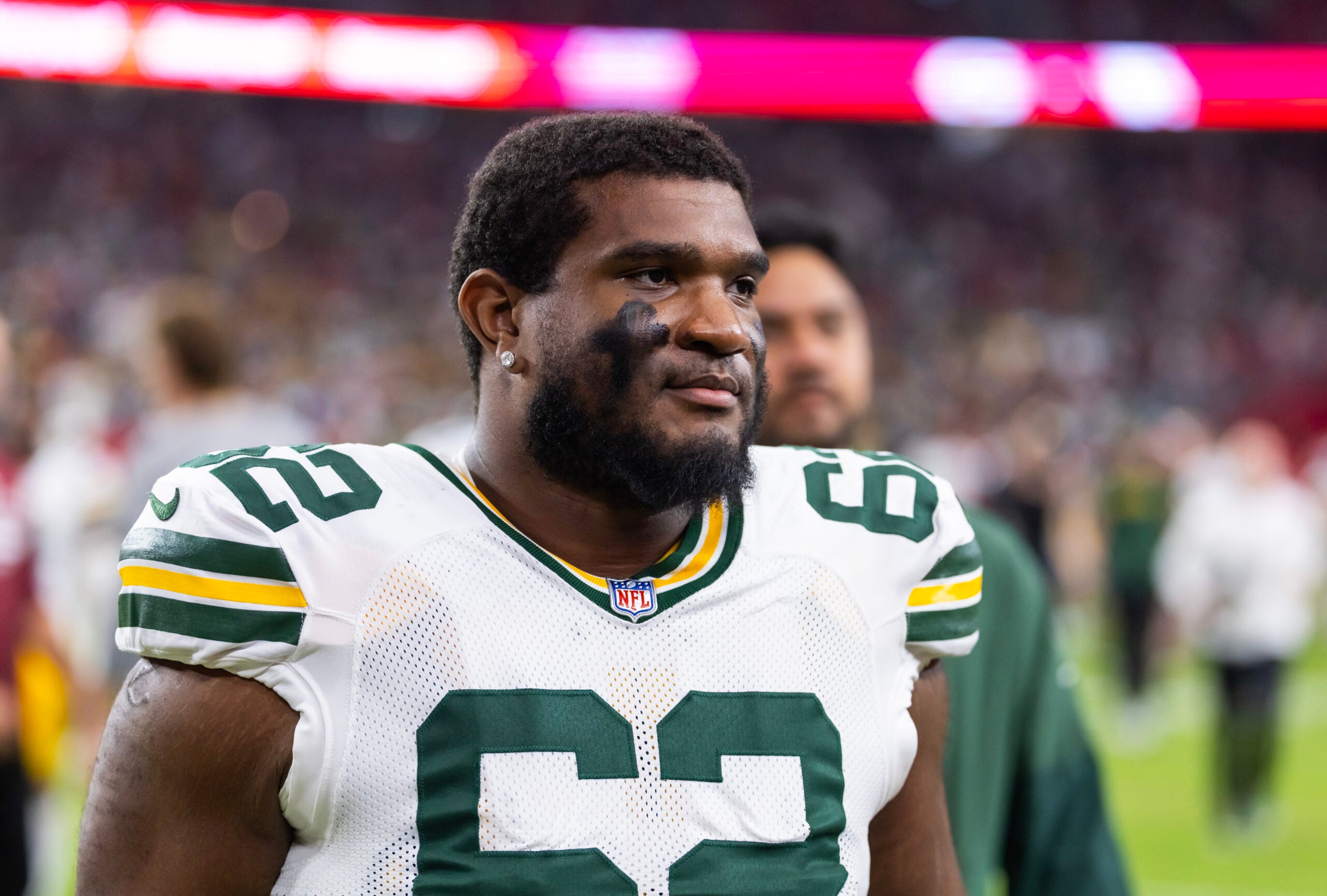
The Green Bay Packers are heading into the 2026 regular season with third-year interior offensive lineman Jacob Monk as the likely starting right guard. The decision is notable because rookie fifth-rounder Jager Burton has arguably been the better player throughout the preseason, particularly in pass protection. Yet the Packers’ coaching staff appears comfortable with Monk in the role, even as the team’s history of offensive line personnel choices raises legitimate questions about the process behind this one.
How Monk landed the starting job
The path to Monk’s right guard role was created by circumstance. While left guard Aaron Banks and right tackle Zach Bako-Bewele were out with injuries, Burton practiced at left guard and Anthony Belton moved to tackle, which opened the door for Monk at right guard. Now that the veterans have returned to the lineup, Monk has remained the starter at right guard. Burton has settled in as a backup left guard, and Anthony Belton is the backup right tackle. Even Donovan Jennings has taken more snaps with the ones lately.
Meanwhile, Monk has established himself as the primary option at right guard, and the coaching staff clearly believes in what he brings.
“I love the mentality he plays the game with,” head coach Matt LaFleur said. “He is as tough as they come. I think he’s shown steady progress throughout his time here, especially in the tail end of last year and into this season as well.”
The performance doesn’t justify the confidence
Monk barely played during his first two seasons in Green Bay. A former fifth-round pick, he started at center against the Minnesota Vikings in that meaningless Week 18 game last season, logging 57 snaps with a 73.7 PFF grade but a concerning 50.7 pass-blocking grade. And that has been his entire regular season experience.
This preseason, the pass-blocking concerns have persisted. Monk has played 23 snaps at right guard with the starting lineup but also 59 snaps at center with the second and third units. His PFF grades paint a split picture: a 38.8 pass-blocking grade and a 71.0 run-blocking grade.
The run-blocking grade is likely what the coaching staff wants to lean on. Monk is a mobile player who fits the outside zone schemes the Packers are seemingly more willing to run again under LaFleur. Offensive coordinator Adam Stenavich spoke to what makes Monk appealing, pointing to his play style.
“He’s a nasty dude,” said Stenavich, a former offensive line coach. “So watching him play has been really fun.”
That physicality matters in Green Bay’s run game. But pass protection is arguably even more important because Jordan Love is the most important and impactful player on the roster, and that half has been an obvious problem.
A coaching staff with a pattern
The most significant concern here isn’t necessarily Monk’s ability. It’s whether the coaching staff is making the right evaluation to find the best lineup. LaFleur and his assistants have a track record of questionable offensive line decisions. They played Lane Taylor over Elgton Jenkins, Billy Turner over Josh Nijman, and then Nijman over Bako-Bewele at different points. Last season, Rasheed Walker started over Jordan Morgan at left tackle when Morgan was probably the better player at that position and showed that early in training camp when he had the chance.
Those decisions didn’t age well. And the current approach to the right guard competition could easily follow a similar path.
The most questionable part of this situation is the process. Burton received some right guard snaps and reps during the offseason program, including work at both center and right guard. But once training camp started, he was almost exclusively a left guard. With Banks back, Burton’s competition is essentially with the veteran for the left guard role rather than with Monk for the right guard job.
That creates a scenario where Monk earns the job largely because he’s the player getting snaps at the position. The Packers moved Burton to left guard and Belton to right tackle while the presumed starters were injured, and by the time everyone returned, Monk had accumulated enough reps to hold the spot. It’s a competition that was shaped more by roster logistics than by a true head-to-head evaluation.
