
Packers’ struggles expose bigger problem for running game beyond Josh Jacobs’ absence
MarShawn Lloyd and Chris Brooks couldn’t do much behind a weak offensive line, and it’s a challenging scenario ahead.


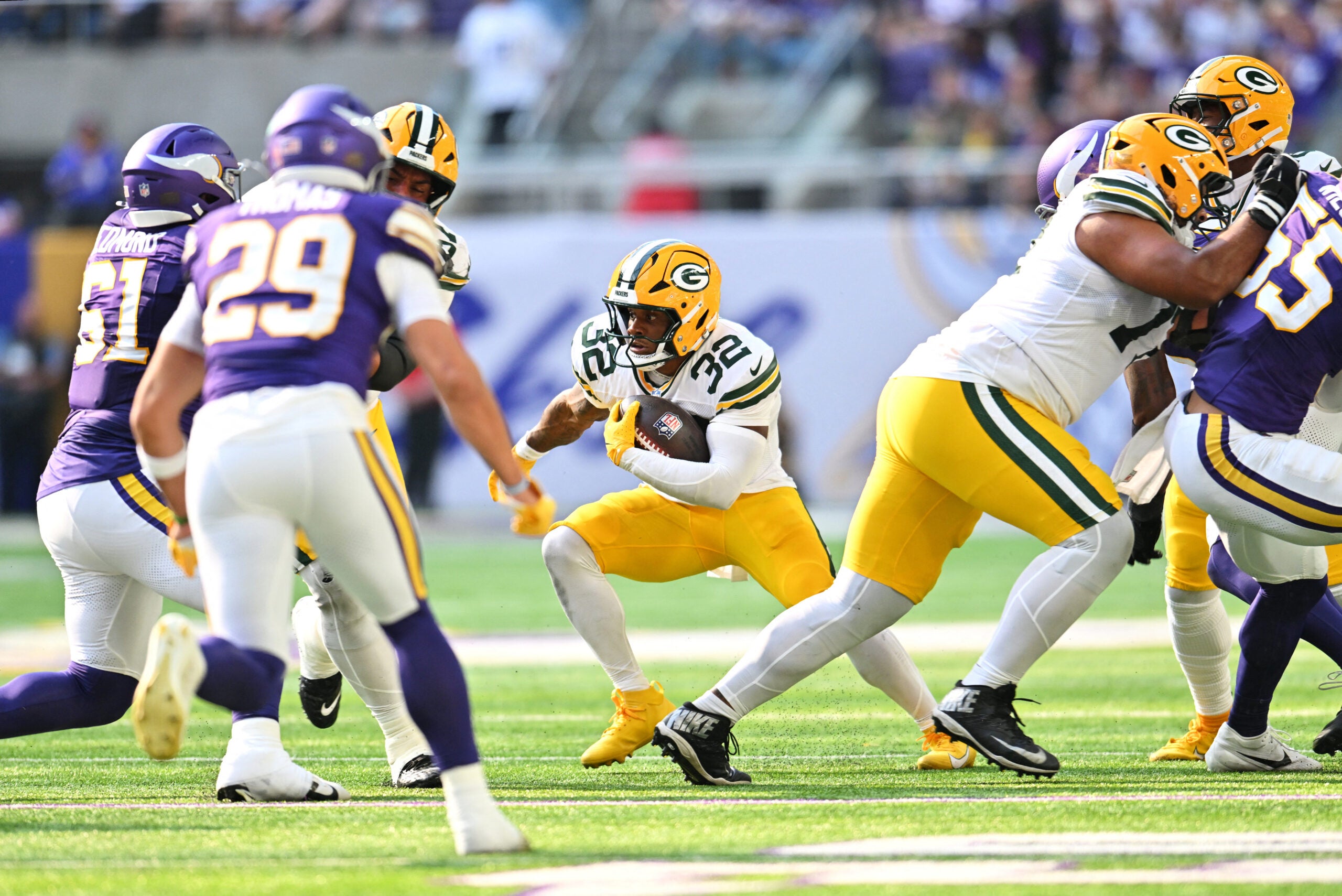
The Green Bay Packers running back room faced a difficult debut in Week 1, but the results reflected challenging circumstances beyond individual production. With Josh Jacobs sidelined on the NFL Commissioner’s Exempt List, MarShawn Lloyd and Chris Brooks shouldered the load against the Minnesota Vikings. Neither player found much room to operate, and the offensive line’s struggles only made matters worse.
Run blocking created limited opportunities
According to ESPN, Green Bay ranked 25th in run block win rate at 72%, a number that paints a clear picture of the problems up front. The Packers simply couldn’t generate consistent run holes or gaps for their backs to exploit against Minnesota’s defensive front. That lack of push at the line of scrimmage limited what Lloyd and Brooks could accomplish on the ground.
The run game’s struggles forced the Packers to lean on the passing attack. Jordan Love and the offense finished among the top five in pass rate in neutral situations during Week 1, something rare under head coach Matt LaFleur. The Packers were only 24th in rush success rate in the first week of the season.
“The best pass protection is running the ball,” said offensive coordinator Adam Stenavich on Tuesday. “There’s no doubt about that. The problem, you just have to have a consistent run game. You can’t have a six-, seven-, eight-yard gain, and then all of a sudden you have a negative run or a zero. Now you’re forcing yourself into a passing situation. So I think the more consistent you can be in the run game, that’s what’s going to help you. Just make sure you’re hammering out three-, four-, five-yard gains to keep you in those situations where you can run or pass.”
Despite the tough sledding, Lloyd earned a slightly higher PFF rushing grade at 62.8 compared to Brooks’ 62.0. Brooks did generate more yards after contact per attempt (2.57 versus Lloyd’s 2.00), and Lloyd forced one missed tackle on the day.
The surprising development was the pass blocking. Brooks, widely regarded as one of the best blitz pickup running backs in the league, posted a 38.2 PFF pass blocking grade. Lloyd graded higher at 47.4. In true pass sets, the gap widened further: Lloyd earned a 73.0 pass blocking grade while Brooks managed only a 53.3 mark, per PFF.
Neither player contributed in the receiving game. Lloyd drew one target, but both backs finished without a reception. That part of the game plan simply didn’t involve the running backs against the Vikings.
What comes next at running back
Lloyd finished with 13 carries for 37 yards (2.8 yards per attempt), while Brooks had seven attempts for 29 yards (4.1 yards per attempt). Considering the circumstances, they didn’t produce much beyond what the offensive line offered them, and the offensive line was underwhelming at best.
The Packers are waiting to see how the Josh Jacobs situation unfolds, but the team cannot necessarily count on him returning anytime soon. The third option on the roster is Kaleb Johnson, recently acquired from the Pittsburgh Steelers for a 2028 sixth-round pick. Johnson played only a couple of special teams snaps on Sunday and is still learning LaFleur’s system. Green Bay could expect more from him over the next few weeks, but against the Vikings, he didn’t log a single offensive snap.
The Packers need better production from their ground game, and that starts with the offensive line creating opportunities. Until the blocking improves, Lloyd and Brooks will continue operating with a narrow margin for error. And it didn’t seem like they were capable of it in Week 1.
