
Ty Simpson’s Los Angeles Rams debut unveils masterful QB development plan by HC Sean McVay
Ty Simpson made quite the first impression during his Los Angeles Rams debut. What were the biggest takeaways from that outing?

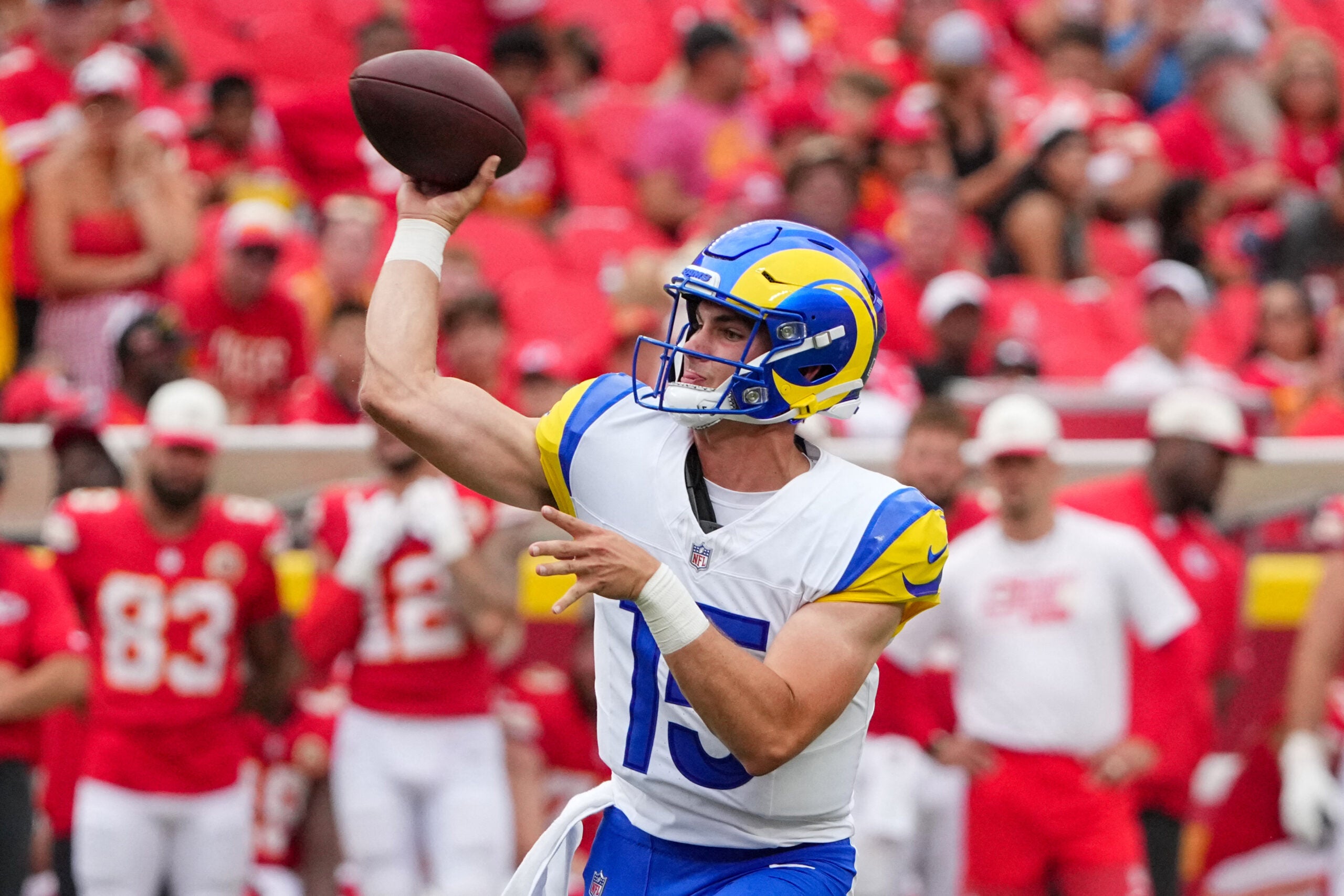
The Los Angeles Rams opened the preseason with a quarterback decision that raised eyebrows across the NFL.
Stetson Bennett, not 2026 first-round pick Ty Simpson, got the start against the Kansas City Chiefs. Bennett went 4 for 6 for 38 yards across two series before giving way to the rookie, who then played the rest of the game and finished 21 of 25 for 190 yards and 2 touchdown passes.
The result was a revealing look at how head coach Sean McVay plans to develop his young quarterback.
The optics versus the reality of Bennett starting
The optics of starting Bennett over Simpson look worse than the actual reasoning behind it. Bennett has been in the McVay system for a few years now. This isn’t his first rodeo. He’s not some undrafted free agent or second-year player with barely any experience. The mental side of the offense is something Bennett has the capacity for at this point.
The minute McVay made Bennett the starter, he essentially guaranteed that Simpson would play the majority of the game. Bennett played two series. Simpson threw 20-plus passes and took every snap outside of those opening possessions. From a developmental standpoint, it gave the rookie the runway to get a high volume of reps, which is exactly what he needs.
The one unsettling element is the conversation leading into the game. Reports in the media space suggested Simpson was struggling to separate himself from Bennett in camp. That is not good any way you slice it.
But getting extended game action as the second quarterback was probably more valuable for Simpson’s growth than a ceremonial start with limited snaps would have been.
McVay’s tactical approach to Simpson’s workload
Sean McVay is a sharp offensive mind, and everything he does is tactical. There appears to have been a deliberate plan to ease Simpson into live action and then gradually expand his plate as the game progressed.
Early on, the approach was elementary. The Rams leaned on the run game with Jarquez Hunter, then Dean Connors came in and ran the ball hard. The passing concepts were built around play action, rollouts, half-boots, and quick-game completions. Deep overs, slide routes, easy throws to build confidence. The training wheels were on, and that was probably smart for a quarterback making his first NFL appearance.
Simpson’s first drive went three plays, 8 yards, and a punt. His second drive put the Rams in field goal position. Then came a sneaky important sequence at the end of the first half.
After the Chiefs tied the game with a field goal, Simpson got the ball back with 30 seconds left on his own 31-yard line. He completed passes to Max Klare and hit Xavier Smith before working the Rams across midfield. It didn’t result in points, but handling a two-minute situation before halftime was a valuable experience for the rookie.
That drive marked the transition point. The staff shifted from boot action and designed movement to traditional dropback passing. In the second half, the concepts became more demanding, with pure progression reads and 5-to-7-step drops.
Simpson’s progression from snap 1 to snap 25
Early in the second half, when the Rams asked Simpson to work from the pocket with traditional dropback concepts, his eyes moved a little fast. The game was moving quickly for him. But as he settled in, the game slowed down.
By the fourth quarter, Simpson delivered a couple of touchdown passes, and the overall trajectory from his first snap to his 25th throw showed real growth within a single game.
The box score alone tells an encouraging story. Going 21 of 25 for 190 yards and 2 touchdowns in a first preseason outing is a strong showing. Watching the tape reveals the context behind those numbers: a coaching staff that carefully managed the difficulty level and a rookie who responded well as the challenge increased.
What comes next in the QB2 battle
There is reason to believe Simpson could start the next preseason game, especially with Matthew Stafford unlikely to play at all. McVay may want to throw the rookie into the fire against potential starters now that his feet are wet. That would be the natural next step in the progression the staff mapped out against Kansas City.
If you’re truly trying to find out what Simpson is, you want him going through the nerves and emotions of knowing he’s starting an NFL game.
The Rams have two more preseason games to push that evaluation forward. The Bennett decision made sense as a first step, but a first-round pick who was a one-year college starter needs real game situations to prove himself. The next outing should tell us even more about where the Rams QB2 battle is headed.
