
Brian Flores’ Vikings defense isn’t just incredible, they create massive issues that are difficult to overcome
The Minnesota Vikings’ defense is both simple and extremely complicated, making it difficult for quarterbacks to attack.


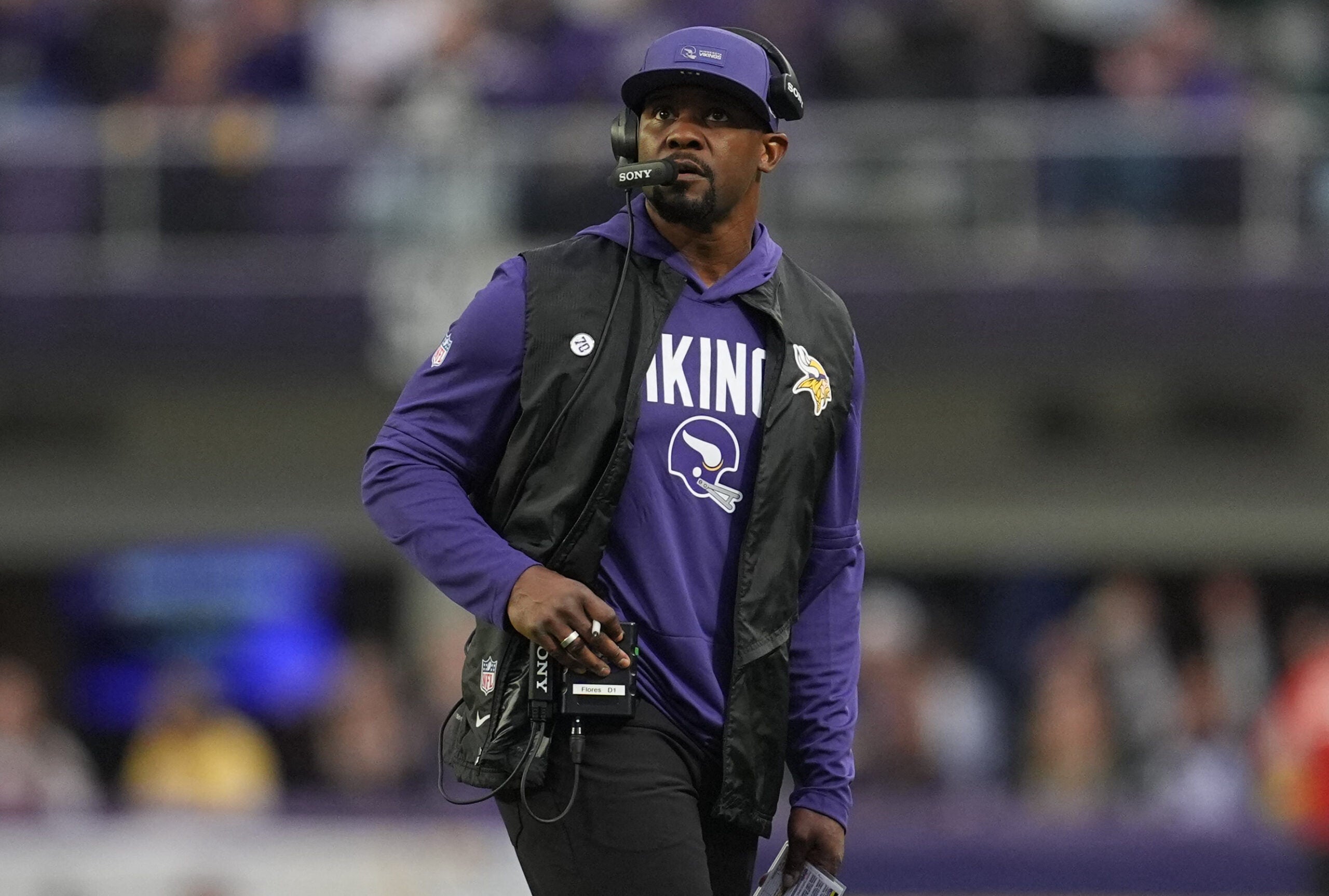
The Minnesota Vikings defense under Brian Flores is the best unit in the NFL, and that shouldn’t surprise anybody. It’s allowing just 14 points per game, and the Vikings lead the league in both pressure rate and blitz rate per NextGen Stats.
Those numbers only tell part of the story. Flores’ defense is a unique blend of concepts focused on one thing: massive pressure. They want to attack you in ways that nobody else has ever tried. Their blitz rate of 72.3% is 29.4% higher than the second place Tampa Bay Buccaneers. Within that blitz rate, the Vikings do things much differently than anyone else
Brian Flores’ version of a blitz is different
When you look at blitz rates, a blitz is calculated as five or more rushers. At some point, the NFL decided four rushers were the standard, and the copycat league never moved away from it.
That’s not how Flores operates his business. For him, sending five pass rushers is the base. On a game-to-game basis, the Vikings “blitz” somewhere between 60% and 90% of the time. In 2025, they led the league in rushing three or five-plus, while ranking last in rushing four. That tells you everything about the philosophy. Either Flores drops eight and makes you find space on the back end, or he sends everything at you and forces you to survive it.
This hasn’t been a simple process. In 2023, Minnesota leaned on the bengal hawk blitz, mugging the A gaps and bailing whichever two players the center slid toward. Offenses figured it out because it often left a player like Harrison Phillips in coverage, and teams peppered concepts like dagger behind it. Once it got figured out, the Vikings allowed 30.0 points per game in the final four games
In 2024, the Vikings didn’t have the guys on the defensive line, so they leaned on the NASCAR package with three or more edge rushers. It produced 49 sacks and a 14-3 record, but sacrificing size inside proved to not be sustainable. The 2025 defense added that interior presence and notched 49 sacks again, though offensive issues capped the team at 9-8.
The 2026 roster has finally struck the proper balance with the interior pass rushers and edge defenders.
The personnel finally fits the scheme
Even though the investment on the interior hasn’t been massive, they have the right guys. Jalen Redmond is one of the best at the position, Levi Drake Rodriguez has taken an incredible step, and Tyrion Ingram-Dawkins has been good. Elijah Williams has been a nice addition over the last two games, while Caleb Banks and Domonique Orange have shown flashes despite inconsistency as rookies.
What separates the Vikings is their versatility in the front seven. Andrew Van Ginkel, Dallas Turner, Eric Wilson, and Blake Cashman can all rush the passer at a high level and drop into coverage effectively. Van Ginkel has 8.5 sacks, second in the NFL, while also leading all edge rushers in coverage snaps.
The Green Bay Packers tried to put Van Ginkel in conflict on Sunday, hoping he would miss his drop depth and pepper passes in around him. On the Vikings’ first forced turnover, Van Ginkel held his midpoint and took away the slant. Green Bay settled for a dump-off to tight end Mark Redmond and Van Ginkel subsequently forced a fumble, and Minnesota had a 3-0 lead within roughly five real-time minutes.
That’s a big reason why the short game that burned them in 2024, when Jared Goff and the Detroit Lions swept them by feeding Sam LaPorta and Amon-Ra St. Brown, isn’t working anymore. The coverage is mostly hot quarters with palms technique from the cornerbacks, which lets them play the midpoint between deep and short responsibilities. Richard Sherman made a career out of palms, and it’s become a very common NFL coverage. Add sure tackling, and the short spaces are covered.
That leaves one way to beat this defense: block the blitzes and hit explosives consistently. It’s incredibly hard to do, and only the Packers in the first half of Week 1 have pulled that off.
The numbers back it up
Against Green Bay on Sunday, Jordan Love was pressured on 19 of his 35 dropbacks, and it majorly impacted his play. Minnesota piled up 31 total pressures, all against Love, before the Packers turned to Tyrod Taylor with the game already a 20-point margin. Love took eight sacks and four more hits, meaning he was hit 12 times on 35 dropbacks.
Even when the pressure doesn’t land, the quarterback feels it. His clock speeds up, and every hit deepens the wound.
Per Fantasy Points data, the Vikings are second in EPA per play allowed, first in EPA per dropback, eighth in EPA per rush, and first in success rate allowed. They’re back up to eighth in explosive play rate allowed at 9%. The calculated bet the VIkings are making is that you can’t block their pressures to hit the explosive plays that are open, and they are right in doing so.
The Associated Press’s Josh Dubow provided a couple of stats that put this in perspective
For context, the passer rating for spiking the football is 39.6. When you look at the 1989 Vikings, featuring Chris Doleman, Keith Millard, and Henry Thomas, they thrived in multiple situations, but this unit is better.
Dubow also noted the red zone gap heading into this week.
Even after two losses in which they allowed a combined 42 points, the Vikings remain far and away the best defense in football. Now that they have a complementary offense, the question is how far this team can go.
If they win on Sunday night, the goals are going to get even more lofty.
