
Kyler Murray received all the blame for Vikings’ anemic offensive performance, but the reality is far more complicated
The Minnesota Vikings’ offense posted its worst success rate in over 20 years, and the real issue goes far beyond the quarterback.


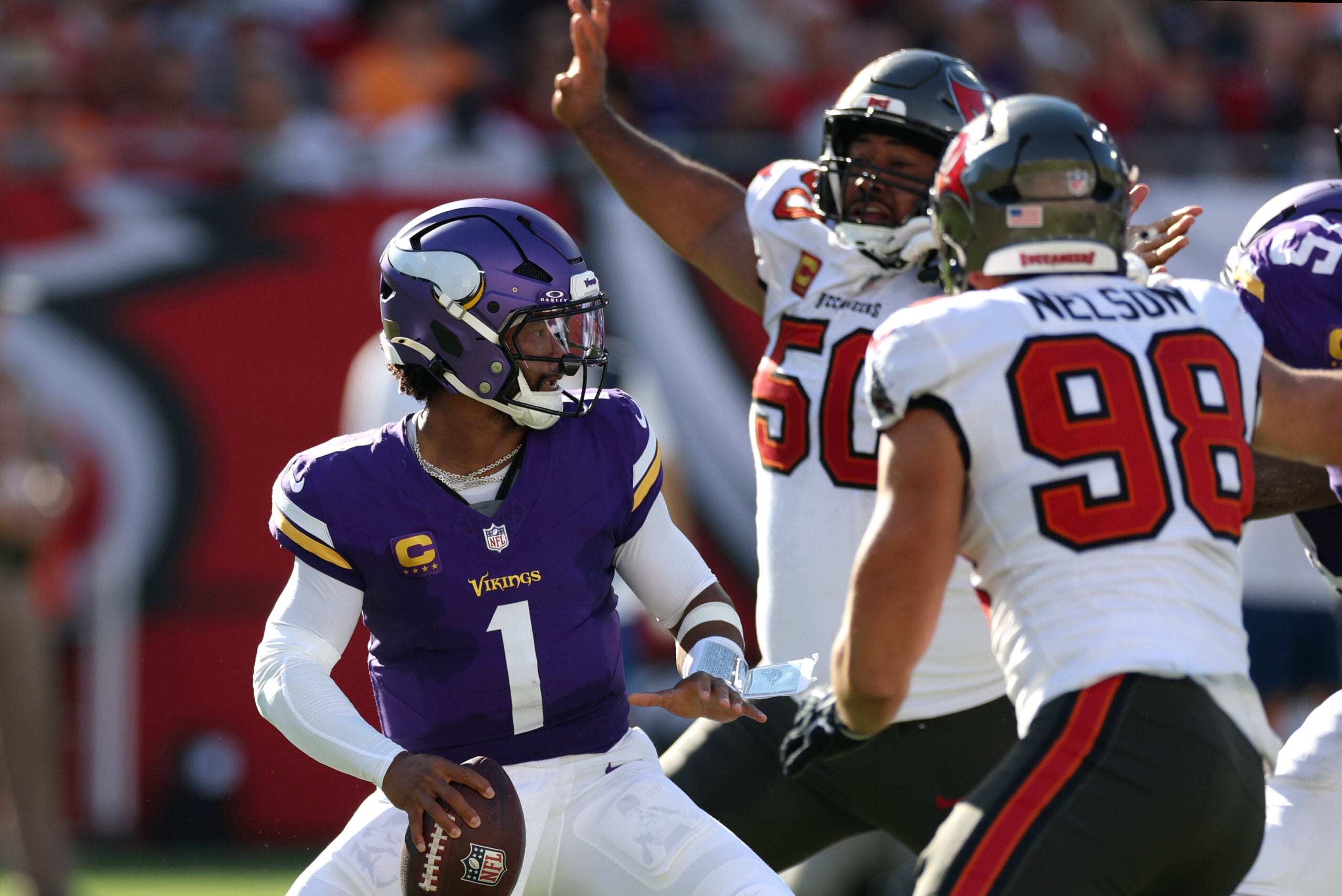
The narrative after the Minnesota Vikings‘ win over the Tampa Bay Buccaneers has centered on Kyler Murray‘s stat line: 15-of-29, 168 yards, a touchdown, and an interception. The Vikings offense looked anemic, failing to eclipse 250 yards for the third consecutive game this season. It’s easy to look at the raw numbers and declare Murray the problem.
The reality on the all-22 film tells a different story, one that points to a lack of second-half adjustments from Vikings head coach Kevin O’Connell.
Todd Bowles devised a masterful plan
The announcers kept repeating the same theme during Sunday’s broadcast: nothing was open. The Buccaneers were sitting on the Vikings’ route concepts, and Tampa Bay coach Todd Bowles designed a scheme specifically to neutralize Murray’s biggest threat as a quarterback.
The pressures came primarily from the interior. Bowles used his edge defenders not as much to rush the passer but to contain Murray in the pocket, eliminating the scramble opportunities that make him dangerous. Without an escape route, Murray struggled to create outside of structure. It mirrors what the Vikings did to Caleb Williams the week prior against the Chicago Bears, corralling him inside the pocket and limiting his ability to extend plays.
Bowles also deployed heavy fronts, to help control the ground game. Once Justin Jefferson left with an injury, the Buccaneers showed even less respect for the remaining wide receiver group.
Lack of adjustments cratered the Vikings
According to Fantasy Points data, Tampa Bay ran single-high coverage 73.5% of the time, with 67.6% of that being Cover 3. In the first half, the Vikings found answers. They completed their first three passes of 20-plus yards. Jordan Addison’s touchdown came on a well-designed concept where Jauan Jennings occupied the middle-of-the-field safety, leaving Addison one-on-one against a cornerback playing quarters. Addison finished with five catches, 90 yards, and a touchdown.
The second half was a different story. Those heavy fronts choked the run game, and the linebackers stopped cheating on play action. They got depth instead of coming forward, because they weren’t afraid of the Vikings doing anything underneath. That depth became the critical factor. On a fourth-quarter drift concept, a Shanahan-McVay staple with a deeper inbreaker and a post on the opposite side, Addison was getting open. The linebackers had enough depth to prevent Murray from layering the ball over the top initially before the pressure got to him. Two or three fewer yards of depth from those linebackers, and that’s likely a touchdown to seal the game.
Murray wasn’t great, but he wasn’t the issue
While Murray wasn’t the issue on Sunday, there were miscommunication moments that need cleaning up. Addison ran a corner route flat while Murray read the cornerback’s depth and threw it deeper. Ideally, both players see the same thing and adjust on the fly. In the third quarter, Murray was aggressive on a seam route to T.J. Hockenson, who stopped and drifted toward the sideline looking for a first down while Murray threw it deep.
Those chemistry issues highlight how much time Murray still needs in this offense, where receivers and the quarterback read leverage points and adjust routes accordingly. That run-and-shoot element baked into O’Connell’s system requires sync, and it takes reps.
The fastest sack of the game was credited to Alex Anzalone at 5.3 seconds, and that was a scramble where Murray ran out of bounds a yard short of the line of scrimmage. When Murray is either throwing the football away or getting sacked because nothing is open, how much blame can you really put on him?
Basic plays aren’t a bad thing
My biggest frustration from Sunday was seeing O’Connell fail to adjust in the second half. The Buccaneers were daring the Vikings to throw shallow crossers, but O’Connell didn’t budge. Tai Felton runs in the 4.3s. Get him on a shallow crosser with a simple mesh concept and create yards-after-catch opportunities to draw those linebackers forward, then attack vertically once they bite. O’Connell has those plays in his bag and he’s pulled them out before. T.J. Hockenson should have had a massive game given Tampa Bay’s weaknesses at linebacker, but he finished with two catches for 11 yards.
O’Connell is a brilliant play designer, and a lot of what he draws up works incredibly well. Sometimes you just have to go back to basics. The continued insistence on the vertical game in the second half without adjusting to what the defense gave them was a major misstep.
The Vikings’ offense posted its worst success rate in over 20 years and they still got the win, but if the offense doesn’t show real improvement by Week 7, which is one week after the bye, real questions about the direction of this team are going to start surfacing.

