
49ers' resurgent defense gets another chance to solve Eagles riddle
The most concerning issue facing the San Francisco 49ers as they entered their Week 9 bye was not the turnovers from Brock Purdy that put their starting quarterback under significant scrutiny, but the performance of a defense that was in the midst of a worrying slide. Defensive coordinator Steve Wilks came in for criticism as […]

The most concerning issue facing the San Francisco 49ers as they entered their Week 9 bye was not the turnovers from Brock Purdy that put their starting quarterback under significant scrutiny, but the performance of a defense that was in the midst of a worrying slide.
Defensive coordinator Steve Wilks came in for criticism as the 49ers allowed gave up 1,186 yards over the course of a three-game losing streak that dropped San Francisco to 5-3.
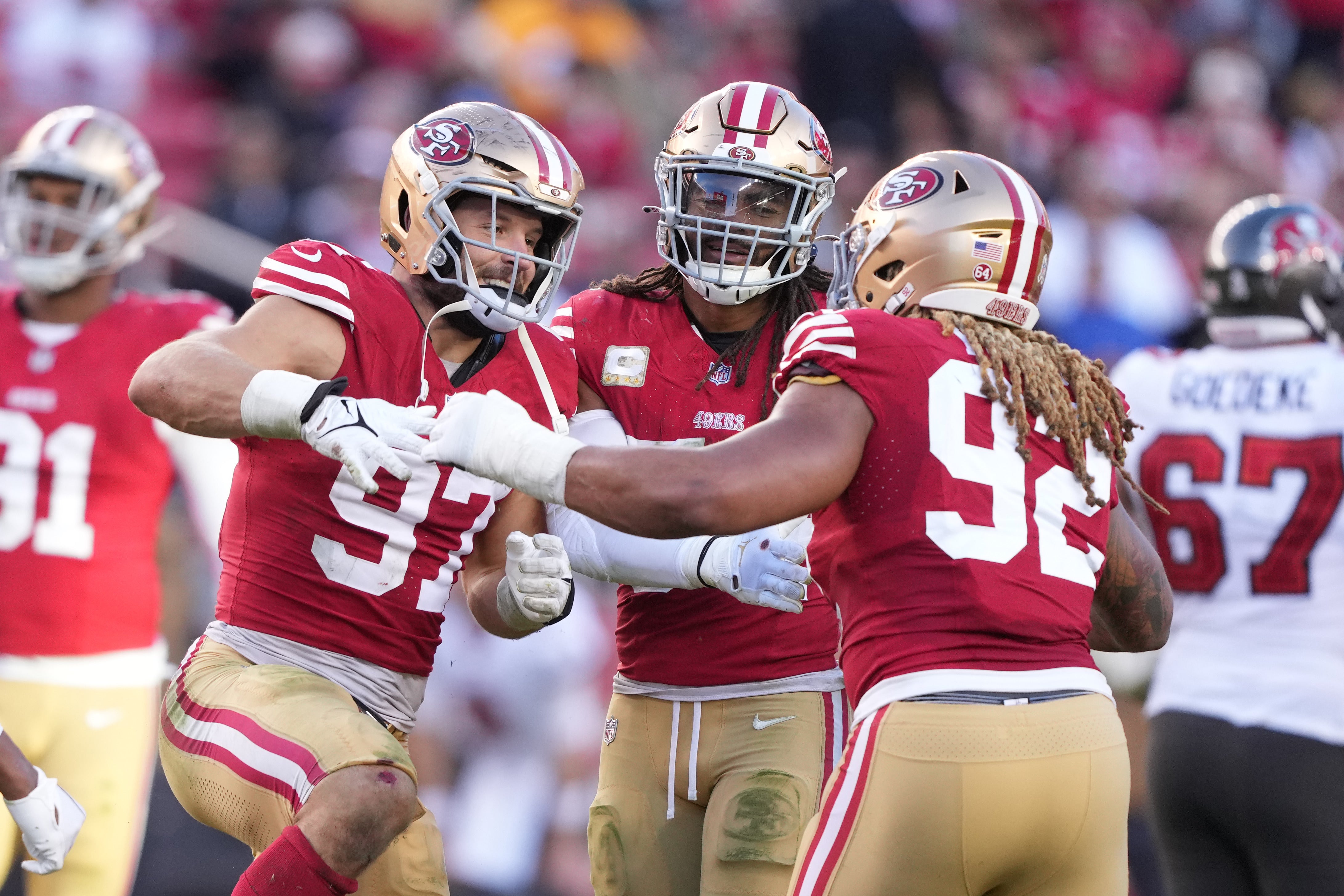
But that losing run, those struggles, and questions about Wilks' suitability as the successor to DeMeco Ryans are now a distant memory, the 49ers' defense producing a resurgence over a span of three successive victories that have put San Francisco firmly in control of the NFC West and kept the Niners in the race to be the one seed in the NFC.
San Francisco's headline decision during the bye week was to strike a blockbuster trade for former second overall pick Chase Young.
The 2020 Defensive Rookie of the Year has predictably made a huge impact rushing from defensive end spot opposite former Ohio State teammate Nick Bosa, but the success of a San Francisco defense that ranked third in Expected Points Added per play between Weeks 10 and 12 is about more than just the addition of a stellar pass rusher.
Indeed, it is also the product of Wilks continuing to push the right buttons and a change in the secondary that could hardly have worked better.
The 49ers quickly proved that three games was too small of a sample size to write off their defense and, by the same token, it cannot be said unequivocally that the recent strides will be maintained all the way down the stretch and into the postseason.
Wilks' defense has gone from appearing extremely vulnerable to one that looks capable of taking over a game against any opponent. The accuracy of the latter perception will receive its most substantial test yet when the 49ers face the Philadelphia Eagles in an NFC Championship Game rematch in which they will need to maintain all of their recent improvements to vindicate their status as surprise favorites.
Making the pressure tell
One the primary critiques of the 49er defense during San Francisco's losing streak surrounded an inability to get home on pressures. The Niners are no longer struggling in that regard, having tallied 15 sacks across their last three games.
That number is partially a consequence of Young's arrival, combined with a much-needed week off for Bosa, Javon Hargrave and Arik Armstead, allowing San Francisco to consistently get pressure with their vaunted front four.
But Wilks also deserves substantial credit for the blitzes he has sent when he has dialed up the pressure.
Wilks received massive criticism that he accepted for a costly zero blitz at the end of the first half in their Week 7 loss to the Minnesota Vikings, but the pressures he has sent over the course of the winning streak have been varied, well-timed and effective.
Though Wilks admitted fault on the fateful zero call, his confidence in sending pressure in high-leverage situations has not been adversely affected by that error.
He had the belief in his players to attack the Tampa Bay Buccaneers with a six-man pressure on fourth down in the red zone on which Isaiah Oliver blitzed from the slot after the 49ers temporarily lost cornerback Charvarius Ward to injury, the impact of Oliver's rush on Baker Mayfield forcing an underthrown ball that Ji'Ayir Brown deflected away from Mike Evans.
On Tampa Bay's next red zone possession, the 49ers hurried Mayfield into a throw that was deflected for the game-sealing interception by Brown.
Wilks this time elected to show a seven-man pressure look but only sent four, wasting a guard and running back Rachaad White in protection as both Bosa and Young won their one-on-ones almost instantaneously.
Those two plays encapsulate the approach Wilks has taken to attempting to pressure the quarterback. He picks his moments to simply send the house, but it is the variety of his plan of attack in recent weeks that has been most impressive.
The 3×1 fronts that consistently succeed at wasting a member of the offensive line in protection remain a staple of the 49ers' approach, as they were under Wilks' predecessor, and San Francisco continues to send a plethora of stunts at opposing offenses.
On top of that are double mug looks that are now not solely the domain of the 49ers' versatile linebacking duo of Fred Warner and Dre Greenlaw. Wilks has shown a willingness to throw such looks at opponents with Bosa and Young stood up in the A gaps.
The usage of the five-man defensive line may have been scaled back in recent weeks, but it is still a part of a repertoire that also features a host of simulated pressures and creepers.
Any defensive coordinator hoping to have thrive in the NFL should have such an extensive menu of pressure looks in the playbook, but Wilks has enjoyed eye-opening success in pressing those buttons since the bye, with those options more available to him because of a personnel change in the secondary that could eventually be viewed as a season-defining move.
Complementary coverage
After seeing him give up two touchdowns in the Week 8 defeat to the Cincinnati Bengals, the 49ers essentially benched much-maligned starting slot Oliver, reverting to the plan with which they started the season.
The 49ers opened the year with Deommodore Lenoir kicking inside to the slot on nickel downs and Ambry Thomas starting on the outside across from Charvarius Ward. An injury to Thomas and a strong Week 2 from Oliver prompted a change, but going back to that original nickel lineup has paid huge dividends.
Ward, Thomas and Lenoir have each displayed great reliability in man coverage, enabling Wilks to send pressure regularly without fear of his secondary being dissected.
A consistent complaint about the defense during the Niners' slump was that the coverage did not complement the rush. In last week's blowout win over the Seattle Seahawks, the back seven scarcely could have provided more support to the front, holding up brilliantly in both man and zone.
Charvarius Ward was the star of the show in the secondary for his lockdown performance against DK Metcalf, but each of the 49ers' corners and both safeties deserved great credit for their coverage effort.
It was the coverage of veteran safety Tashaun Gipson against tight end Noah Fant that forced Geno Smith to hold onto the ball on this play in the red zone.
Gipson's efforts, combined with those of Thomas in covering Metcalf, allowed a 49ers' six-man pressure to get home.
Later, in the fourth quarter, more excellent man coverage work ensured the 49ers got to Smith on a creative pressure on which they ran double stunts with Bosa and Warner as the loopers.
The key player on this occasion was Lenoir, who got hands on Tyler Lockett in the slot early in the route, staying in phase to take away a quick throw over the middle and giving the rush that critical extra second to finish the job against an overmatched Seattle offensive line.
San Francisco still does most of its work in the secondary in zone, and there has been no drop-off in that area with Thomas in the lineup.
Thomas' interception against Seattle came after he displayed great zone eyes to the quarterback and did an excellent job transitioning out of his pedal to cut in front of Lockett and pick off Smith's pass.
The awareness the 49ers' starting corner trio display in zone has eliminated the coverage breakdowns that were present with Oliver in the lineup, San Francisco's defensive backs showing the mutual understanding in changing assignments and passing off routes that was a key feature of their play under Ryans.
Yet if any offense in the NFL is well-placed to cause confusion in the San Francisco defense, it is that of the Eagles.
Wilks' biggest test
Though the NFC title game was realistically over as a contest the moment Brock Purdy went down, the manner in which Philadelphia exploited the San Francisco defense with the threat of Jalen Hurts as a running quarterback is something the Eagles will surely try to replicate.
San Francisco is a top-12 defense by EPA per play against the run over the last three weeks but has long since been vulnerable to dual-threat quarterbacks.
Should Hurts enjoy the same level of success he experienced in January, it will cause hesitation in the back seven against the run and open up the RPO and play-action game, heightening the chances of the kind of mistakes in the secondary that have been conspicuous by their absence of late.
Going against A.J. Brown, the second-highest graded receiver in the NFL when faced with man coverage, per Pro Football Focus, a matchup with the Eagles is one fraught with dangers that could make the 49ers' recent defensive progress look like a mirage.
But that threat will be significantly diminished if the 49ers can do what they have done relentlessly in recent weeks and produce disruption that puts the Eagles in negative down and distance.
The front four is talented enough to cause chaos on its own, but it can't all be on that star-studded quartet. There is great emphasis on Wilks to continue to make the right calls with his pressures, and his ability to rise to that challenge will go a long way to determining whether the 49ers will succeed in avenging their playoff loss and move within a game of the Eagles in the race for the one seed.
