
Is Aaron Rodgers in-season return a realistic scenario for the Jets?
Since rupturing his Achilles in week 1, New York Jets quarterback Aaron Rodgers has made clear his desire to come back. With a reported fast recovery, his target became not only a return to football, but an unexpected in-season comeback — and he is targeting a mid-December return. But is it realistic? And does it […]


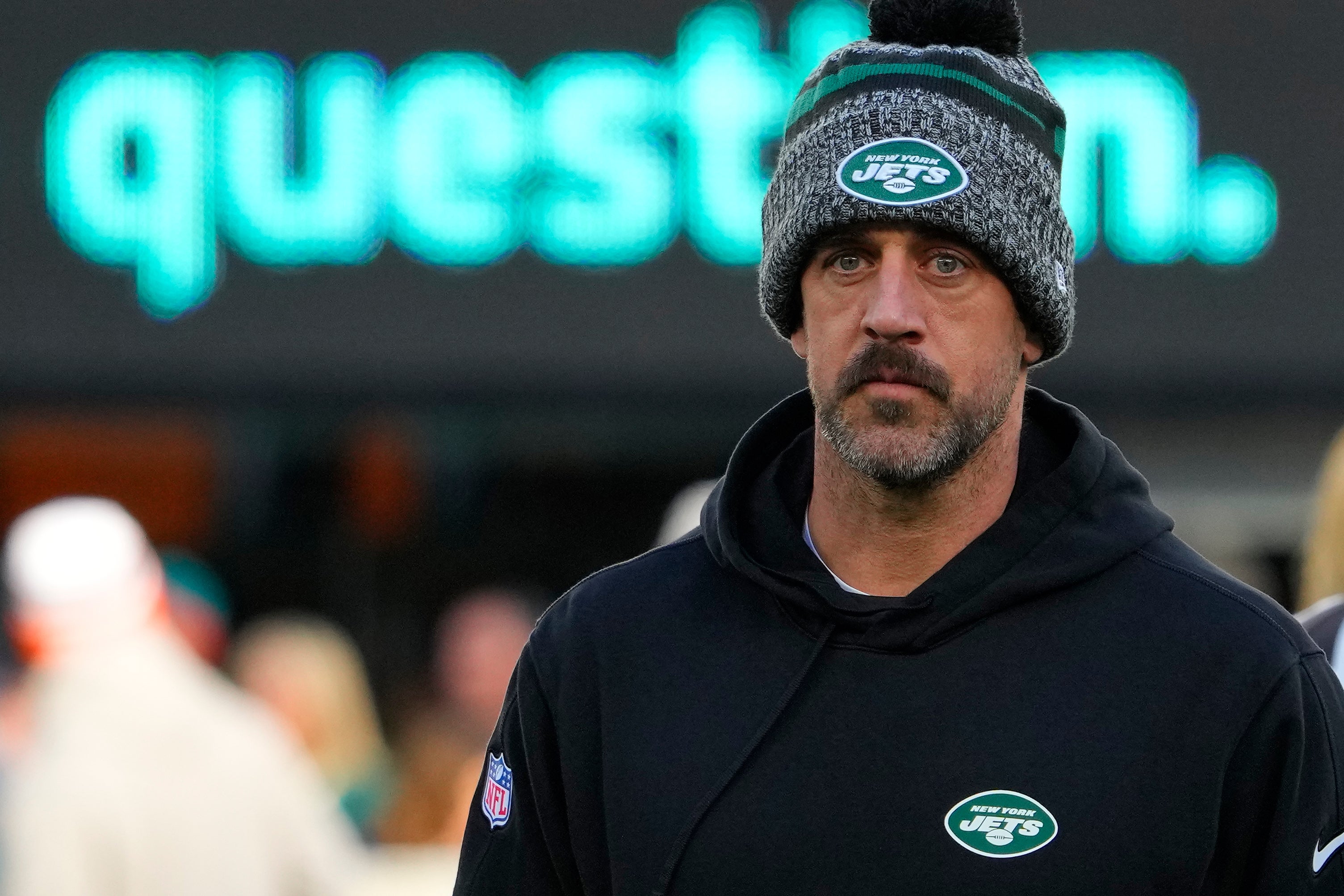
Since rupturing his Achilles in week 1, New York Jets quarterback Aaron Rodgers has made clear his desire to come back. With a reported fast recovery, his target became not only a return to football, but an unexpected in-season comeback — and he is targeting a mid-December return. But is it realistic? And does it make sense?
Road to recovery
Aaron Rodgers got injured 11 weeks ago, against the Buffalo Bills. According to Fox Sports' insider Jay Glazer, Rodgers targets a December 2 return to practice — it's the exact day in which the quarterback turns 40 years old. The week 16 game against the Washington Commanders would be the return target to a real game, as reported by NFL Network’s Ian Rapoport.
"He's in the building," Jets head coach Robert Saleh said about Rodgers. "When we get a doctor's note that says he's clear, he'll be cleared for practice then."
In order to accelerate the player's projected recovery, renowned orthopedic surgeon Neal ElAttrache, who conducted his surgery, placed an internal brace called a "speed bridge" on Rodgers' Achilles.
So far, the fastest player to come back from an Achilles injury in NFL history was running back Cam Akers. He got injured on July 20, 2021, before the preseason had even started, and came back on January 9, 2022, week 18 of that regular season — 24 weeks between the injury and his first game action.
He was clearly not 100%, getting three yards in five carries against the San Francisco 49ers. In the playoffs, he appeared in four games, with 172 yards in 67 attempts (2.6 yards per carry, slightly more than half of the 4.8 yards per carry he had had in the previous postseason). The other factor: Akers was 22 years old.
If Rodgers really comes back in week 18, it would happen 17 weeks after his injury — which would beat Akers’ recovery by an almost two-month gap. Obviously, the reality for a quarterback is different, as running backs have much more contact and risk. But it’s still a tough proposition.
Jets situation
In 2017, when Rodgers suffered his previous significant injury, a broken collarbone, he always left the door open for a potential in-season return.
Rodgers got injured in week 6, against the Minnesota Vikings, and the Green Bay Packers went 3-4 with Brett Hundley at quarterback. It was a pretty decent record, and that kept the Packers alive in the postseason hunt. So when Rodgers had the possibility to come back, he did in week 15, but Green Bay lost to the Carolina Panthers 31-24 anyway.
With the team eliminated from playoff contention, Rodgers was placed back on the injured reserve, and Hundley started the final two games of the season.
Transferring that scenario to the current Jets’ reality, it doesn’t make sense to risk Rodgers’ health unless there’s a realistic path to the playoffs. At this moment, after losing to the Miami Dolphins on Friday, the Jets are 4-7.
According to the New York Times simulation tool, the Jets have a smaller than 1% chance of getting into the postseason.
After nine Zach Wilson starts, the coaching staff decided it was time to change. Tim Boyle had one TD and two interceptions in the loss to Miami, and Saleh said they will stick with the quarterback for now. Before the Commanders game, which is projected as the potential Rodgers return game, the Jets will face the Atlanta Falcons, the Houston Texans, and the Dolphins again.
If the Jets win at least two of these games, the playoffs would still be a possibility, and then Rodgers' return could make sense. But at this point, it's hard to imagine such a scenario with the quarterback play the Jets have had. If they are 4-10 or 5-9 after 14 games, there's no reason to speed up the veteran quarterback's recovery plan.
Offensive line
Robert Saleh said earlier this season that they would allow Aaron Rodgers to come back as soon as he was ready to protect himself. This is particularly important because, well, the Jets offensive line hasn’t been able to protect its quarterbacks. The team’s unit is 29th in true pass-set protection, and this is far from the ideal situation to receive a 40-year-old quarterback with little mobility.
The most realistic option for the Jets and for Aaron Rodgers is to think practically, knowing that this season is basically over.
Next year, Rodgers will be fully healthy by week 1, the team can improve its offensive line, and even add weapons, and they will have their own first-round pick — which is, right now, projected to be the eighth overall selection.
It was obviously nothing like the Jets and their quarterback planned or wanted for this season, but fighting against this reality won’t bring a better outcome to New York.
