
Sarkisian hiring Will Muschamp signals a hard reset for Texas’ defensive future
Steve Sarkisian brings back Will Muschamp as Texas defensive coordinator, signaling a shift from scheme complexity to championship-caliber physicality. How Muschamp’s Georgia pedigree and aggressive philosophy will transform the Longhorns’ defense for playoff contention.


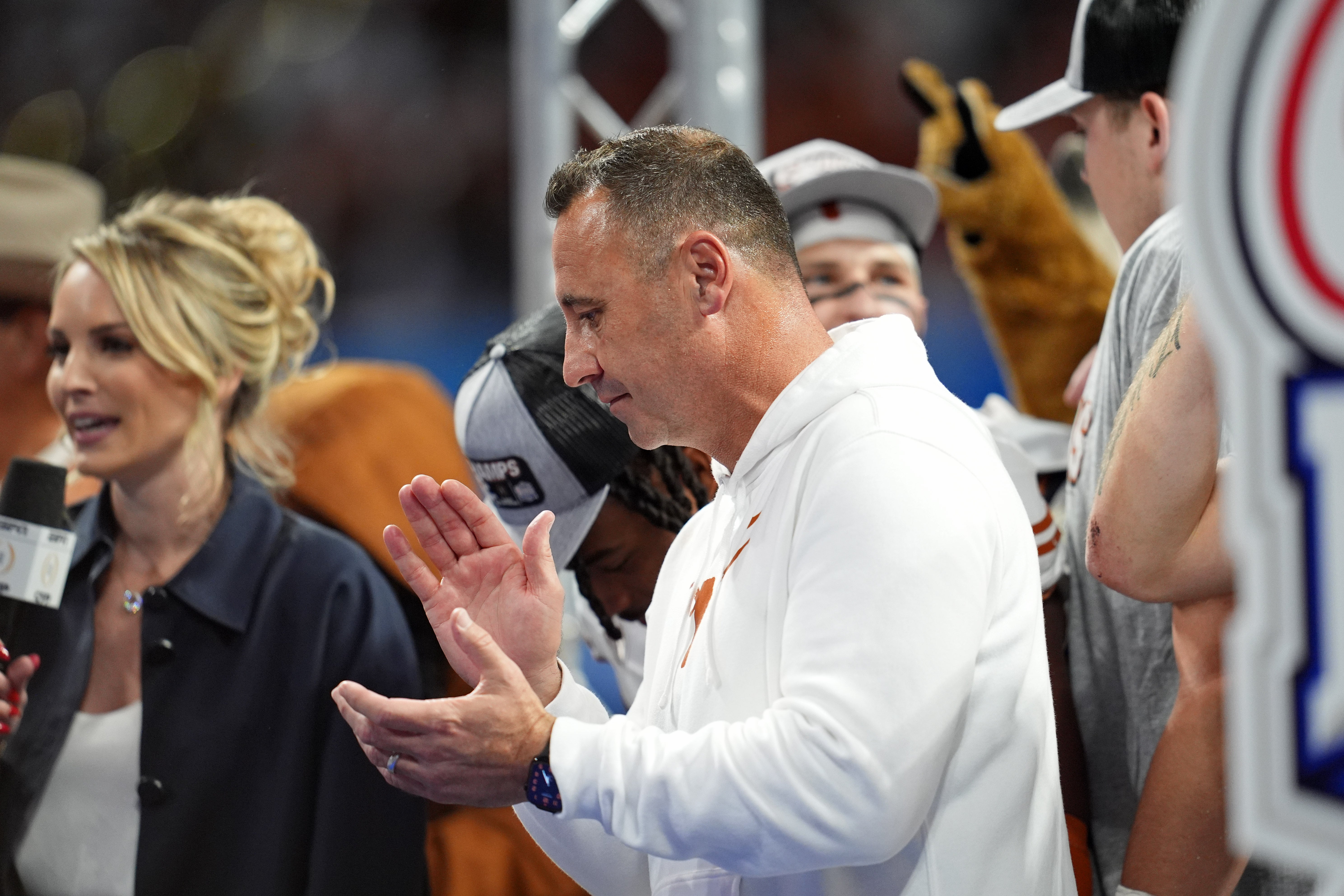
The move from Kwiatkowski to Will Muschamp signals a shift away from cerebral defenses toward aggressive ones. It’s a recognition that Texas doesn’t need to outsmart elite offenses anymore. It needs to overwhelm them. Texas didn’t move on from Pete Kwiatkowski to refresh terminology or to tweak minor tendencies. Steve Sarkisian made this change because the defense he wants next is fundamentally different from the one he just left behind. Less disguise. Less hesitation. More force. More clarity. More aggression.
What Muschamp brings to Texas
The move from Kwiatkowski to Muschamp represents a fundamental philosophical shift, not just a personnel swap.
Kwiatkowski’s defense relied heavily on single-high (post-style) coverage structures, essentially bringing safeties into the box to compensate for losing dominant interior defenders like T’Vondre Sweat and Byron Murphy. It was a four-man rush package with elaborate pre-snap disguises and “creeper” concepts—defensive ends dropping into coverage while linebackers or slot corners rushed from unexpected angles. The approach was cerebral, complex, and built on deception rather than raw aggression.
The issue? Texas ranked 101st nationally in passing yards allowed in 2025, with persistent communication breakdowns in the secondary. When they faced elite quarterbacks—Florida, Mississippi State, Vanderbilt, Georgia—the coverage complexity became a liability. The defense was thinking instead of reacting.
Muschamp’s philosophy, shaped by his time at Georgia, represents something simpler but more violent.
Georgia’s defensive evolution under Muschamp involved simplifying pre-snap checks and relying on pure athletic matchups rather than moving chess pieces around before the snap. The idea: put athletes in space, trust their ability to win one-on-ones, and don’t overthink it. Sarkisian specifically mentioned wanting the “style” and “mentality” needed to beat upper-echelon teams, referencing Georgia’s defensive themes directly.
Here’s what that means schematically:
1. The Buck Position Returns
Muschamp’s Buck is a hybrid defender who lines up everywhere—sometimes with a hand down like a defensive end, sometimes standing like a linebacker, sometimes in the A-gap threatening a blitz, sometimes dropping into robber coverage. It’s less about deception and more about creating real numerical advantages by forcing offensive lines to make impossible choices about who to block.
2. Pressure Philosophy Shift
Kwiatkowski brought four most of the time. Muschamp will still be multiple-front, but the pressure packages will feature six-man blitz looks with zone-match principles—showing blitz, dropping defenders into robber coverage, overloading gaps to force hot routes. The goal isn’t sacks as much as forcing quarterbacks into quick, uncomfortable decisions.
3. Middle-of-Field Control
Muschamp’s first objective is defending the middle of the field in both run and pass—forcing offenses to go wide or vertical, never allowing easy completions over the middle. This is a significant departure from Kwiatkowski’s coverage-heavy approach that tried to take everything away with disguise.
4. Physicality as Identity
Georgia’s defenses under Muschamp pride themselves on a suffocating style that forces opponents into uncomfortable scenarios. Sarkisian acknowledged getting “intel into the Georgia theme” as an added benefit, but more importantly, his offense will now face that style daily in practice—which should better prepare them for playoff-caliber defenses.
How he fits Texas’s roster
This isn’t a rebuild situation. Texas returns significant talent:
- Anthony Hill at linebacker is perfect for the Buck role—athletic enough to cover, violent enough to rush
- The secondary issues weren’t talent-based; they were communication and scheme complexity issues
- Texas has edge rushers and interior defenders who can win one-on-ones without elaborate stunts
The bet Sarkisian is making: Texas’s athletes don’t need to be schemed into success. They need clarity, aggression, and a system that lets them attack rather than react.
The real question
Can Muschamp’s more aggressive, simplified approach hold up against modern spread offenses? Georgia’s defenses worked because they had elite talent executing at an elite level. The 2021 Georgia defense might be the best we’ve seen in the modern spread era, but that was peak talent meeting peak scheme.
Texas is betting they have the horses. Now they’re getting the horseman who knows how to ride them into playoff games in January.
