
The most intriguing Year 2 breakout candidates who could reshape the Super Bowl race
The 2025 NFL Draft class was full of intriguing players, and now they’re getting ready to make a bigger impact on their teams.


The 2025 NFL Draft class produced several rookies who flashed starting-caliber ability right away. Now entering their second seasons, some of these players and others that weren’t as good in Year 1 have a chance to elevate their games and push their teams toward playoff contention. This group of year 2 breakout candidates spans the league and features pieces with significant roles to fill.
Armand Membou, T, New York Jets
The seventh overall pick was already a solid starter as a rookie, which is difficult for a young tackle in the NFL. Membou allowed 33 pressures in his first season and posted a 73.8 pass blocking grade and a 72.1 run blocking grade via PFF. Those are starting-caliber numbers for any offensive lineman, let alone one in his first year.
The Jets have a different offensive coaching staff this season, but offensive line coach Steven Heiden remains in place, providing continuity for Membou’s development. The new wrinkle is the offensive scheme under Frank Reich, the former Indianapolis Colts and Carolina Panthers coach. A different system could unlock another level for the young right tackle.
Colston Loveland, TE, Chicago Bears
Loveland was already productive as a rookie, and he has the potential to become one of the best tight ends in the NFL this season. The reason is simple: he can both receive and block, which is exactly what Ben Johnson’s offense in Chicago demands.
Last year, Loveland posted a 70.1 run blocking grade via PFF while also recording 713 yards and six receiving touchdowns. That combination of receiving production and blocking ability is rare, and his rookie output was already game-changing for the Bears. Year 2 could push him into the elite tier at the position.
Omarion Hampton, RB, Los Angeles Chargers
Hampton was the 22nd overall pick and showed promise as a rookie, but an ankle injury limited him to nine games. He finished with 545 yards and four touchdowns. He wasn’t necessarily the most efficient runner, but his ability to absorb a heavy workload and still produce stood out.
The biggest reason for optimism is new Chargers offensive coordinator Mike McDaniel. McDaniel’s run scheme and concepts tend to give running backs more space to operate. With that type of system, Hampton can take advantage of his volume-oriented skill set and become a far more efficient player for Los Angeles.
Jihad Campbell, LB, Philadelphia Eagles
Campbell was one of the most athletic players in his draft class, a sideline-to-sideline linebacker with elite range. He posted a 76.2 PFF defensive grade as a rookie, which is rare for an off-ball linebacker. In today’s NFL, offensive coaches tend to exploit linebackers who aren’t mentally ready, but Campbell proved he could handle the responsibility.
He recorded 48 tackles and one sack in his first season. Now entering Year 2 under defensive coordinator Vic Fangio, Campbell has a chance to elevate his game and make an already strong Philadelphia Eagles defense even better.
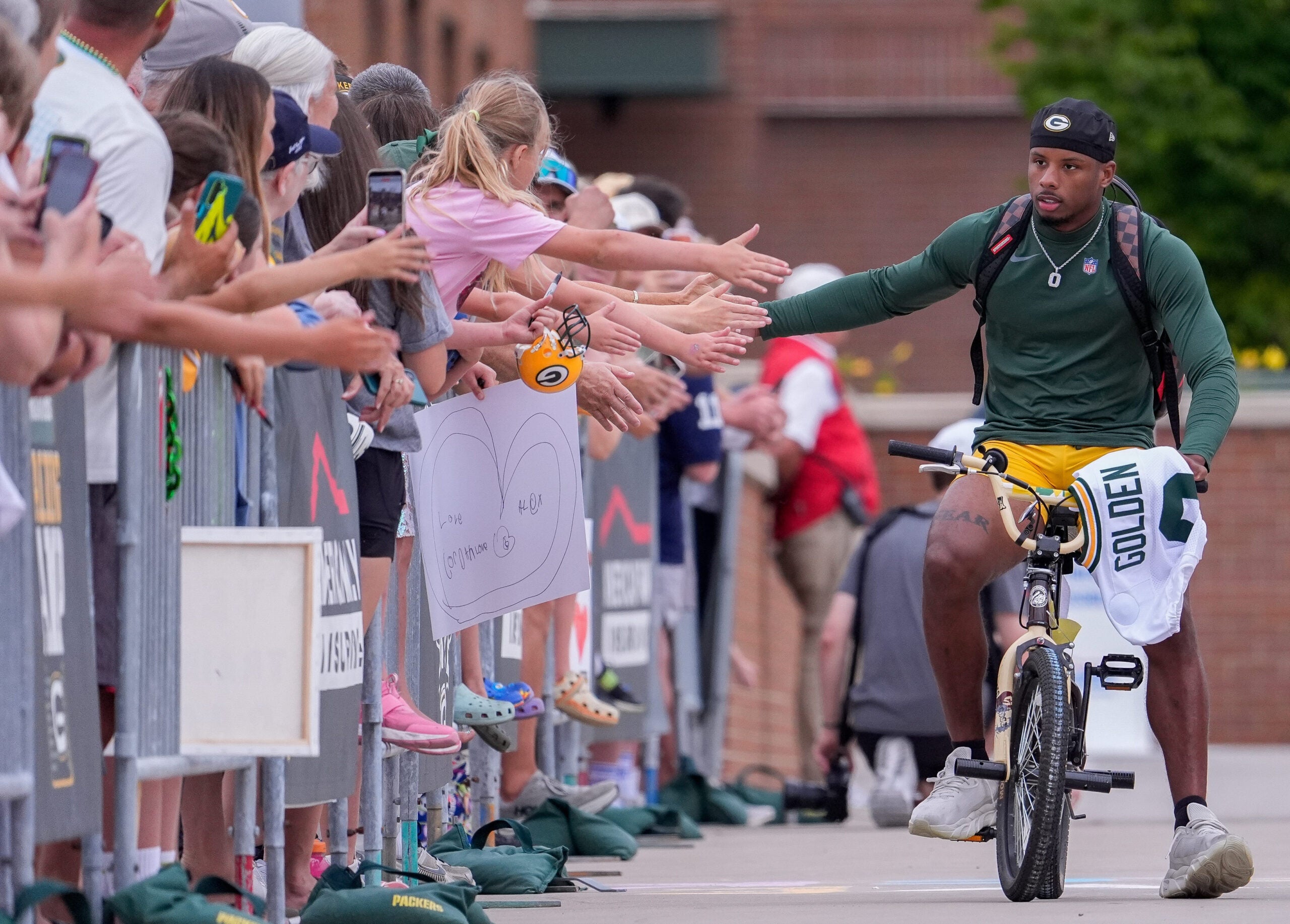
Matthew Golden, WR, and Anthony Belton, G, Green Bay Packers
The Packers have two players on this list. Golden had a quiet rookie season with 29 catches for 361 yards and zero touchdowns in the regular season. Then he flipped the script in the playoffs, catching four passes for 84 yards and a touchdown against the Chicago Bears.
The Packers’ offseason moves make Golden’s breakout potential clear. Green Bay allowed Romeo Doubs to leave in free agency and traded Dontayvion Wicks, opening the door for Golden to step into the starting X receiver role. The first-round pick carries significant responsibility heading into his second year, and the Packers clearly trust him to become an explosive alternative in the passing game.
Belton’s path to this point has been unconventional. During training camp and the start of his rookie season, he practiced exclusively at tackle. Then, during the regular season, the Packers moved him to right guard, where he started several games down the stretch.
Belton is now locked into that right guard spot. He took some reps at right tackle during the offseason program and early in training camp, but that’s the natural cross-training the Packers tend to do with their offensive linemen. His position going forward is right guard. Belton has already shown signs of growth during camp, and for a Packers team with well-documented problems along the offensive line, having a player elevate his level heading into Year 2 would be significant for the entire operation.
